Posted on May 17, 2015
“You can’t control everything. Sometimes you just need to relax and have faith that things will work out. Let go a little and just let life happen.”
~Kody Keplinger
This quote has stuck with me since it appeared on the Facebook circuit a few days ago. Let go and let life happen—which involves waiting. I am a terrible “waiter.” At my worst, waiting is fertile ground for anxieties to sprout and proliferate like weeds. At my best, I occupy my mind and body with distractions so the time goes “faster”—or more likely, goes by unnoticed.
Waiting for life to happen feels an awful lot like being stuck. And loss of control. I have come a LONG way in my journey to overcome my control-freak tendency. Where it tends to creep in is during waiting: times when I must relinquish control and trust life to unfold on its own without any assistance from me.
Funny how life is full of paradoxes like that. There are times we must get off our lazy butts, quit complaining, and make life happen. In contrast, there are times we must let life happen in its own time. We can’t hurry periods of gestation. Babies, and other significant moments, occur when they’re good and ready. Premature and delayed arrivals bring their own challenges—some surmountable, others not. But we can’t change or control it.
We must wait: in line; for the bus; for events; for graduation; for promotions; for deals to come through or fall through; for prayers to be answered, hopes to come true; for messages to be sent and received; for people to hurry up; for decisions to be made; for directions, information, or signs from the heavens. Or as Cheryl Richardson words it in her book, Life Makeovers (2000):
“Maybe you’ve been forced to wait because you’re unsure of what’s next, feeling as though your life has fallen victim to a giant hold button.” (p. 93)
There is no end to waiting. But it need not be stagnant. Waiting can be a time of growth (figuratively and literally). It can be a time of inner reflection, of transition, and preparation. Be open to messages from within. Cheryl challenges us to embrace the discomfort of waiting
“knowing that if you use this time wisely, you’ll strengthen your personal power, the kind of power that no outside person or thing can ever give you.” (p. 94)
Grant yourself the freedom to wait knowing it’s a time of growth, reflection, transition, preparation. Sounds like action words to me.
Read More
Posted on Apr 15, 2015
With the spring equinox just past, I read a timely article in the Spirituality & Health magazine (March/April 2015 issue) entitled “The Joy of Spring” by Jane Ganahl. So I am going to piggy back on a few of her ideas for this blog.
She opens her article by talking about fertility celebrations and the science behind the equinox. However, she really grabbed my attention by describing the spring equinox as “a powerful time of regrowth and rebirth” (p. 54) with examples of ancient rituals such as Stonehenge. And it is no coincidence that Easter falls within this time frame (first Sunday after the first full moon after the equinox) or that traditions are reinterpreted from pagan rituals like the Easter egg. Originally egg rituals were “ways of inviting fertility and renewal.” (p. 54)
As a therapist, I am always interested in themes of regrowth, rebirth, and renewal—for that is what my job is really all about: change, growth. And when we can combine the natural environment with our inner worlds, the symbolism can enrich our lives. Formerly empty rituals—even religious ones—can be imbued with ‘new’ or fuller meaning.
For me, I try to see these dreary spring days as expectant with regrowth, rebirth, and renewal. The gray trees symbolize hope of green to come. Tight little buds will unfurl to show forth verdant abundance. The brown earth will release new growth that adds colour to life.
The same can be said for human beings. We may feel drab within our brown and gray environments, but hope is stirring deep within all of us. Here are a few suggestions from Jane to “Put Spring in Your Steps.” (p. 55)
1. Visualize yourself in full bloom: Notice what parts of yourself you’d like to see changed or born. Write one list of things to release and another list of things you’d like to have more of in your life.
2. Connect to natural light: In winter we are deprived of the sun’s healing energies and spend more time with bright screens that disrupt our natural rhythms. With the equinox, we turn the tide on the darkness. On at least one day, witness both sunrise and sunset.
3. Reconnect to the earth: Put your bare feet, hands, and even body on the ground. Breathe in the newness in nature. Plant something.
4. Reboot relationships—or let them go: There are always a few of these in our lives. Examine the source of the discord, and open your heart with compassion. Decide whether the relationship can be saved.
5. Create your altar or shrine to spring: Use elements from nature that inspire you, and colours that resonate with you. Use this space to meditate.
6. Arouse your sensual self: Cuddle, learn tantra, slather your lover and/or yourself in oil.
7. Create your own equinox ritual: Whether it’s dancing, painting, hiking—anything that gives you a feeling of connection and rebirth. And get moving. Winter is over, and it’s time to come alive.
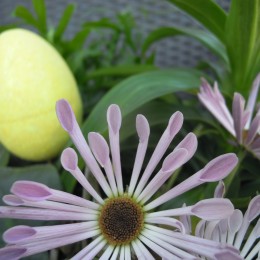
As I type this, I am looking at an indoor plant collection purchased at Costco with symbols such as the Easter Lily and a sparkly, bright yellow (Easter) egg in the centre. A veritable treat for the senses as the lilies exuded a very sensual scent while they were in full bloom, the other flowers are a sight for sore eyes in shades of bright yellow and purple, the dirt feels good to the touch when checking for moistness. Spring flavours were savoured in sweet Easter treats, long since devoured. And I’m listening to a music mix called “In the Summertime” which is sure to pick up my mood on a gray day. Not to mention the cheerful sounds of the birds returning from their time in the south.
May this time of renewal find your verdant Self emerging, ready to show forth the unique beauty and splendour that is you. Release that tight hold on the bud and let your Self unfurl.
Read More
Posted on Mar 15, 2015
Since last month’s blog entry, I have been give opportunities to think about my own positive self-talk—or lack thereof. And specifically what gets in the way. From what I can gather, it all comes down to the concept of shame—which the dictionary defines as “a painful senses of having done something wrong, improper, or immodest.” Synonyms are disgrace and dishonor.
This describes healthy shame when we are actually guilty of wrong doing. But what of the deeper underlying sense of shame-the unhealthy kind—that writes us off as a person? This shame is not limited to a single “bad” or misguided behaviour. This shame is a painful sense of being something wrong, improper, or immodest—of being a disgrace not just behaving dishonourably or disgracefully.
We develop such a sense of shame early on—usually in childhood or adolescence—by the shaming action of another person. The child or youth comes to the conclusion: “There must be something wrong with me; I must be a bad person for this to happen to me.” I had such experiences and conclusions as a child and adolescent—even into young adulthood.
It can carry on indefinitely depending on one’s life circumstances. Shaming is perpetuated by parents toward adult children, spouses, siblings, peers, co-workers, supervisors, managers, teachers, professors, therapists, doctors, church leaders, in fact leaders of any kind. Relationships with a power differential of some sort are especially vulnerable to the practice of shaming.
So early on in my development I internalized that I must be a “bad person”: the only explanation my child-brain could come up with for life’s circumstances. And which was ingrained over the years by shaming messages from a variety of sources. So ingrained that I became expert at shaming myself. No other voice necessary but my own at times.
This healing journey I’ve been on has led me to examine the statement: “I am a good person.” At first, it didn’t fit right at all; but the more I tried it on, the better it felt each time. I was (am) changing the neuronal pathways of my brain. It still needs more wear to become a cozy fit, but I am slowly internalizing that I am good person. And I’m learning the most effective antidote for shaming is a healthy sense of self. Slowly the shaming voices in my head are being silenced.
For I am a good person—even though far from perfect—just like you.
Read More