Posted on Nov 11, 2017
I know we are well into November—and the onset of winter—but I will still refer to this as my fall blog. Hopefully next month, I will return to my regular monthly musings. So much has happened in my life since the spring. I have definitely traversed my own Heroine’s Journey—and it’s been quite the wild ride! To (re)discover one’s Self is…well, it’s quite beyond words, really. I do know that I am grateful for the opportunity taken. Intimidating and scary as it was to embark on this Journey, the rewards have been beyond estimation. There is a light at the end of the tunnel. And I’ve no regrets.
I’ve looked back a few times (fortunately, not turning into a pillar of salt—for those familiar with the biblical OT story of Lot’s wife); but all I have seen is how far I’ve come. Obviously I am writing this while in a “good place.” There have definitely been many times of quiet (and not so quiet) despair. Along with the usual suspects of longing, anger, hurt, pain, insecurity, and intense confusion/questioning. I have had to close chapters of my life story and begin new ones.
Recently, my sister lent me a book called Anam Ċara: A Book of Celtic Wisdom by John O’Donohue (1997). Anam Ċara is Gaelic for soul friend. And while most of us look outside ourselves for that soul friend (and I am blessed to have more than one of those), I am learning to look inside myself as well. To befriend that deepest part of myself. Here’s a compilation of quotes that really resonated with me:
“The soul needs love as urgently as the body needs air. In the warmth of love, the soul can be itself. All the possibilities of your human destiny are asleep in your soul. You are here to realize and honour these possibilities. When love comes in to your life, unrecognized dimensions of your destiny awaken and blossom and grow. Possibility is the secret heart of time…Love is the nature of the soul. When we love and allow ourselves to be loved, we begin more and more to inhabit the kingdom of the eternal…We do not need to go out to find love; rather, we need to be still and let love discover us…We cannot fill up our emptiness with objects, possessions, or people. We have to go deeper into that emptiness; then we will find beneath nothingness the flame of love waiting to warm us.” (O’Donohue, pp. 9-12)
How beautiful is that! Which makes me think of the blogs I wrote about The Void (worth a re-read even for me). It’s something we all have to face, or else we get caught up in filling it with objects, possessions, or people—some leading to addictions of every shape, size, and colour. My “drug” of choice is food and sometimes retail therapy in the form of bargain hunting. In those moments, I have to become mindful of what is going on for me and choose a healthier coping strategy or method of self-soothing. Music is a big one for me—with no weight gain or self-loathing or over-spending. Journalling is another, as well as being out in nature.
One of the blessings of being where I am now is that I can look out my front window and observe nature without leaving the comfort of my cabin in cold weather! Yesterday, a wood pecker decided to taste-test the exterior of my humble abode right by the window. Fortunately, it didn’t have the right flavour; so he moved on to something more palatable. I also saw a deer in the distance; but the trees directly in front of my cabin blocked my view. Back to watching the wood pecker and other perching birds. Reminds me, I need to refill the bird feeder.
Pardon the wandering off on a rabbit trail.? Back to possibilities: “All the possibilities of your human destiny are asleep in your soul. You are here to realize and honour these possibilities.”(O’Donohue, p. 9) Within that inner Void lie possibilities. If we drown out the Void, we miss out. Embarking on my Heroine’s Journey of self discovery provided me the opportunity to realize and honour the possibilities deep within—to live out my True Self—to find my purpose. We each have personal purpose lying within the Void of possibilities. Your destiny—should you wish to accept it—is waiting to be awakened.
The word that struck me was “honour.” I cannot honour what lies deep within if I don’t befriend my soul—if I don’t allow myself to love and be loved—if I don’t look beneath the nothingness to find the flame of love waiting to ignite me. I am reminded of another Celtic concept: praying through the elements, particularly breathing in the Fiery Presence to become Fire. I need to let go of self-denial and self-denigration if I am to honour and realize the possibilities within—to be ignited or set on fire, as it were.
This brings to mind a quote by Marianne Williamson that has been used in a couple of “overcoming-the-odds” movies such as Coach Carter (2005) starring Samuel L. Jackson and Akeela and the Bee (2006) with Angela Bassett, Laurence Fishburne, and Keke Palmer. On a side note, these movies follow the Hero’s Quest motif from each gender’s perspective: Coach Carter, the masculine; Akeela and the Bee, the feminine.
“Our deepest fear is not that we are inadequate. Our deepest fear is that we are powerful beyond measure. It is our light, not our darkness, that most frightens us. We ask ourselves, Who am I to be brilliant, gorgeous, talented, fabulous? Actually, who are you not to be? You are a child of God. Your playing small doesn’t serve the world. There’s nothing enlightened about shrinking so that other people won’t feel insecure around you. We are all meant to shine, as children do. We were born to make manifest the glory of God that is within us. It’s not just in some of us; it’s in everyone. And as we let our own light shine, we unconsciously give other people permission to do the same. As we’re liberated from our own fear, our presence automatically liberates others.”
(pp. 190-191 of “A Return to Love: Reflections on the Principles of A Course in Miracles” by Marianne Williamson, 1993)
Embrace your possibilities. Or we risk growing stagnant, even bitter and resentful. Incapable of giving and receiving love.
“Others want to love, to give themselves, but they have no energy. They carry around in their hearts the corpses of past relationships and are addicted to hurt as confirmation of identity.” (O’Donohue, pp. 12-13)
What a profound metaphor for how we self-sabotage. We carry around the corpses of past relationships (the wounding by others). We can’t let go and free ourselves to honour possibilities. We strangely think that if we let go, we lose our sense of self, our identity. Somehow we have become convinced that the hurt is who we are. We become stuck in victim mode. Let go of the past hurts. Release yourself to live anew. To become a world of possibilities…
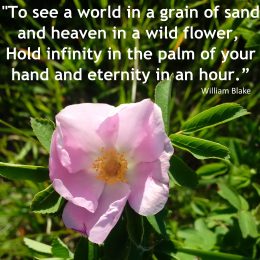
”To see a world in a grain of sand and heaven in a wild flower, Hold infinity in the palm of your hand and eternity in an hour.” poet William Blake (1757-1827)
That pep talk is as much for me as for you dear readers, my friends and fellow life-travellers. I may need to post the phrase, “Embrace your possibility,” somewhere I can see it everyday; along with “Befriend your own soul.” That really could be a killer combination—befriending myself and embracing the possibilities that surface. Who knows what could all come of that! ?
So…Allow the inner Void to exist. Peer over the edge. Let the spaciousness you see speak to you. And then look past, beneath the nothingness, to the flame of love waiting to warm and ignite you. It will illuminate the possibilities just waiting to be honoured and realized.
Read More
Posted on Aug 13, 2017
It is with some amusement that I start this blog inspired by my second viewing of the movie, Rango. Five years ago, it was all about finding community—a sense of belonging. And same as before, the hero’s quest motif was evident to me this time, too. Which got me mulling again about the Heroine’s Journey as well as the depth and subtleties hidden within Rango—the character and the movie. For such “light fare” as animated films generally are meant to be, this one strikes me as quite profound at the same time as amusing and uplifting.
Using Rango as the quintessential hero’s quest (rather than the usual Hercules), it showcases well the contrasts and similarities to the classic Heroine’s Journey. Much of what I’ll be referencing is from the book, Jane Eyre’s Sisters: How Women Live and Write the Heroine’s Story, by Jody Gentian Bower (2015). For starters we’ll look at what the genres have in common.
- In essence, they are stories about emotion and connection.
- Both the Journey and the Quest are about the lead character becoming a whole person, but following different paths to get there.
- Both travel physically as well as within his or her “psyche to a new place of self-understanding.” (p. 134)
The key difference is that the hero must travel away from community in order to rejoin the community with a fuller understanding of himself and what he contributes to society/ how he serves the group or greater good—to find or fulfill his sense of belonging. The heroine or Aletis (Greek for wanderer) must break away from the community she serves to find herself and a truer way of being in community on her own terms—not defined by those around her.
At its core, the hero’s quest is about the male protagonist accomplishing something to prove himself the hero: “the single wondrous thing” that solves all problems for the hero and for his realm. (42) The male hero must leave the comforts of home to prove his masculinity and return to embrace the feminine.
“Men are constantly under tremendous pressure, particularly in Western society, to prove their maleness. Until they can accomplish this feat, they may be denied heartfelt connection to others…Almost any show of emotion, other than anger or pride, is feminine—and therefore threatening to heterosexual maleness. But emotion is how we connect with others…The hero has to learn to trust his maleness, to know that he is truly a man, by doing what only a man can do. Once the hero knows absolutely that he is a real man, he can stop fearing betrayal by the feminine side of his own nature and learn how to connect emotionally…The whole man is at ease with his emotions and can respond to an appeal for connection. The quest usually ends with the hero coming full circle, back to the land of his origin, and getting married. This is symbolic recognition that the feminine is no longer a threat and that the hero’s feminine qualities no longer have to remain in shadow.” (Bower, 45-47)
A female’s femininity is never in question. The female protagonist must wander in search of herself and her true place in the world. She, rather, must travel away from home “to seek not only to know herself but also to reclaim those parts of herself devalued by society.” (135) It is no easy task to break away from the confines of a prescribed role or definition of femininity to discover what it means to be a woman for yourself—to be your own true self regardless of what others tell you it means. “We have to stop looking for a heroine who acts like a hero and look instead for a different kind of bravery.” (Bower, 67)
In the movie, Rango faces challenges to figure out the answer to the question: Who are you? Turns out he is much more than he thinks he is. He looks upon himself as insignificant—not even having a name. Yet he bravely faces his fears, overcomes obstacles, is guided by ancient wisdom in various forms, and ends up saving the day—and himself. He knows who he is now. He is no longer insignificant. He has a place where he belongs. He knows what he brings to the table—what he contributes to society—and he gets the girl.
The Aletis (wanderer) learns who she is when she leaves too. But she doesn’t return from whence she came. She finds a new place of belonging—after she discovers who she is and how she chooses to contribute and connect. She also meets ancient wisdom, but usually as a teacher of some sort—hidden in the woods or a cave—from whom she learns difficult lessons. She proves herself to the “wise woman” in order to face future challenges. As Bower notes, “To embrace femininity entirely means to embrace the dark, wild, and dangerous aspects as well as the queenly, loving, and mother-like aspects.” (60) Too often our prescribed female role in the community focuses on serving and overall goodness which means denying being fully human with a dangerous, dark side as well. This leads to all sorts of un-wellness and dysfunction with which we are all familiar.
There are far too many nuggets in the book by Bower to do it justice in this blog. In a nutshell:
- The Hero’s Quest is about “doing” and the Heroine’s Journey is about “being.”
- The hero’s bravery is in accomplishing the “single wondrous thing,” while the heroine’s is in refusing to do what is expected of her.
- The hero often starts out isolated from community whereas the heroine is immersed in it to the point of being invisible or denied a separate identity.
- The hero does what is expected to complete his quest, the heroine does what is unexpected to begin her journey.
- The hero moves toward, and the heroine away from, something.
- Significantly, “the hero transforms himself and restores or preserves the community…The Aletis transforms the community while preserving herself.” (69) The heroine “embarks on the journey because she knows her soul will die if she stays”…She journeys to discover “and value the uniqueness of her being.”(72)
Bower concludes her chapter highlighting the key differences by saying, “To become balanced and whole, it seems each must learn the opposite shape: the hero must trace a circle while the Aletis must follow the arrow’s flight.” (72)
Understanding these two types of storytelling will change forever how you watch movies or read books. You will see these patterns and motifs over and over again. Hence why plots and characters can become predictable. We know how the story will end because we have been told it so often. It is the storytellers who brave exposing the shadow side that tend to switch things up and pique our interest—and disappointment without the expected happy-ending. Fortunately life stories are made of chapters—each with its own ending—leaving the story open for more possibilities. We never know what lies around the next corner…
Read More
Posted on May 14, 2017
Today is Mother’s Day. And I am reflecting upon the life of my (step)grandmother (my stepmother’s mother passed away at age 99 on 5 May 2017). While it ties in with the promised entry on the Heroine’s Journey, I will postpone delving deeply into that concept to another time.
Reading my grandmother’s obituary (or life summary presented by the family) saddened me. And not out of a sense of personal loss. A sadness that my grandmother did not get to go on a Heroine’s Journey for herself. She lived by the rules of the patriarchal culture in which she was raised (and perpetuated).
It was a very glowing account of a remarkable woman’s self-denial and self-sacrifice—her dedication to her faith and her family. But I did not get a sense of who she really was. Her True Essence burned low in the grate—nearly snuffed out by cultural conditioning. She was not afforded the opportunity of self-discovery. Which is another layer of patriarchy that saddens me: women are taught self-denial long before they ever get a chance to discover who they are and what they are sacrificing! Hence the Heroine’s Journey for those who choose to embark on it.
My grandma would have balked at going on such a journey. It would have seemed antithetical to her faith and upbringing. So indoctrinated was she, that fanning into flame her True Essence would be heretical. Jesus’ hard work at women’s liberation would have been lost on her—in fact confusing. She knew how to function, and function well, in the patriarchal society. According to the obituary, she flourished in that environment. But did she? She followed the rules well, but where was she in all the rules?
If using the plant/flower analogy, she was a well-maintained (and contained) garden that produced beautifully; but I wonder about the wild flowers planted deep within. Did she ever want more out of life? Did she ever want to escape the boundaries and flourish in other ways?
She likely was fairly content with her life—up until the end when her vision and hearing deteriorated; and she lost the will to live. Given how she lived her life for others, when she could no longer do that, it likely did kill her spirit. She had no sense of self to fall back on. She relied on the dynamic of self-sacrifice to give her life meaning.
I was also raised in that environment. And I am on a Heroine’s Journey of self-discovery so that I can better live out my True Essence. It is a totally different experience to give of yourself from self-knowledge rather than a sense of existence. It is rather empowering to embrace your True Self. When we live by a culture’s rules, we never get to be “real” with each other. We are always playing a role, saying our lines, doing our part. I much prefer realness. And when we honour the realness in others, it changes how we interact in the world.
Reading my grandmother’s obituary, I was struck by how contained her world really was. While she had a great impact on that world of family, she didn’t engage with the larger world in any significant way (other than supporting others who claimed to do so, like missionaries). If grandma could have lived out her True Self, I wonder what impact she would have had on the global community. Where would her heart have drawn her? What would she have been passionate about? What change would she have worked towards? How would she have attempted to better the world?
There is so much of her personal story that I don’t know—and she didn’t want to talk about (like surviving the depression of the 1930’s and being raised in an exceptionally large family by a father who married three times). So many untold stories that shaped who she became.
My (step)grandmother was not a storyteller. And she didn’t talk about herself much. That would have been prideful. How I wish I had more role models of strong women who owned their own presence in the world; lived out their True Essence. Instead, I learned how to hide and self-deny. And internalized that I wasn’t worthy. Not uncommon.
It’s also why it’s so important to read about, reflect upon, and embark on the Heroine’s Journey of self-discovery. After living for everyone else and by society or family rules, it’s time to figure out who we were born to be as women and as fellow human beings.
Because of its starkness, my grandmother’s story inspires me to pursue colouring outside the lines, growing wild in the weeds, not conforming. I am choosing to sacrifice connection to family and friends (who will not understand my Heroine’s Journey) instead of sacrificing my Self for family, religion, culture, career (all intertwined). And in a surprising twist, it is because of the strong women in my family story that I am able to do so—even though their strength lay in survival and hopes for future generations rather than personal accomplishment or “the greater good.”
And today, on Mother’s Day, I am grateful to the Divine Feminine for her Mothering Presence in my life. Without that significant shift in my thinking, I would not be able to pursue the Heroine’s Journey. And God/Universe/Transcendent Being’s Mothering Love has kept me safe and been constant when human love (maternal or paternal) has been lacking—even when I was unaware of it.
Today is a day to honour feminine attributes in general—that either gender lives out. May you feel mothered by those around you today—whomever they may be.
Read More
Posted on Apr 16, 2017
In honour of Easter, I am going to step out of my safe zone and go into preacher mode—breaking two of my guidelines for writing this blog: avoid preaching and Scripture references. Have no fear, this won’t be a sermon or lecture you usually hear! I will surprise you by sharing what Easter has come to mean to me, something very near and dear to my heart.
Easter is an occasion to celebrate women’s liberation and human equality—honouring the Breath of Life and Divine Spark in each and every human being.
Having grown up in the “the Church,” Easter was the cornerstone holiday or feast-day of our Christian faith. It marked a turning point in human history. Unfortunately, too much focus is placed on symbols, metaphors, and “remembering” instead of continuing the action of turning the world upside down like Christ did.
We who claim to follow in Christ’s footsteps have failed to do just that. We have failed to advance liberty and equality for all humans. We have instead pursued hidden agendas and conditions or expectations that must be met in our “acts of service.” We tend to be intolerant and judgmental—at least in my personal experience and general observation. It seems we have come full circle or reverted back to the patriarchy and piety of the Jewish religious leaders—our ancestral “world order.”
On my faith journey, Easter has come to mean liberation and equality—which sorrowfully has become lost or buried again over the past two millennium. It saddens me greatly how far off-course we have wandered. Doctrine, dogma, and theological debate have overtaken living redeemed and liberated lives. We no longer fight for the causes Christ initiated: overcoming oppression, poverty, and injustice—fighting for the underdog. We are once again enslaved to tradition, piety, and cultural conditioning. We have lost being counter-cultural movers and shakers. We instead promote and strive for conformity.
Liberation and equality. We do not live like those are the cornerstones of our Christian faith. We, in fact, don’t live that much differently from our ancestors—other than in Western culture, brides are no longer purchased for land or livestock. This world has not changed much. I will be so bold as to say that an outside observer would not be able to tell Christ came at all—we have done that poorly at advancing the “new order” or way of life: upending patriarchy and liberating women, the oppressed, the downtrodden—pursuing human equality and mutual respect.
If I were to take two verses of Scripture (one from each Testament) that capture the essence of a life lived by faith, we have done poorly indeed. Here are the 2 verses to live by.
“There is neither Jew nor Greek, there is neither slave nor free man, there is neither male nor female; for you are all one in Christ Jesus.” Galatians 3:28
“[God] has told you, O [person], what is good; And what does the LORD require of you? But to do justice, to love kindness, And to walk humbly with your God.” Micah 6:8
If we respectfully treat each other as equals, pursue justice, uphold kindness, and live humbly (knowing we are but a speck in the grand scheme of things)—what a different world this would be. Yet we persist in being legalistic, judgmental, pious, and proprietary. And I am guilty of all of it, too. That is why Easter has taken on new meaning for me. I finally get it. Easter means redemption, liberation, and equality. I am no longer enslaved to indoctrination, cultural conditioning, and tradition. I can choose for myself.
I do not yet live in the utopian society of people living redeemed, respectful, and liberated lives with justice, kindness, and humility. But Easter reminds me to celebrate I am redeemed and liberated—that I can choose to live my life fully. And it is an opportunity to renew my sense of purpose towards being an agent of healing change—in whatever small or big ways that I can. Hence, I am grateful for what Christ did to end patriarchy and piety. For it allows me to embark on the Heroine’s Journey (next month’s blog).
Read More
Posted on Mar 18, 2017
This past week, I experienced a major setback to my health and sense of well being. When I reflect back, it has been building for some time; meaning a single event can be overwhelming given the right context. Like a perfect storm brewing. My boat has capsized. I am now faced with figuring out how to right my boat, get back in, and keep rowing—but my navigation equipment has failed; and I must determine where I’m going and how I’m going to get there.
This means a complete re-evaluation of who I am and what I do for a living. I have to reconsider why I care so much; why I invest so much of my Self into my clients. It also means that I cannot keep investing my Self into my work like I have been. I cannot sustain what I have built up. I need to make change. Not only re-evaluate who I am, but also what I want out of life. I want so much for other people. Time to direct that attention and energy towards myself.
At the risk of sounding over-the-top, I have lived my life for others. Looking at that more closely, I realize that I have over extended myself trying to “correct” the wrongs of my life story: no one was there for me, so now I’m going to be there for everyone else. I have been driven to ensure that others do not share my experience of being lost and alone. I care very deeply for the people who cross my path. And I strive to empower my clients to live fully, to know their core worth and value, to stand up for themselves and not be used or taken advantage of.
In my striving to empower others, I have tried to rescue them from continued lives of misery and to protect them from themselves and their life situations. I have fallen into the trap of empowering others in order to rescue and/or protect them. And when I don’t succeed at empowering/rescuing/protecting—I am devastated. Old feelings of being a failure surface. I struggle with not being seen and heard, with being misunderstood. My sense of self gets wrapped up in what happens in the lives of my clients. I have inadvertently given my clients the reason for my existence. My work gives my life meaning.
By ‘being myself’—as in a deeply caring person, very invested in the lives of others—I have made an overcorrection, causing me to spin out of control. Somehow by living out my true Self, I have lost my Self. While I have finally embraced my own innate worth and value as well as come to an understanding of who I am and what I can contribute to the world, I still managed to put others ahead of myself. I continue to operate from a position of self-sacrifice, to the point that I sacrificed more than I had to give. I didn’t make sure I took care of myself in the service of others.
Yet, that is not it entirely. I have practiced self-care in my daily routine. What I didn’t do is honour my Self—treat myself with the same focused attention I offer to others—I didn’t respect my own boundaries. My edges became frayed without me even noticing. I ended up throwing myself in harm’s way, not seeing the danger. I was so focused on the other people that I lost sight of my Self—and my frayed edges. I didn’t see it coming when my efforts to empower others backfired. I was blindsided. Thrown for a loop.
However, this culmination of the perfect storm—this crucible I find myself in—has meaning in that it does force me to re-evaluate. I was on a downward spiral of my own making that I didn’t see. Having the rug ripped out from under me, while painful to land on my backside, has provided new perspective. I must view my life and my Self differently. As I process what I see from this angle, it requires contemplation and adjustment. Survival requires change. But I want more than survival. I want to thrive. And in order to do that, I must honour my strengths and my limitations. I must pay attention to the container that I grow in—which may even require repotting. We’ll see what happens as I reassess what my life is all about.
Like me, maybe it’s time to check out your own little world that you grow in. What needs adjustment so that you, too, can thrive?
Read More
Posted on Feb 16, 2017
In December’s blog, I opened the discourse about sexual assault. And in that blog, I introduced the idea of the messages we receive about what it means to be a sexual being.
We are bombarded with social images and concepts about what it means to be sexual with the opposite sex. Standards are set. Often there are competing and conflicting standards from media, parents and family, peers, institutions, religious convictions, etc. Fairly new on the scene is the concept of a spectrum for sexuality and gender. Not everyone fits conveniently into a heterosexual box or even a male-female polarization. And if you happen to be one of those people who is not easily “defined” by sexual standards or gender boxes, it can be very confusing and even complicated. Other issues surface including sense of self, victimization and abuse, exclusion, isolation, defamation, equality, and the list goes on.
Sexuality is deeply personal. It is not as simple as checking off a box, joining a certain group. It is tied to our very essence—our soul. How we see ourselves is impacted by the messages we receive about what it means to be a man or a woman (which can be very limiting) and what it means to engage in sexual experiences. In order to embrace who we are as individual persons, we have to set aside gender at the same time as honour the bodies that our essence comes in. In my utopia, people will learn what it means to be fellow (as in equal) human beings (without prejudicial labels) before stepping onto the trampoline of gender and sexuality. However, we are not there yet. Not even close. It is a different conceptualization to consider humanity at the core with gender and sexuality as expressions of a unique person—having no bearing on their value or ability to contribute to communal life on this planet.
So we have two things held in tension: gender and sexuality along with equality; which is a whole other discussion that I may take on in a future blog. And once again, I went in a direction different than intended; so let’s get back to what was initially on my mind: what we believe it means to be a sexual being, and what we believe about the act of sex itself.
Each sexual encounter can hold different meanings. There is the physical release (including all those bonding hormones that can make it a wonderfully satisfying experience; but for some, the focus is the adrenaline rush, not intimacy). There can also be a spiritual connection, when we invite that to be a part of it. And there is the intense confusion when the physical release by the body, naturally responding as it does to stimulation, is combined with manipulation and control. There is also the mental shut down (dissociation) that prevents a person from having any positive associations with sex or blocks unpleasant sexual experiences. Definitely not one-size-fits-all.
As for beliefs about personal female sexuality, one author* has broken it down to four basic cultural beliefs:
1) I must be good to be worthy of love.
2) I am not really a woman unless someone desires me sexually or romantically.
3) If I am sexual, I am bad.
4) I must be sexual to be lovable.
None of these internalized messages are healthy perceptions of oneself as a sexual being. They are reflections of an externally-based sense of self: how others perceive me influences my worth or value. Human value is innate. Everyone has the Breath of Life. It is not determined by external forces such as money, power, actions, acquisitions, attention, accolades, or achievements. No one person is more valuable than the next. We may do different things with our unique lives, but one’s choices do not determine one’s value. Our choices determine the trajectory of our lives. Our choices give expression to our human uniqueness. And the choices of others do not have any bearing on our value—maybe what happens to us, but not our core value.
Seeing ourselves as worthy of love and respect from the inside generates a different way of being in the world—including how we express our sexuality. Our sexuality is not about proving a point, earning approval, fulfilling obligations, performing a duty, or serving another person. It is not about inferiority or superiority. We need to reclaim our sexuality from the harmful internalized messages. It is part of being human, not a means to an end.
On my healing journey, I’ve had to reclaim my sexuality as being part of who I am, not a right or duty or something to be denied, hidden. I have had to untangle the conflicting messages I was fed. Sex isn’t bad. Being good doesn’t mean not having sex. I don’t have to be “good” (non-sexual) to be worthy of love. Nor do I have to be sexual (“bad”) to be lovable. A man’s attention does not validate me as a woman. I do not need to be desired to be female or even a person of worth and value. I am a person in my own right—it is not dependent upon how others see me or treat me.
My personal choices are a way to express my sexuality on my own terms and within my own boundaries. It is not something to be taken advantage of, violated, or exploited. I must also respect the boundaries of others and be mindful of how my choices may be received by others. Being a whole (integrated) human being in our society is not black and white. It is not a matter of right or wrong. It requires being respectful of ourselves and others. It is a delicate dance that requires we pay attention to subtle shifts in body language, the words people say, and what remains unsaid.
Sexuality is first and foremost about respect, with safety and security a close second. It is about setting boundaries as well as honouring boundaries. It is about understanding innate worth and value. It is not about defining ourselves to fit social standards but about understanding who we are at our very core.
May your journey of self-discovery include what it means to be the person you are in the package that you come in. Namaste: The Spirit within me salutes the Spirit in you.
*Ready to Heal: Break Free of Addictive Relationships by Kelly McDaniel (2012), pp. 73-8.
Read More