Posted on Jan 22, 2017
“Forces beyond your control can take away everything you possess except one thing, your freedom to choose how you will respond to the situation. You cannot control what happens to you in life, but you can always control what you will feel and do about what happens to you.”
~ Harold S. Kushner, from the Foreword to “Man’s Search for Meaning” (2006), by Viktor E. Frankl (survivor of 4 concentration camps including Auschwitz)
In my December blog, I came across many rabbit trails to pursue in the future, one being forgiveness (or letting go). I anticipated having time to research this concept even further than I have, thus far, in my work as a psychotherapist. However, that is not the case. I have been mulling over what I have learned up to this point. This will be my attempt to synthesize those ponderings into a cohesive entry.
I will start with the conundrum that got me thinking about forgiveness. When I processed my sexual assault of 25 or so years ago back in November, I was able to let go of the grime, if you will, of that experience. I released the guilt and shame (yet again), the hurt and pain, the hold that it had on me. I closed the chapter. It is no longer a defining moment in my life. I am free to pursue who I am truly meant to be. However, I was not prepared to release the perpetrator from being the one responsible. I had finally placed the responsibility onto the perpetrator (no longer taking the blame myself); and I am not about to ‘set him free’ from that. He remains the responsible one. So does that mean I haven’t forgiven him?
Much of the material on forgiveness/letting go is focused on the person doing the forgiveness. It is the very thing I did—released myself from the grime or residual effects of the abuse. But one thing I don’t want to do is the let the perpetrator “off the hook.” I don’t want to absolve him of responsibility. Synonyms for absolve include: pardon, forgive, clear, release, free. Which brings me to my quandary: I do not want to forgive my abuser in the sense of forgiving a debt. Nothing owing. Free and clear. No longer held accountable or responsible for what is owed.
Yet contrary to that sentiment, I am not holding a grudge or expect any retribution. I don’t feel I am owed anything—not even an apology (I want no contact with him, so no sense trying to apologize). There is nothing he can do to restore my sense of self or repair the damage done. So making amends is also out of the question. Which makes me think of something I recently learned in reading a novel by Jodi Picoult (The Storyteller) about the Jewish concept of forgiveness.
In Judaism, there are two wrongs that are unforgivable: murder and a ruined reputation. In the case of murder, it is impossible to go to the wronged party to plead one’s case; and a dead person cannot grant forgiveness. No one else can substitute their forgiveness (as in the case of genocide or bereaved family members). As for a good reputation, that cannot be reclaimed. It can’t be undone, so-to-speak. Reparation is not viable—in either case of murder (death) or reputation.
So where does this leave me? Common considerations in the process of forgiveness are letting go of the victim role and reclaiming personal power, as well as reconciliation. In regards to my sexual assault, there is no need, nor opportunity, for reconciliation. When it comes to ongoing relationships with abusers, which I do have in the case of family, reconciliation for me looks more like coming to terms with reality. True reconciliation, when the abuser takes ownership of their actions and makes restitution, is not always possible. Not everyone is open to seeing the error or impact of their ways. In such situations, it is a matter of adjusting expectations and setting boundaries. But that is another story for another day.
At this point, I am mentally holding in tension the conflicting ideas of wiping the slate clean and holding someone accountable. I am no longer held prisoner by the impact of another person’s actions. In that sense, I hold nothing against them; and I expect nothing from them. To some people, this is forgiveness. I have successfully let go. I chafe at using the word forgiveness, though, because I will not wipe the slate clean in that I will not release them from being the responsible party. It was not my fault. I am not to blame. The damage was done—but not by me. And that opens yet another can of worms in that his actions were part of a system. The beliefs I grew up with contributed to the abuse dynamic. So I also hold those people and institutions responsible for what happened to me. But now I am staring at the slippery slope of what if’s.
So once again I ask myself, where does all this rambling rumination leave me? I may not be comfortable using the word forgiveness in the classic sense of granting a pardon—as I am not prepared to no longer hold my abuser(s) accountable/responsible—however, I have let go of the pain and shame and expect nothing from my abuser(s). So if you are comfortable calling that forgiveness, be my guest. For now, I will keep holding those concepts in tension: letting go of my own “stuff” while laying the blame and responsibility where it belongs. Nothing more to be said or done. That chapter is closed. I have the freedom to move on.
Read More
Posted on Dec 14, 2016
“As the legend goes, when the Phoenix resurrects from the flames, she is even more beautiful than before.”
~ Danielle Laporte
I am going to go in a totally different direction with this blog than the usual holiday cheer. This is pretty heavy stuff; but I think I’m finally ready to ‘go there.’ November was a pivotal month for me. I encountered parts of my story that I had long buried, but evidently had not laid to rest. So here goes…
I was the victim of sexual assault. Of course, back then, it wasn’t known as such. “Date rape” was not part of our cultural vocabulary—nor was the concept of two consenting adults—neither was the idea that sexual assault and/or molestation is not limited to forced vaginal penetration. There was a strange connotation (at least to my limited understanding at the time) that sexual assault was attempted rape and sexual molestation was rape. Now we understand sexual assault in much broader terms. It was also an understanding at the time that what happened in a relationship did not constitute assault or molestation.
One of the fallouts (which can be seen as either good or bad) of the American election is the exposure of assault in our Western culture in its many forms (physical, sexual, racial, economical, etc.). Other high profile sexual abuse cases in Canada and the States have also brought this issue to the forefront. But I must stay on task and side step the rabbit trail of social commentary.
My “oh wow” moment last month was realizing that I was sexually assaulted by my first serious boyfriend. Let me clarify. He did not sexually “molest” me (aka rape). There was no vaginal penetration. But he did push me to be sexually expressive in ways I was not comfortable. My “no” was not respected. My discussions with him on the topic were ignored. I felt powerless, helpless, and ashamed.
There are many contributing factors to the sexual assault chapter of my story. The two key ones are combined: being raised in a patriarchal society (Mennonite background for those familiar with religious sects) and an abusive home. It was ingrained in my brain long before I ‘came of age’ that my “no” had no power and my body had no boundaries. It was eye opening to me to learn years later that skin is a boundary. As is common with abuse survivors, touch is confusing to me—having grown up with very mixed messages coupled with the basic core needs for attention and affection.
I also learned from an early age that men were superior and women inferior. Women were put on this earth to serve men. If women were good wives, they would be taken care of by their men—given the religious standards or “blessings for obedience.” If I was “good,” God would take care of me. Well, God has taken care of me and been with me to hell and back a few times. However, it had nothing to do with being good or perfect or holy. It had everything to do with whom I now understand God to be: Unconditional Love. Not something easily grasped by a victim of abuse. It’s been a long healing journey for God and me to get on good terms with each other. Feeling safe and secure—and loved. Powerful stuff. I sure didn’t learn those things from my parents, other family members, friends, church, or social connections.
As a result, when someone became “amorous” with me, I was very uncomfortable due to my upbringing as well as my comfort zone. I hoped he would understand where I was coming from and back off. Not what happened. I felt guilt and shame—for breaking the taboos I had been taught, for not being able to keep the men in my life happy, for not knowing what was wrong with me. Why wasn’t life working out the way it was “supposed” to? Where was I failing? Why could no one help me navigate this unknown relationship terrain?
I have worked through the guilt and shame over the years. Finally comprehending that the guilt and shame are not mine. Placing responsibility back on the abuser. Setting myself free from that abuse dynamic and the victim mentality. Hence, I hadn’t thought about it in quite some time. So imagine my surprise when I had the realization, just weeks ago, that I was ‘by definition’ sexually assaulted. The label fit. What I had subconsciously suspected was confirmed after all this time (over 25 years ago). And it was oddly liberating. I think there is also a sense of belonging—to a specific group of trauma survivors. It now makes sense why I can relate to many women in the counselling room even if the details of our stories differ.
In a nutshell, my first sexual experiences were not between two consenting adults (we were barely adults by the Canadian legal designation), and I remember specifically saying “no” and having those discussions of what I felt was inappropriate behaviour towards me. Sex is about more than intercourse. We learn many messages as we develop into adults about what it means to be a sexual being—a side trail that may be explored in a future blog.
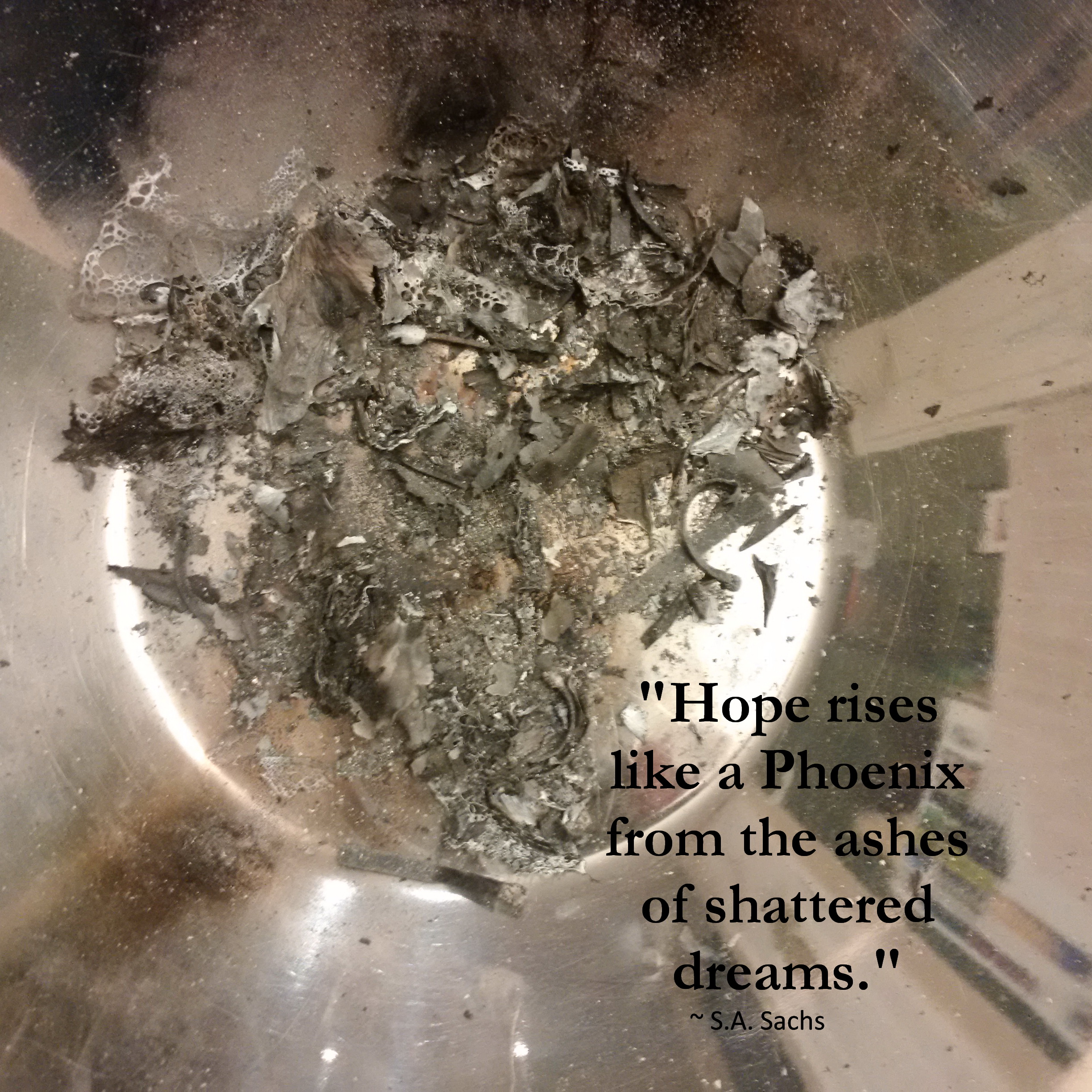
As I write this in preparation for December’s blog, I am reflecting upon recent events of the past couple days. I had a ‘letting go ceremony,’ attended by my sister, of burning the photographs of my abuser. Someone once unwisely told me not to destroy photos of past boyfriends for they are part of our story and shape who we become. Conversely, those photos were not of a boyfriend but of an abuser. It is absurd to keep photos of an abuser! Especially one who is not connected to me in any other way.
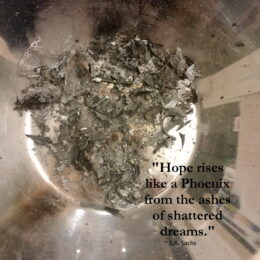
I was surprised by the depth of emotion elicited by the action of burning those photos (and there weren’t many as this happened pre-digital age). It was closing a chapter for me. He has been written out of the story. All that was left were the ashes of pain at the bottom of the metal receptacle. Ashes that were dispersed the next day in a carefully chosen spot, also witnessed by my sister. I released my pain with those ashes which unexpectedly opened another avenue of contemplation: forgiveness. That is a trail to travel down in a separate blog entry—maybe the start of the New Year. I have much more contemplation to do on the subject!
Reflecting on the release of pain, I struggle to find a way to end this blog. It is tempting to return to social commentary. However, that is not the purpose of this confession. The purpose is to step from the shadows—knowing that my story continues as does my healing journey. Chapters close. Characters come and go. The plot constantly changes. I am no longer a victim. I am the protagonist of my story.
Read More
Posted on Nov 16, 2016
“Madame Michel has the elegance of the hedgehog: on the outside she is covered in quills, a real fortress, but my gut feeling is that on the inside, she has the same simple refinement as the hedgehog: a deceptively indolent little creature, fiercely solitary–and terrible elegant. ”
― Muriel Barbery, The Elegance of the Hedgehog
An interesting theme has doggedly pursued me for the past couple weeks. It started with the book club selection, The Elegance of the Hedgehog, by Muriel Barbery (2008). It is not the easiest book to read; but once you get half way through, it becomes very engaging and thought provoking. The theme of the book is being seen and loved/accepted for who we are—yet we go to great lengths to hide our true selves from others—for fear of rejection, judgment, being misunderstood, being unseen, being lost, being wounded.
For me, this theme of being seen by others for who we truly are has also surfaced in sessions, friendships, and social media. The Universe is not letting this one go for me! Evidently I have a significant lesson to learn. I am fascinated that we do not see ourselves as others see us—the good, the bad, the ugly. Yet even our best efforts at hiding cannot dim our light for those who see us sparkle. They can see through the subterfuge—are not put off by it—but simply, gently pursue what they see—maybe even light their own candle by the inner flame of those they encounter.
I have had to squirm my way through this concept of self-acceptance and sense of value these past couple weeks. Not only to be present for my clients also squirming through this one in sessions, but for my personal growth and development: to know that others hold the shiny with dull with complete acceptance and maybe even understanding. I am continuously amazed by the strength and beauty in my clients—a light they cannot always see or are comfortable with. So it is somewhat ironic that others see my inner light even when I don’t. And yes, it makes me uncomfortable to be seen. I am just as afraid as my clients.
There is something about feeling exposed, vulnerable, and unworthy in being seen. We learned at a very early age that love can’t be trusted. That being our true selves leads to pain and suffering. That it is much safer to hide and put on a persona of self-protection. That our dull aspects have no value, are beyond polishing. And yet, there remain those incredibly special souls who see through all of that and wish to draw us out of our protective shells. It is terrifying. Another ironic twist is how I must terrify my clients when I attempt to bring forth their inner light. The word exposure comes to mind as well as safety, trust, and patience.
The absurd conundrum is: we obsess about what “everyone” thinks of us when “everyone” doesn’t even care. And if they do, it is to make judgments; but they are surface judgments without seeing or appreciating our deepest selves. We worry about what impression we are making, when that is not what we are meant to do with our time and energy—or even money. Our true light will shine regardless of what impression or mirage we try to construct. And for those to whom mirages matter—we must ask ourselves, why are we trying to impress them? What benefit is it to us what someone else thinks? How does that help us live more fully?
We get dreadfully distracted from our life purpose when we try to hide behind an impression or mirage. We have no one to impress. We have only to shine. Our true selves will be honoured by those who can see the light. And those who are blinded by smoke and mirrors don’t value what they see anyways.
When we get comfortable in our skin, value our unique contribution to life on this planet, we can confidently go where we’ve never gone before. If others bask in our light, let them. If others prefer to dull our sparkle, get out the chamois to restore the brilliance. Our task is twofold: to continue to shine despite the naysayers—the “everyone” we are trying to impress yet who don’t care; and to soak up the warmth from the flames of fellow, brightly-lit souls. If we add a third task, it would be to contribute to the radiance of others—especially when they don’t see it themselves.
Shine on Beautiful Soul reading this, shine on! Blind others with your brightness.
“It would be so much better if we could share our insecurity, if we could all venture inside ourselves and realize that green beans and vitamin C, however much they nurture us, cannot save lives, or sustain our souls.”
― Muriel Barbery, The Elegance of the Hedgehog
Read More
Posted on Oct 15, 2016
“Love is not the least bit illogical or random, but actually an ordered and wise recipe for survival. The need for connection is our first and most primary instinct.”
~ Dr. Sue Johnson, author of Love Sense (2013) and Hold Me Tight (2008)
While the theory of “survival of the fittest” is lauded in our Western culture and used to promote or justify many terrible behaviours, it is not very accurate and rather misunderstood. Even Darwin himself realized the importance of collaboration and adaptability to change as necessary for survival.
“In the long history of humankind (and animal kind, too) those who learned to collaborate and improvise most effectively have prevailed.”
~ Charles Darwin, English naturalist and geologist, author of Origin of Species (1859)
“It is not the strongest of the species that survive, nor the most intelligent, but the one most responsive to change.”
Working together to adapt to constant change. Not something we excel at as a culture. Yet there is evidence of this all around us in the natural world: species collaborating to survive and even thrive. Paradoxically, the one constant in all the change: relationships and our need for them. So how do we make them work?
“Science says: It is not familiarity or time that kills desire and passion, it is lack of emotional safety and attuned connection.”
~ Dr. Sue Johnson, author of Love Sense (2013) and Hold Me Tight (2008)
Emotional safety and attuned connection. The two aspects needed in order to thrive. Two things we are not taught from infancy—yet which we intuitively know at birth. That’s how we manage those first months of life outside the womb. When emotional safety and attuned connection are compromised, we suffer—as infants, children, adolescents, and adults. We never lose the need for connection and safety.
While developing emotional safety and attuned connection can be a complicated, misunderstood, and unappreciated process, there are two critical avenues we can pursue at any age or stage in life. They are daily affection and check-in conversations.
Daily affection (touch) is a necessity for infants to physically survive. Our lives as adults may no longer be at risk without touch, but life is certainly compromised in all aspects of our health from lowered immune systems to increased risk for depression and anxiety. Touch—especially skin-to-skin contact—produces oxytocin: the bonding hormone. When we touch, we connect and bond on a chemical level. Hence the importance of daily affection such as morning and bedtime hugs and kisses, greetings upon parting and reuniting.
Daily check-in conversations. While it may sound simple, and many people think “we do this already;” it is not a natural way we converse and requires practice as well as patience. When we check in with each other, we are going beyond the banal, perfunctory, and possibly distracted, “How was your day?” to a genuine interest made obvious. It is a structured conversation giving each person time to speak—literally taking turns. Partner 1 has 10-15 minutes (or whatever works for you) to tell about his or her day (what happened, what they did, how they felt about it). Partner 2 repeats back what is said without interpreting, problem solving, or fixing. Just listening and validating. Partner 2 can say something like, “I heard you say….” Followed by “I imagine you feel…” or “I get that would be [name of emotion] for you.” Then Partner 2 has equal time to describe their day and how they feel about it—with Partner 1 repeating back what was said and validating associated emotions. If a partner struggles to identify their emotions, ask questions about what they feel in their body and prompting with “That would make me feel….How about you?” or the “I imagine you feel…” may be enough to prompt emotional reflection.
Generally, when we are ‘listening’ to our conversation partner, we are developing a response in our head long before the partner is finished speaking. We have a rebuttal ready the moment our partner pauses. This contributes to arguments escalating to full-blown fighting that creates distance. We have lost connection and emotional safety—a threat to survival. Reflective Listening (repeating back what is said and validating emotion) is a useful tool for arguments as well as daily check-in conversations. Another communication tool, Expression of Needs (aka Complain without Blame), is also useful to keep in mind if the conversation veers of course (separate handout).
Daily check-in conversations are to be reserved just for that: checking in. They are not the time or place to resolve arguments or problem solve. Those are separate, and equally important, conversations which may go better having an overall understanding of your partner’s interior world/inner life achieved by daily check-in conversations. As well, having established emotional safety and attuned connection, arguments/disagreements will be less threatening knowing each other is secure in the relationship.
These principles can be applied to any relationship and context (with modification for dynamics such as parent-child, friends, school, or workplace). We all need touch and attunement. Armed with this information, we can fulfill our common need for affection and focused attention in respectful ways.
May your day be filled with emotional safety and attuned connection.
Love is a constant process of tuning in, connecting, missing and misreading cues, disconnecting, repairing, and finding deeper connection. It is a dance of meeting and parting and finding each other again. Minute to minute and day to day.
~ Dr. Sue Johnson, author of Love Sense (2013) and Hold Me Tight (2008)
Read More
Posted on Sep 24, 2016
“Those who contemplate the beauty of the earth find reserves of strength that will endure as long as life lasts. There is something infinitely healing in the repeated refrains of nature — the assurance that dawn comes after night, and spring after winter.” – Rachel Carson
As I write this, I am enjoying a few days away spent in the Rocky Mountains of Jasper National Park. It is absolutely delightful to be among nature, in an unhurried pace. Nothing to accomplish but refreshing the soul. I am also reminded how much I love autumn. At least the first part: once the leaves fall, the trees are bare, and the world is grey until the snow comes to stay, I find the season a bit wearying. On the plus side, it is always rejuvenating being in nature, regardless of its mood—unless there’s a blizzard.
“To be interested in the changing seasons is a happier state of mind than to be hopelessly in love with spring.” – George Santayana
Maybe it’s not so much being in nature as connecting with it. One can more readily connect with a blizzard if one is cozy inside their home or cabin. Even the darker moods of nature have lessons to teach us about our vulnerability and need for each other. We are such finite specks in the grand scheme of things. Sometimes I think technology dulls our senses to our vulnerability and need for connection.
At any rate, I agree with John Burroughs: “I go to nature to be soothed and healed, and to have my senses put in order.” Not only does being in nature regain perspective, it does soothe my soul. It is like there is a reset button that gets pressed when I take a stroll through a forest. Anthony Douglas Williams words it well when he says, “Take a quiet walk with Mother Nature. It will nurture your mind, body, and soul.”
Going for a nature walk gives your mind something else to ponder besides the daily grind. Quiet reflection has a mind-altering ability—no drugs required. Your body moves in unaccustomed ways as it maneuvers the uneven terrain. It may even get your heart pounding and your lungs heaving—life-giving oxygen pulsing to the outermost regions of your body. What the soul experiences is for you to feel as well as contemplate. This is more than a mental or physical exercise—emotion accompanies any outdoor pursuit.
I feel very fortunate that I live in relative close proximity to dramatic vistas and geographic wonders. However, specific surroundings are not required to appreciate nature. Wherever you find yourself, nature is willing to speak to you; or as George Santayana poetically puts it: The earth has music for those who listen.
I realize this blog has borrowed words from several others. Maybe it’s because I find I am at a loss for words to express the eloquence of Mother Nature herself. I do know that my soul is soothed, my mind quieted, by body restored by being where I am.
May you experience the healing power of Nature even if it means stepping out your front door and taking a deep breath of autumn air.
“The muffled syllables that Nature speaks
Fill us with deeper longing for her word;
She hides a meaning that the spirit seeks,
She makes a sweeter music than is heard.”
― George Santayana
Read More
Posted on Aug 17, 2016
“The most essential factor is persistence — the determination never to allow your energy or enthusiasm to be dampened by the discouragement that must inevitably come.”
~ James Whitcomb Riley (American writer, poet, author)
The Olympics. Can’t say I’m a big fan. I watch a bit on TV with my husband here and there. Prefer winter Olympics over summer. Maybe because I live in a country with a long winter. Canadians take great pride in their winter sports and activities.
I’m also not an athletic person. I have never enjoyed, let alone excelled at, sports or physical activity in general. The only reason to move more as an adolescent was vanity: to be thin. Fitness was not a motivator. However, once my husband and brother introduced me to hiking and mountain biking in the Yukon, my interest changed to the pleasure of the activity, communing with nature, pushing physical proficiency, and sharing the experience with others. Of course, I was usually a bit behind the others which either spurred me on or frustrated me to tears.
As a child, I was the last one picked for teams. I was very un-co-ordinated, crossed the finish line dragging after the others, and struggled with performance. Teachers got frustrated with my tears and reluctance to participate. I hated running or any form of physical exertion. I was jealous of the classmate who had asthma and didn’t have to participate as fully in Phys. Ed. Now looking back, with my Chronic Fatigue Syndrome diagnosis, there were early signs of the illness—but I internalized my lack of physical prowess as being something wrong with me.
Internalized messages. They can haunt us all our lives and/or drive us to excel, perform, achieve. Olympians are obviously driven people. They are dedicated to their sport or activity. Synonyms or related words to dedication include: committment, application, diligence, industry, resolve, enthusiasm, zeal, conscientiousness, perseverance, persistence, tenacity, drive, staying power; hard work, effort—as in “athletic excellence requires dedication.”
And while I may not relate to dedication and its synonyms for athletic reasons, I can be inspired by the Olympic athletes for what it takes to live with mental illness. Committment, application, diligence, resolve, conscientiousness, perseverance, persistence, tenacity, and all the rest are necessary just to survive some days—even to get out of bed. Anxiety, depression, trauma, abuse, and the whole host of mental illness manifestations can suck the life right out of a person.
In order to survive and thrive, a person performs mental gymnastics on a regular basis to counter the internalized messages, the damaging thought patterns, the overwhelming emotions. And like athletes in training, mental gymnastics takes repetition, practice, and tenacity. Failure, setbacks, and discouragement will happen. But we learn to keep going, keep trying. Success in life demands it. Not success in the conventional meaning (money and power), but to live life fully engaged.
We can do this. Press on my fellow mental gymnasts!
“There is a difference between interest and commitment. When you’re interested in something, you do it only when it’s convenient. When you’re committed to something, you accept no excuses, only results.”
~Kenneth H. Blanchard (leadership expert & author)
Read More