Posted on Feb 23, 2019
February is a funny month. The first half is focused on symbolic gestures (large and small) of romantic relationships. After Valentine’s Day, the Holly wood award season no longer has to share the spotlight; and social culture becomes hyper-aware of what awards celebrities win and what they wear to award shows. My focus is going to return to the former subject: love. In an odd coupling, it occurred to me that Saints serve a similar purpose to super-heroes and celebrities: those to admire and emulate. But Saint Valentine aside, I want to focus on the modern fascination with love and romance.
“Love is just a word until you meet someone who gives it meaning…” paraphrase from a line in the movie, “Book Club.”
Of all the subtle and not-so-subtle quips and quotes I’ve been handed over the years about love, this one rings the most true. I made some very misguided decisions based on the concept that love is a choice and takes work. In a nutshell: love = committment. [Something very doable for me.] But totally dismissing chemistry and connection. Not to mention mutual respect, consideration, and loving kindness. And now we know scientifically what it takes for a romantic partnership to last long-term: consistent, reciprocal affection and attention.
You don’t have to be in a romantic relationship for those primal needs of consistent attention and affection to be met. After all, our first introduction to those concepts came with infancy. We are hardwired from birth to know that the adults surrounding us are responsible for our well-being. In the world of psychology, it is fairly common knowledge about the post-war Romanian infants who died in orphanages—not for lack of food or shelter—but because the nuns couldn’t hold each infant while making loving eye contact (the distance of an infant’s vision). Tragic experiments were also conducted with monkeys to “prove” the hypothesis.
As adults, we still have these two primal needs for affection and attention. However, as we are no longer at risk of dying from these unmet needs, we experience other forms of un-wellness in the forms of physical and mental illness. In our Western culture, we have become almost exclusively dependent upon romantic partners to meet these primal needs. But I know people who are living proof you can thrive in social communities getting these needs met in platonic ways. Hugs and eye contact need not be in short supply.
We form communities of connections in all sorts of ways: work, friendships, book clubs, brother/sisterhood, therapists of all kinds, faith groups, sports leagues, hobby groups. Not to say these social circles automatically provide authentic connections, but they all have the capacity to provide healthy affection and attention. Sadly, however, we have all experienced the opposite effect from involvement in various systems, groups, or organizations. Hence, the opportunities abound—but, so too, the risks of being hurt. And emotional wounding is a significant mental health issue.
In my experience, my marriage was anything but attentive and affectionate. So I still had to look elsewhere for those primal needs to be met. Sometimes seeking it out specifically in a romantic relationship is what sets us up for failure. And sometimes seeking is the misguided first step. What if being open to it crossing our path is the first step? Not easy. Our primal needs drive us. We crave connection. That stable base from which we go out to explore the world, only to come back to replenish before going out again.
Sometimes we’ll do anything to find it, or at least fill the void. Not so easy to sit with our craving and open ourselves to the possibility of it being satisfied.
Hence why creating a loving world can only enhance our lives. The legends of Saint Valentine vary—as well as how his religious feast day became commercialized into Valentine’s Day. But maybe we can borrow a page from the story within the story. The basic idea is reminding people they are loved and cared for (whether the child of a jailor whose sight is restored or officiating secret marriage ceremonies) and to consider ways we can provide healthy affection and attention to those around us. None of us know the emotional wounding that is walking all around us. A greeting, touch of the hand, and eye contact may be all it takes to add loving kindness to someone’s day.
And the added bonus—at least two people always benefit from touch, eye contact, kinds words, and listening ears.
Read More
Posted on Jan 18, 2019
I have chosen to revise my personal New Year’s letter for my first blog of the year. Oddly enough, it was just what I needed to read today having been rather discouraged about my life yesterday. I am reminded not to give up. So here goes…
Another year has come and gone with a brand new one ahead of us. This past year has held many challenges as well as pleasant surprises. The best one being the arrival of my dog, Abbie, whom I adopted from a rescue in April. She is a very well-mannered pup and a great companion, with just enough attitude to keep life interesting. After the first few months of excessive energy, she has settled into a more mellow life, accommodating my Chronic Fatigue limitations quite well.
As I look back over the past year and forward into the new one, I am grateful for my cozy cabin right next to a Provincial Park. It’s a great place to walk Abbie in all seasons; and we’ve taken great advantage of the snow and well-used ski/hiking trail minutes from my front door.
My office in St Pierre is very tiny (hardly more than a storage closet); but it is welcoming and comfortable for two (and a good reason to take a break from couple’s counselling). There was literally nothing to rent in the area; and my landlords graciously made space for me at a reasonable rate. Hard to believe I have been on this journey of re-establishing myself for over a year now. Sometimes it feels like I left my old life “just yesterday,” as they say.
There are moments I get discouraged as my work is not nearly as busy as it was in Didsbury, but that took 3 years to build up (the advantage then was that mine was the supplemental income, not the main one). The two provinces are vastly different for mental health networking; so it has been an uphill battle to break into the Manitoba market. Professionally, I have acquired the sought-after designation of CCC: Canadian Certified Counsellor, granted by the CCPA (Canadian Counselling and Psychotherapy Association). I attended the CCPA national convention, conveniently held in Winnipeg last year in May, as well as a couple of networking events for the Manitoba branch, garnering some great contacts plus broadening my understanding of the First Nations cultural situation. Disturbing and fascinating. I have also become a service provider for MB Blue Cross, so hopefully that will prove beneficial as well.
Living in a predominantly French/bi-lingual community has also afforded me the opportunity to continue my second year of French studies (building upon my high school French). I am a long way from being fluent; but it is good practice for my brain and counters my reclusive (aka homebody) nature. I have met some wonderful people and quite enjoy living in this rural neck of the woods.
As for marital status, I remain separated until I have the financial resources to file for divorce. Many have wondered how I am doing and of course are curious what happened. The short version is that our marriage did not survive the strain of losing our beloved dog, Gracie. She was the glue that held us together; and Elsa was a band-aid that couldn’t heal the wound. I miss her very much. I doubt I will ever find a self-trained therapy assistant like her again.
However, let me assure you I have no regrets—not to being married for 20 years and not for leaving said marriage. I have not only grown, but also blossomed, since venturing out on my own. When asked if I am okay, I can honestly say with enthusiasm, I am better than okay. Liberated is a good word. I sacrificed a lot in my past life. It feels very good to find myself once again. I have a new appreciation for so many different things now: as we say in this biz, that which doesn’t kill you makes you a more empathetic and effective therapist. I truly love my work and hope I can make a decent living out of it as self-employment is a necessity given my health limitations. If I could, I would do it for free; but I have yet to find that pot of gold at the end of the rainbow. I’ll let you know if I find it.
In the meantime, I will fail forward this year (a phrase that resonated with me when I heard it in a TV interview). I cannot avoid failure (and I saw plenty of it trying to start a practice all over again); so it gives me hope. Every experience can build upon another until I find I have a foundation that will hold me steady. It won’t be perfect, but the best things in life never are.
I am not there
I am not then
I am nowhere else
but here.
I am not them
I am not you
I am myself.
I rest from doing
need not achieve.
I do not ask
I do not need.
This is the place
for me to be.
Here I am.
“Dwelling” by Wendy Rudd
Read More
Posted on Dec 23, 2018
Something I do to relax, unwind, de-stress (with not enough regularity) is to submerse myself in a tub of sudsy, hot water until my ears are submerged, leaving the rest of my face above the water. This acts as a decompression chamber for me. Once I slow my mind, its noise subsides; and all I can hear is my breathing and my heart beating.
When I can focus my attention on these two things: breaths and heartbeats—a “surreality” sets in. Everything floats away. It is just me, as au naturel as it gets. Lungs and heart doing their thing. My body in perfect harmony. No interruptions or distractions. Having a total in-my-body experience. As a woman, this is a close as it gets to emptying my mind. A limited shut off button, or a reset button, if you will.
No. The cares of the world haven’t changed significantly once I emerge from my water chamber, but I have. I feel reborn in an inexplicable way. I am not the same person who entered the chamber. Just as with any reboot, the operating system doesn’t restart exactly as before. A reconfiguration takes place.
That is what it is like when I give my brain a break by having an in-my-body water experience. I am held in place by space and time (and the solid support of a bathtub) sufficiently that I can completely relax, enough to “float” and concentrate on the essence of Life: breaths and beats.
I also peruse any manner of reading material before or after decompression. For this entry, I will share with you the words of a poet.
Giver of life, giver of breath
You, the mystery in our breath
the light in our breath
the breath of our breath
You who are life
without whom there is no life
in whom there is no death…
We desire, in our bodies
in our hearts, in our souls
and between us
and between all breathing beings
a harmony like the harmony
of the stars and planets
shining and whirling for Your sake
a music
like the music of the spheres
~from “Supplication” by Pir Zia Inayat-khar published in Presence. Vol. 21. No. 4. December 2015.
Such poetic words about breath and breathing! The only time I give my own breaths a chance to be even remotely poetic would be in my decompression chamber. Somehow that which is the very function of every day life becomes soothing when heard under water—with only the steady drumbeat of my heart to accompany the rhythm.
Music. The music of my body. My body in perfect harmony.
For those briefest of moments, there is total absence of chaos. Pure serenity. Very rare in this day and age—and at this time of year.
How will you find serenity—your own version of peace—this holiday season? If I may offer a suggestion, maybe take a stolen moment to savour the words of the above poem? Let the words trip over your tongue, tickling your imagination, your breath connecting you to every other breathing being, connecting to the harmony we crave this season.
May the winds of change—the true essence of this time of year on so many levels—refresh your spirit for the coming year.
Ring the bells that still can ring
Forget your perfect offering
There is a crack, a crack in everything
That’s how the light gets in
~Leonard Cohen
Read More
Posted on Nov 19, 2018
When I started writing this blog entry, it very quickly took the tone of a ranting vent, taking too long to get to my point. So let’s start there. A series of events relating to my health over a period of a few weeks culminated in my falling prey to that nasty speed bump of second guessing myself. As I reflect back, I think the speed bump jarred me so terribly because I had taken specific measures to ensure success.
But I failed.
And in that failure, questioned my judgment about how I was feeling in my own body and of what I was capable. It was only after emailing a client that I was fighting an adenoid (gland behind the ears) infection without antibiotics (the failed mission) and with an autoimmune disorder (Chronic Fatigue Syndrome) that I was actually able to give myself permission to be too sick to work.
Losing one’s voice also impacts one’s ability to work when one’s job depends upon it. The doctor was more eager to write me a “doctor’s note” for work than a prescription for antibiotics. If only I had a boss to give a note to! Yes, the irony—did I need a note to give myself permission to be too ill to earn a living? But I digress.
I teach self-care and setting boundaries—and think I do fairly well practicing what I preach. But there are certain settings that pose extra challenges. Being sick is one of them, combined with my ingrained belief that I come last (if at all)—or more accurately in my head that everyone else comes before me (it’s not about me, you see, but about everyone else). I was raised that way; so it is second nature. I don’t even have to think about it.
Until I am sick—and then I do have to actually think about it. How far do I extend myself? What safeguards are in place? That works for pacing when I am “well.” When I fall ill, I have a harder time gauging what is reasonable, what is expected. Externally, not internally, driven. I can connect the dots of my past to understand where this dilemma comes from. I have a harder time sorting through it in the present.
So, in a nutshell, I struggle giving myself permission to be sick (to the exclusion of all other activities). Then when a male authority figure (aka physician) didn’t take me seriously (even though I put in extra effort to expedite my visit), I hit that speed bump of self-doubt with a heavy thud. Forcing me to circle the proverbial wagons and take care of myself (to the exclusion of all others).
And I have to be patient as this was a significant setback for me. I have to pace myself differently as I recover my baseline health. This experience has left me with many unanswered questions as well as a firm resolve to believe my body when it communicates with me. I have to break the lifelong pattern of not being seen, not being heard, not being believed—by doing those very things for mySelf.
I must take a hard look and see my Self. I must listen and hear my mind, body, and spirit. I must believe mySelf. Not to be confused with believing in myself. I do that OK these days. But believing me…Well, I know how to talk myself into or out of anything. I easily believe the indoctrination of my youth. But I do not readily believe my own felt experience. Add to that, it is SO difficult to consciously choose me. I am much better at doing what I can to meet expectations and commitments and perceived obligations.
So. How not to give up? The words “setback” and “recovery” come to mind along with the query: how many times does my dang phoenix have to be burned up and rise from the ashes??? My Phoenix must be running out of lives, or metamorphoses, by now!
Which brings me to the next thought to mull over: living in the mystery. In this case, living in the mystery of those unanswered questions I mentioned—and the mystery of what my charred Phoenix will transform into next. Maybe a creature who knows her own mind, speaks her own reality, listens with her heart, and moves (unapologetically) to her own beat.
Read More
Posted on Oct 13, 2018
Once again I am combining two months into one blog. Somehow, when this happens, I feel guilty—and that I have to explain myself. I’m not sure of what I’m guilty: Being lazy? Failing? Deep-seated beliefs rumble below the surface. Beliefs I have been fighting for a long time—but most ardently since being diagnosed with Chronic Fatigue Syndrome/Myalgic Encephalomyelitis nearly 7 years ago.
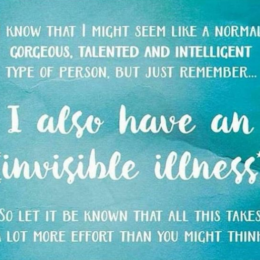
It occurred to me today that I have never blogged about living with an invisible illness. Well, that’s not true. I have written about anxiety and depression. Those are also invisible illnesses. But we have this strange habit of separating mental and physical illnesses. Which is technically impossible for two reasons: 1) mental illness has a biological location—the brain; and 2) we cannot have a mental illness without a physical body. There is no such thing as separating the mind from the body. Emotions and cognitions all happen within the body—a physical location. So why do we separate them? And even more oddly, why do we classify one as “acceptable” or “within reason” and the other as “all in their head?” That is rather absurd.
However, my “physical” invisible illness is one that usually doesn’t get recognition in any field—and is often wrongly classified as “mental;” and therefore the human’s fault. So we’re back to the crazy notion that mental illness is not physical—and mental illness is judged to be of the person’s own making. I also don’t know how a person can experience debilitating symptoms without any causation (or be self-inflicted). Why would the brain (aka mental breakdown) mess with one’s body in that way? That makes no sense. I just finished watching the documentary on Netflix called “Unrest” by Jennifer Brea. I was horrified by how some patients are treated—taken away from loving homes and institutionalized without any further family contact! I also felt extremely lucky that my illness is not as severe as others experience it. I am not bed ridden. I haven’t lost my ability to communicate (brain misfiring aside). I am not in a semi-coma. And experts say this is self-inflicted???
I don’t know of any human being on this planet that would make themselves sick of their own volition. Yes, our choices often lead to sickness—but that’s not what we set out to do. And no one asks for anxiety or depression. Those are equally debilitating as the auto-immune illness I have. And sometimes I can’t tell them apart. Is this a depressive episode? Or a chronic fatigue crash?
This afternoon I took my dog for a 2km walk through the woods which tuckered me right out. I used to hike 16km in rocky terrain and make my way up and down mountains! At least I have a past life to reflect upon. Some people in the documentary were children and teenagers who hadn’t even lived yet. Their world consisted of their bedrooms and what they could experience from their beds. I can’t imagine being bedridden. However, every morning, getting out of bed is a struggle. So I could relate to the documentary—ironically as a chronic fatigue crash had me lying on the couch. Once the film was finished, all I wanted to do was rest. My dog had other ideas.
Tonight, I know a bath would be good for me post-massage; but the exertion required for “drawing a bath” discourages me from doing something good for my aching body—and prevent more soreness tomorrow. That’s when it dawned on me maybe I should write about this. It feels like too much work to fill a bathtub with water. Yes, you read that correctly. How can something so simple be far too much work—far more effort than it’s worth? Story of my life: assessing the cost-benefit ratio before pursuing any activity. So, instead of the exertion of bathing, I decided to write about my crash; when really all I want to do is read in bed.
This particular eddy of my thoughts is actually part of a bigger swirling mass in my brain within the theme of suffering well. This is not new to me, but has been resurfacing lately…
…Well, I had to abandon ship last night. My brain refused to keep up. And this morning it was a challenge to get out of bed—prompting me to ponder what it would be like to “give in” to the sluggishness and just stay in bed. It is a push-pull dynamic: grateful I have the energy to push myself out of bed, but always with the anticipation (the pull) of a rest. And never without with the overhanging thought I could/should be doing more. I have innumerable projects I want to pursue to completion, but insufficient mental and physical resources for follow through. And then I punish myself from deep within—those haunting beliefs that I am lazy or failing if I can’t produce/accomplish/achieve. Oddly enough, I asked myself this morning what it would be like to “indulge” in remaining in bed for a day; knowing full well my fellow CFS/ME sufferers who are bedridden often pay for indulging in any form of activity with a crash. So do I—but not as dramatically as seen in the documentary. Push-Pull.
I learned in the documentary that CFS/ME claims lives every year via suicide—the depression consuming their compromised life into appearing meaningless, hopeless, pointless. And it certainly feels that way at times. The struggle is real even if unseen. I feel it every day that I cannot live up to cultural expectations: to earn sufficient money for my daily expenses let alone a future retirement; to attend social functions; to participate in activities that others enjoy easily. I have to plan, starting with assessing the cost-benefit ratio. Asking myself how much effort is required and will the payout be worth the exertion—either mentally or physically—as well as anticipating what the fallout will be if I decline an invitation or an opportunity, and how much time I need to budget for recovery (reducing my capacity to earn money, build connections, etc.).
Jennifer Brea described it has having a battery always at 10%. As you can imagine, that requires frequent recharging for minimal output. We all know what it is like when our electronics’ batteries drain faster than our usage—we get frustrated when our technology can’t keep up with the demand. Imagine what it’s like having a body that can’t recharge to sustain usage.
So, we are left with a predicament. How to manage a perpetual low battery while maintaining enough quality of life to counter the depression that is lurking in the corners, ready to pounce and consume us? This is where the work of holocaust survivor, Viktor Frankl, comes in: the idea of suffering well. Pain is unavoidable, but what about suffering? Viktor states: “We had to learn ourselves and, furthermore, we had to teach the despairing men, that it did not really matter what we expected from life, but rather what life expected from us.” (Frankl, p. 77). If I could capture the “moral of the story” from Jennifer Brea’s documentary, it would be these words of Frankl’s. She is bravely learning what life expects of her as well as teaching the despairing fellow-sufferers to grasp onto that same hope/lifeline.
Frankl borrows from German philosopher, Nietzsche, who is known for a few quotable phrases such as “Was mich nicht umbringt macht mich stӓrker.” (That which does not kill me, makes me stronger.); and “He who has a why to live for can bear with almost any how.” (Frankl, p. 82, 104) Frankl expands upon these concepts by saying, “[hu]man’s main concern is not to gain pleasure or to avoid pain but rather to see a meaning in his life” (Frankl, p. 113)–affirming my belief that the Western world is very misguided in their impossible pursuit of happiness. Frankl goes on to say,
“There are situations in which one is cut off from the opportunity to do one’s work or to enjoy one’s life; but what never can be ruled out is the unavoidability of suffering. In accepting this challenge to suffer bravely, life has a meaning up to the last moment, and it retains this meaning literally to the end. In other words, life’s meaning is an unconditional one, for it even includes the potential meaning of unavoidable suffering. (Frankl, p. 114).
Frankl’s concept is reiterated in an emotional regulation workbook: “While we can’t always control the pain in our lives, we can control the amount of suffering we have in response to that pain.” (McKay, Wood, Brantley, p. 9) And at the very beginning of suffering well is the radical acceptance of pain and suffering: it just is. No one escapes it or is exempt from it. So if I can’t avoid it, how can I make the most of it? This is the challenge life presents us. A lifelong work in progress—only ending in death. And some, understandingly, do choose a premature death for very complicated biological, mental, emotional, and social reasons.
So where am I going with all this? I suppose it is my attempt at following the examples of Frankl and Brea: to learn for myself and encourage my despairing fellow-sufferers. Your life, whatever it looks like, counts and matters. It is up to us to choose how to live it/play the cards we are dealt—choose what to do with the Gift of Life—unique to each and every living being.
And so I ask: What makes your life meaningful in all its glory and its limitations?
References:
Man’s Search for Meaning by Viktor E. Frankl (2006 edition)
The Dialectical Behavior Therapy Skills Workbook by McKay, Wood, & Brantley (2007)
Read More
Posted on Aug 6, 2018
Life is “funny,” ain’t it? I was full of ideas for my July blog. And then I hit a slump. Not writer’s block. A full blown bout of depression. What I usually refer to as a low. And at its lowest, hung on for a few days. Try as I might, I couldn’t shake it; nor could I reach its source.
Forcing myself through the usual coping strategies, the best I could ascertain was the link between powerless and depression. Being “in limbo” in my life—strung between yet-to-be severed connections to my old life and yet-to-be-made breakthroughs into my new life—keeps me stuck—and feeling powerless to move forward. I cannot control the past connections anymore than I can force things to go my way for my future. I hate that feeling. More accurately, I hate waiting. I must wait to deal with my past. And I must wait for things to fall into place for my future. I can control neither. I must be patient. And I must trust. Not my strong suits.
In a nutshell, I am once again faced with my old “demons” of never feeling/having safety, security, or stability in my life. I must provide it for myself; and when my efforts are thwarted, hang on to Trust that things will come together to carry me through. I think facing my fears of once again living on my own were a walk in the park compared to having to trust.
In my past life, I had hard-earned financial stability—but it came with strings attached—so it didn’t feel so secure to me. And being well-acquainted with the rickety low-income lifestyle since childhood, financial security is not something I readily rely upon. Add to that, between external criticism and my inner critic, I have struggled with insecurity issues my entire life. Professionally, it took many years (nearly a decade) to gain confidence in my innate and acquired abilities. Personally, it has taken even more effort, time, and courage to trust my closest friends, and to lean on those friendships to get me through my most challenging moments.
So when I am faced with situations that require waiting, my anxiety and depression flare up. Yes, I have control issues. Which are always based in anxiety. And I am well aware I am in good company with other self-professed “Control Freaks.” We have a low (or no) tolerance for uncertainty, the unknown. We like to have our ducks in a row so that we can prepare for any eventuality. Essentially, anxiety and control are ways we try to prevent bad things from happening. But we can’t. Shit happens no matter what. Life throws us curve balls regardless of how well-prepared we think we are to handle any eventuality.
Yet again I am faced with letting go of the angst…and to trust. Trust that the Universe won’t abandon me. Ooh, that’s a tough one. Trust that I am only responsible for one day at a time. Sometimes one moment at a time. Trust that I won’t end up penniless or homeless. Trust that any challenge also comes with a solution.
It was back to the basics for me. Remembering what I do have power over versus the powerless of not being able to control outcomes. Plus a reality check of my worst case scenarios and my anxieties (biggest one: not being able to live within my meager means). Fortunately I have solid folks who help with the reality check—reminding me that for this month, everything is taken care of. No need to worry about next month; it will take care of itself. But my obsession with independence sometimes trips me up. I want to be self-sufficient without any loose ends. I don’t want to depend upon others—and that being the back-up plan never sits right with me. At its core, my need for control is my fear of rejection/abandonment/betrayal. Trust opens me up to the risk of others failing to be there for me. I hyper focus on sufficiency—just in case things go sideways—which means I don’t leave room for things to work out with supports that are already in place. I fail to live in the moment.
I have a tendency of spending too much time in my past trying to figure things out, or in the unforeseen future, trying to prevent or prepare for the worst. In accepting that risk, I must make a conscious choice to live in the present. Sometimes reeling myself all the way in, to this very moment—not just the day, the week, the month, or the year—by practicing mindfulness. Paying attention to my surroundings and my thoughts without judgment or analysis. Not easy for a supremely analytical brain that earns a living by connecting the dots for other people.
Sometimes I have to accept that there are dots that have yet to connect. And trust that they will connect on their own, all in good time. Oddly enough, the antidotes to my anxiety and depression lie in the acceptance of my limitations: Trust. Patience. Hope. All of which have no limits.
Read More