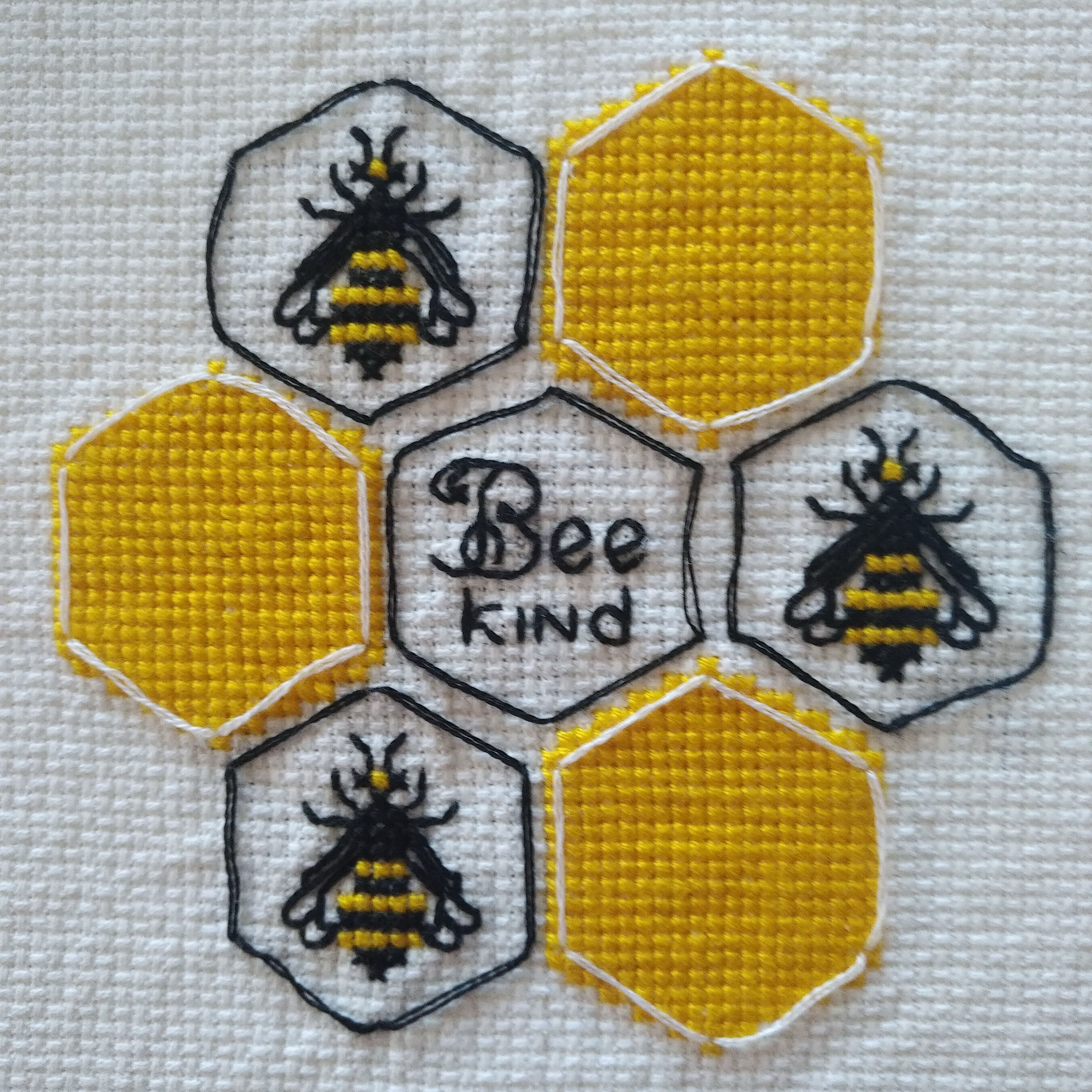
I love bees. I have always had an affinity for them. When I was a young child, my father—who was an amateur apiarist at the time—taught me and my older brother to respect and not be scared of bees. I have never been stung; but my brother was once. My father promptly applied a mud pack to draw out the stinger and no harm was done. To my knowledge, no one in my immediate family has an allergy to bee stings. However, there really is only one way to find out—the hard way! But with a little education and respect, it is not difficult to avoid being stung.
After I married, my initials (BZ) came in handy to purposefully embrace identification with bees. I began personalizing handmade cards with my initials and a bee stamp. The obsession, if one can call it that, grew from there. I began collecting bee-themed objects. Now my kitchen is decorated with a bee and daisies motif. Friends and family have begun to get in on the action creating delightful works of art to adorn my kitchen walls. The feature photo is one of a pair of cross stitched projects my sister made for me this last Christmas.
Recently, I finished reading Song of Increase: Listening to the Wisdom of Honeybees for Kinder Beekeeping and a Better World by American beekeeper Jacqueline Freeman. Now I wish I had an acreage on which to start keeping bees! 🙂 My yard is big enough for one hive; but I doubt the neighbours would approve. Nor am I as patient as the author in educating neighbours about healthy bee populations. But I am looking forward to planting bee-friendly flowers in my garden this summer that will certainly be pesticide free.
Beekeeping aside, this book affirmed my affinity for bees. I even joked with a client about bees being my spirit animal. A bit later, photos appeared in a text about bees from a book about spirit animals she owned. Not surprisingly, the spirit animal book focused on the industry and productivity of bees. While I am a task-oriented person that likes to keep busy, my affinity for bees goes much deeper than that after reading about their natures.
Bees are all about loving kindness. They work together for the good of the hive, the local and global community of bees, and the well-being of the planet. Using their stingers has significant purpose for it becomes a suicide mission. Bees cannot live once they have released their stinger as they lose their entire bee-hind. 🙂 It is a conscious decision on the bee’s part to sacrifice its life for the greater good: of the hive, of the beekeeper, of the cosmos.
This genuine concern for others and the greater good is what clarified my affinity for bees as I am a person who is keen on kindness and collaboration. I, too, am genuinely concerned for the well-being of others: be it friends, family, clients, neighbours, acquaintances, strangers, the global village. For me, it is both innate and a conscious choice. So much so, that I have to set boundaries for myself not to get involved at times—to make better decisions about personal sacrifice (figuratively losing my stinger).
While I may not lose my life, per se, sacrifice does cause more harm than good at times (to myself or others). I must refrain from jumping in when leaving well enough alone is the better long-term option. It also means acknowledging my limitations and, at times, accepting powerlessness to affect change. This will be a lifelong challenge for me. I take heart being in the company of such purposeful do-gooders as the bees who will continue to inspire and uplift me.
Next time I encounter a bee, I will be sure to send it loving thoughts with much gratitude for its industry as well as its goodwill. They are, after all, what keeps this planet alive and habitable—even when misunderstood and maligned. We truly cannot live without them. Brava Bees! And a Bravo for the drone bees as well. 😉 Buzz on, my friends.
It has arrived: Christmas Eve. For some, tonight and tomorrow will be Christmas as usual with their immediate families living under one roof. For others, it will be a very strange Christmas not to be surrounded by the usual chaos nor anticipating its arrival.
At the start of the Advent season (the four Sundays prior to Christmas Day), I experienced a deep sadness. Some of you will have read what I posted on The Winding Path Facebook page. To give some context, it was prompted by events and postings that minimized the impact of the pandemic, trivializing the pain and suffering of others. And a blatant misuse of privileges perceived as rights to be brandished about with total disregard for others or even “the greater good.” The following two paragraphs are what I posted the last Sunday of November.
My heart aches today. As an empath who thinks and feels deeply, I find I need an outlet for my sadness. I would use my grief to facilitate change. However, therein is much of my sadness: feeling powerless to effect positive change. A blog entry is likely a better venue, but for now, suffice to say the state of inhumanity breaks my heart. Humanity’s inability to overcome pride and privilege. The total lack of kindness, compassion, collaboration, consideration, empathy, sense of greater good. Making other people the enemy rather than the virus. My heart breaks that animals treat their weakest members with more care and concern than humans do. Animals care about their own kind without turning on each other. They are incapable of humankind’s atrocities. I have yet to see evidence of human’s superiority over the animal kingdom. I much prefer the company of animals. Guess I am less evolved than the rest of the world’s occupants. I am okay with that. For now I will do something that feeds my spirit. Maybe decorating the Christmas Tree on the First Sunday of Advent is what I need.
Oh the irony. Just looked up the 4 themes of advent: Hope, Peace, Love, Joy. Today’s theme is Hope which I am dearly lacking today. Hope for what? That humankind will get its collective head out of its arse?? I must find something else to hope for that is within my grasp. I am far too cynical for any religious implications, humanity proving to be what it is. To hope for a better life for myself (read: security and stability — what every trauma survivor craves) sounds selfish. But it is true. I do hope for that. I also hope I continue to add rather than detract from instilling hope in others. I do believe in the healing journey. So here is my hope: that you and those you care about keep on keeping on. That in whatever small measure, you cling to the hope of travelling further along your personal journey to find hope and healing. And whatever we do, may we cause as little harm as possible to others along the way. Which will be tricky for me as I tend to step on toes standing up for those without a voice.
A month later, and I am not as hope-less as I was that day. I have seen evidence of Hope, Peace, Love, and Joy: in my life and in the lives of others. I have also minimized exposure to the inhumanity that makes my spirit cringe. I think it has helped having Christmas Spirit increase over the past four weeks—especially my efforts in that department. I decorated my tree—always a pleasure as my ornaments all have stories to tell and memories attached. And I fulfilled my intention to listen to every Christmas CD I own. I am now on round two of that one. I also baked and iced some of my favourite cookies, sharing as opportunity arose.
Even if fewer people surround me, I have not abandoned what makes this time of year special to me: decorations, music, food, being out in the snow (either walking dogs or x-country skiing). The wonders of technology also make virtual gatherings possible. This will be a new one for my family as we are rather used to living far apart, but gathering (either some or all of us) at Christmas fairly regularly. I have mixed feelings about gathering this year (virtual or otherwise); but that is not the focus of this blog. Not that I know what the focus is!
I am aware that I have received many gifts this year, especially because I am a traumatized introvert who doesn’t need the company of others very often. I sympathize with the extroverts who have felt abandoned and lost. It has been a very trying year learning new ways of being in this world. One thing became clear to me: the Universe does have my back. I remain clothed, sheltered, fed, warm, ambulatory, without loss of sight or sound. And loved. It may not always be shown in ways that I see, desire, or even crave. But I can say without a doubt that I am loved. That in itself is a miracle. The gift of Love. The essence of our very Beings.
May 2021 be welcomed in with more awareness of Love. Particularly our ability to give, not just receive (or feel the lack thereof), the Essence of our Beings. Love is not meant to be hoarded, but to flow freely among all Creation. May we bestow more Love in the coming year. May it be a year of healing for the entire planet.
Being a trauma therapist and a trauma survivor lends itself to some interesting self-revelations. Recently it came to my attention that a by-product or collateral damage of my trauma experience is the ingrained survival skill of “reading between the lines.” This is completely second-nature to me. I don’t even realize my brain is scanning for hidden messages: such as seeking out the personal application of general comments.
This type of scanning is an example of how hypervigilance “works.” Our amygdala, the danger detector in the brain, is continually on high alert. We “sense” things before we are consciously aware of them. Part of trauma recovery is retraining the amygdala as to what is truly dangerous and what is a memory related to danger. This retraining is, unfortunately, a process and not a “hard” reset like turning a computer off and on when it crashes.
Evidently, as much effort as I have already put into retraining my amygdala, there remain antennae that need reprogramming. Hard to do when you don’t recognize it happening in the moment. So we start after the event—when it surfaces to awareness. I have my doubts I can completely reprogram these antennae; but I can at least review the data, which will hopefully help progressively turn down the dial in the future.
How do I explain what I mean? Let’s say we’re having a conversation about music. We talk about all kinds of things like genres, concerts, volume preferences, etc. As we chat, my brain involuntarily scans for indicators of what is required for optimal interactions: assessing if you are upset, disappointed, frustrated, angry, happy, in sync with me, etc. In essence, anticipating what you need before trouble occurs. If my amygdala senses that something could be amiss, internalized messages are activated to ensure I keep everyone safe and contented (aka happy) and to explain the tension I sense.
This became part of my brain development from constantly having to monitor the mood in my earliest environment(s): Am I in trouble? What is expected of me? Do I need to smooth things over? Most of the time, the amygdala is trying to prevent bad things from happening—like being struck or berated or yelled at—determining what is necessary for survival and/or avoid danger. If unsuccessful, it then tries to make things better by apologizing, offering help, or escaping (either shutting down/dissociating or physically leaving).
Even if there was a tool to inform my brain it doesn’t need to do that anymore, I doubt it would believe me. So instead of trying to convince my brain not to scan for subliminal messages (what are people indirectly communicating they need from me), I need to ascertain what is my responsibility and what is beyond my purview. Such is the nature of my compulsion to “fix things.” Somehow I need to increase my comfort levels with ambiguity and generalities.
Reminds me of the criticisms I received not to take things personally or to quit being so sensitive. And there’s those internalized shame messages activated again (“not being enough”). I cannot be “un-sensitive;” but I can turn down the volume. As for taking things personally, it’s a survival skill not easily unlearned. For if I don’t look for the personal in the general, I may put myself in harm’s way. This is what happens when we grow up with covert and/or passive aggression. We become very good at reading subtext: What are they really saying?
Paradoxically, the same ones who use covert aggression are also the ones who label others as over sensitive or too personal. In reality, they are playing a “get out of jail free” card: always someone else’s fault or problem. So… given the environment I grew up in, it makes sense why my brain scans for the hidden messages. However, it creates awkward situations when it misreads situations or expectations in other contexts, and I seek to restore equilibrium that hasn’t been disrupted.
As I have processed this survival skill and its repercussions, it became apparent I need to give myself permission to be awkward. I’d rather over correct then miss a legitimate cue! Per chance I need to celebrate the relief so that my brain registers the misfire. I have been thinking I need to correct something when instead it simply needs to be acknowledged: “Oh, I misread that. Whew. Glad that is sorted.”
I physically have a low tolerance for emotional discomfort. I will do whatever it takes to restore homeostasis (that compulsion to “fix things”). Even make a fool of myself or an over correction. Checking in, clarifying is all part of good communication. I would rather over communicate than under. Mainly because if I am at all uncertain, my brain will ceaselessly gnaw on that bone—which is exhausting mentally, emotionally, and physically.
The hazard to subconscious “reading between the lines” is drawing flawed conclusions with knee-jerk reactions. Many friendships are ruined this way. The classic move is making accusations based upon interpretations of sensory input without seeking clarification. By conversing, we can be reassured that what we sensed was inaccurate. We, in fact, did not have to keep anyone happy to prevent disaster or disconnection.
Strange how my musings meandered from seeking a solution (correct one aspect of hypervigilance) to accepting awkwardness. This also means circumventing the internalized shame messages that are activated by discomfort. I am not stupid or foolish or flawed by my attempts to read between the lines or to overcorrect. It’s a survival skill.
Misreading a situation, taking things “too personally” are not bad or shameful. Simply moments in time that require a “double take.” Risking awkwardness requires courage and humility which just may help to rewire the amygdala’s hypervigilance in the long run. I may make things worse in order to make them better. Better that than resentment or conflict. My brain will continue to scan; I will continue to maintain equilibrium as best I can; I will sometimes get it right and sometimes over correct.
My distress tolerance needs to increase so that I can process incoming data and, most importantly, deal with awkwardness/discomfort and accompanying shame messages. I must hold in tension the simultaneous goals of accepting the fallout of being a trauma survivor and rerouting the shame messages that inevitably surface. That compulsion to “fix things” will only decrease by boldly stepping into awkwardness and allowing myself to spend time there without judgment.
What situations are you facing that may require risking awkwardness? Does your knee-jerk reactor or your subliminal scanner need a reset? Or do you need to be gentle with yourself and celebrate the awkward moments?
This poem came to my attention today. The author plans to fine tune and put it to music once she fully recovers. I thought it aptly captured the struggle.
All I can do… by Sarah Patton
I feel the tears welling behind my eyes. Another day of quarantine. Another day of body scans and monitoring. Another day wondering if I’ll see tomorrow. All I can do is cry.
I never asked for this. I did what I was supposed to do. Hell, I hid from the world for months. And now, laying here alone. All I can do is cry.
Every day is something new. My new normal of weirdness. My body is fighting it’s hardest. My mind trying to grasp onto sanity. All I can do is cry.
No one can comfort me. No one can hold me. Tears roll down my cheeks, Forming a lonely river down my face. All I can do is cry.
Watching the heart rate monitor on my wrist I pray that things will be ok. I know it could be way worse for me That I am lucky for mild symptoms but All I can do is cry.
I take solace in the comfort of spirit I feel the love of my angels and guides Messages of support and hope Of resiliency and of pride. All I can do is cry.
No one will hear these whimpers No one will comfort this loneliness It is all on me, to dig deep To be strong and face this alone All I can do is cry.
I find myself thinking of others like me Wondering if the next breath will be our last Praying to see our friends and family again Will someone be there should the worst happen? All I can do is cry.
I get angry at the state of my province The recklessness of a government supposed to protect us all. I watch the numbers climb knowing that any one digit could be the end of a life. Why can’t they see reason? All I can do is cry.
When this is over Someday I’ll be stronger again I promise to fight back harder than I ever have Time to end this madness and fear I can do more than cry.
Thanksgiving weekend marked the one year anniversary of moving into my fixer-upper house. So much has happened in that time. The most notable is, of course, the global pandemic. However, the silver lining for me has been a year of “home renovation therapy.” Reduced clientele has meant more concentrated effort on improving my living conditions. This has also been exceptionally stressful.
Aside from stress management, it has been therapeutic in more ways than one. Most importantly for me, I have enjoyed working on my house. I love DIY projects and appreciate making what’s old, new again. Repurposing and upcycling otherwise discarded items—totally up my alley. Or how do they say it these days, totally my jam?
There is nothing like getting the creative juices flowing to make you feel alive. But for a recovering people pleaser, focusing on myself and my wants and wishes has also had a curative effect. I am feeling more sure of myself, and more in tune with my Self.
Dedicated “Home Renovation Therapy” also afforded quality time for quiet reflection—both intra-personally and externally (big picture thinking). As a result: personal growth. My professional life may have taken a blow; but in time that will recover too. It’s all about switching gears and making changes these days.
I could list all the projects that have been completed in the past year. Less easy would be to itemize the “therapeutic gains,” as we say in the counselling ‘biz.’ I have noticed a shift in some attitudes, beliefs, hopes and dreams. Others remain firmly entrenched no matter how self-aware I am—like body image issues.
Somehow that prompted me to ponder what my house thinks of all these changes. With all this devoted attention, does my house feel loved and cared for? Is that a sigh of relief I hear that someone is finally listening to the creaks and groans? Seeing the cracks and leaks?
In all of this musing, I realize the question is really whether I feel loved and cared for. Am I paying attention to my own creaks and groans, cracks and leaks? Oddly enough, the answer is, “Yes, I do feel loved and cared for.” Quite a surreal sensation given the years wasted to self-hatred, self-denial, and self-sacrifice. And it’s like my body, brain, and soul heave a collective sigh of relief: Finally!
In caring for an aging gem of a house, I end up caring for my Self. Only the Universe could come up with a treatment plan like that! Indulging a passion, a hobby sets me on a path of healing. It has not been smooth sailing (to mix metaphors); but that IS part of the process. Growth only happens by overcoming challenges.
To quote a line from the move, The Last Word, starring Shirley Maclaine as Harriet: “You don’t make mistakes. Mistakes make you. Mistakes make you smarter. They make you stronger, and they make you more self-reliant.” Her character’s biggest regret? Not encouraging her daughter to fail, instead of pursuing perfection.
There is no growth without struggle whether out of a seed pod, or old beliefs and attitudes, or no-longer-useful coping strategies. We cannot transform a neglected building with a magic wand. There is struggle: with time, money, equipment, tools, ladders, helpers, products, and our bodies. But the finished project, the end result fills us with joy and makes the struggle worthwhile.
It is not unlike the labour of giving birth—the reward makes the pain irrelevant. So much so, that we subject ourselves to repeated pain (whether gestation of a baby or building project). Disclaimer: This is not to minimize the suffering of those who long to conceive and give birth. It is my hope that you, too, can find solace in my words of struggle and growth.
So this Thanksgiving season, I am grateful for the past year and it’s unconventional therapy program. I am grateful for my house that keeps on giving—as shelter and haven as well as wellspring of creative projects. I am grateful for the lessons in self-love and self-care. And I am grateful that in some weird “cosmic” way, this house makes me feel loved and cared for (as I love and care for it).
I have a business name in mind for my future retreat. Barb’s Bunker: A House of Hope & Healing. But I keep thinking my house needs a personal name, like Lady Jane, Dame Agatha, or Miss Pettigrew. Something reflective of the mid-1920s when it was built and of its strong, defiant-yet-charming, character.
The right name will come to me eventually. Maybe once she has new eyes (aka windows) in the back of her head and a new “do” (aka shingles) on her head. She will be stylin’ then! 🙂 As will her owner, sporting a revamped sense of self, being all loved and cared for…
May a new discovery surprise and delight you today!
Last month, I received the news that my former canine therapy
assistant, Elsa, died of intestinal cancer. This was a hard blow for a number of
reasons. One is that I had been thinking of her as she reached her tenth birthday—the
senior years in a dog’s short life—wondering if she was showing her age yet,
that sort of thing. Another is that I learned of her death via indirect
channels—which triggered dormant “divorce trauma.” Third is the bond she and I
had. I have missed that girl greatly. She was not only my office assistant, but
also my “therapist with four legs and fur.”
Mostly dealing with anxiety—hers and mine. We taught each other a lot. And she proved to be incredibly empathetic. A natural therapy assistant—instinctively knowing what each client needed—snuggle, kiss, curl up at their feet, keep a safe distance or a watchful eye. She knew the art of “just being” in the moment and of “just being there” for someone.
It’s also a strange experience grieving the death of a pet that you already lost in a divorce. I had not seen Elsa for 3 years; yet the news of her death hit hard. I think it was the finality of never seeing her again. There must have been a part of me that held out hope for one more visit. A strange silver lining to this finality is that it also slams shut the door on my marriage. I was about to write “failed” marriage; but to me that is inaccurate. While the marriage did not last until “death do us part,” I do not perceive it as a failure. It is by far more a success story that I kept working at it for 20 years.
I see it along the lines of a completed marriage. It served
its purpose. Its time had come. If I were to remain, it would have continued to
steal my soul until I was an empty shell, going through the motions. Elsa
played a significant role in those last 5 years. I think she preserved my life,
protecting me from the complete loss of my Self. Her behaviour issues demanded
I stay in the present and face my own. This is not to diminish the role played
by many concerned friends who witnessed my demise long before it surfaced in my
consciousness. However, the “daily-ness” of dealing with Elsa held me
accountable—I could not bury my head in the sand.
My first attempts at leaving the marriage all centered
around Elsa. I hoped to stay nearby to have “shared custody” as she was such a significant
part of my life and profession. However, in the end, I had to sacrifice that
bond for my Being. She could not be the defining factor in my preparations. It
also meant living with unknowns. I had no idea how my ex-husband would cope
with her behaviour issues on a daily basis. In my heart-of-hearts, I assumed he
would give up and ask that I take her. This was not the case. Somehow he
learned to manage; and she, by all accounts, continued to thrive.
As have I.
It has been a gong-show year for most of us. Yet we all hang
in there somehow. I have come a long way in the last 3 years—even if my life appears
in disarray at the moment with numerous projects on hold: partially painted
bathroom, tarp on my roof for winter, broken tooth, paused fence construction, persnickety
stove, and the latest—snow blower in need of repair before winter.
But if life with Elsa taught me anything, it was to live in the moment, always be curious, cherish the ones you love, be there for others, and deal with it when “life happens”—even if you’re learning new ways of doing that. And never take for granted the kind souls you meet along the way who make the journey worthwhile.