Posted on Jul 31, 2020
As evidenced by the absence of blog entries, I haven’t written much lately. Not even in my personal journal, which had me puzzled. In the “real world” of writers, it is common practice that one must write at least something every day. It’s certainly not for lack of pondering. And I wouldn’t label it as writer’s block. More along the lines of missing motivation than inspiration. Reluctantly, I admit to moments of losing interest in the idea of maintaining a regular blog. I don’t know how daily or even weekly bloggers do it.
I love words. Always have. I enjoy the actual process of
playing with combinations of words to create just the right nuance or picture.
I appreciate the power of words—to uplift, encourage, challenge, inspire, heal,
connect, engage, interact; but most of all, the ability to make sense of the
senseless. The healing power of meaning can only be conveyed via words.
Many weeks ago, I made an attempt at writing a blog entry to
“use my words” to process anger I was experiencing at the time. This proved
helpful and produced a seed or nugget for a future blog. I even liked what I
wrote at the time; but instead of pursuing that line of thinking, it is time to
unpack this supposed “writer’s block.” After mulling it over for quite some
time, the reason finally occurred to me: survival mode.
For quite some time now I have been in “survival mode.” Not
the kind that lands a person on a survival skills TV show—although some would likely
challenge that assumption living in an ongoing renovation project—but the psychological
kind that engulfs a person in a shroud of self-preservation stifling creativity
and spontaneity. However, I didn’t recognize it as survival mode. I was
sheltered, fed, clothed. All the essentials. Finances are tight; but somehow I
am staying afloat—or as I like to say, keeping the wolves from the door. I have
never been healthier (all things considered). My mental health is in check.
So what was I surviving? Turns out my mental health may not
have been as stable as I was leading myself to believe. I went into survival
mode because the normal routines that keep me sane were being challenged daily.
I am no longer a neat-, clean-, or control-freak. I can live with more
ambiguity than ever before. However, my house was in limbo for several months waiting for its electrical
upgrade to be completed. Wires hanging about. Fixtures waiting to be homed.
Opened cavities in my walls.
Two things I remain terrible at handling: waiting and
disorganization. With my actual house in a state of disarray: Paperwork piled
up; Messes piled up; Dust piled up. I couldn’t properly clean anything. Objects
couldn’t be put back in their places. My house (and life) was in a state of
limbo. And for the most part, I was powerless to make anything happen not being
an electrician and circumstances being beyond my control. So my two Achilles
heels combined into kryptonite (mixed metaphor, I know). I was forced to wait
in an environment of disorganization.
The cornerstone of mental health is maintaining routines. I
was barely managing to keep up with the basics, so some things fell by the
wayside. I am slowly returning to my full morning and bedtime routines with
positive results. And my house is inching its way back to habitable. I am once
again feeling the creative juices flowing—whether writing or making home
improvements. Structural cavities have been filled, primer and paint are
gradually making their way to my walls.
So I do find it interesting that survival mode does not mean
lack of productivity. Many projects have been completed in the past few months.
My home and yard are continually evolving into my own little paradise and
sanctuary. But living in a state of chaos does impact my sense of self and
well-being. My brain focuses on the practical, day-to-day stuff only. Part of
me shuts down as it were. My mind can’t relax and wander where it will. My
spirit retreats to safety—waiting for the imposed disorganization to pass.
Survival mode.
Interestingly, recently I spoke to someone about waiting—which
in retrospect clarifies my survival mode. Waiting is generally associated with anticipation
and excitement—or annoyance and frustration. But for those of us with traumatic
childhoods, waiting is linked to danger: waiting for the other shoe to drop;
for the mood to change; for the blow to hit; for the storm to pass. Our brains need
to be retrained to the many nuances of waiting—not just danger.
Hence, in the framework of waiting equaling danger, it makes
sense that my brain entered survival or shut-down mode. Even though it was
innocuous waiting—for the electrician to be done and my house to return to being
my sanctuary—my brain didn’t know the difference. It just knew we were waiting.
And waiting means impending danger. To make matters worse, I could not rely
upon my usual “go to” to self-soothe: organization; amplifying the angst attached
to waiting. Now that this is part of my consciousness, I can work on retraining
my brain and its associations with waiting. Maybe next time my life is
surrounded by chaos, I will be able to self-soothe more effectively and not
enter survival mode. The healing journey continues.
As you continue on your own journey, here are some questions
to consider: What is your kryptonite that sends you into survival mode? What does
it look like when you shut down? What negative associations hinder your ability
to self-soothe? What changes need to be made to your framework?
Read More
Posted on Mar 17, 2020
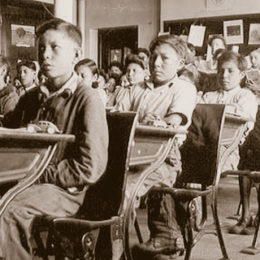
While the world is distracted by Covid 19, I have been mulling over the idea of rebuilding (heads up, this is going to be a long rant!). Not my home—that I am renovating, not rebuilding, thank goodness! Recently, I watched an interview that impelled me to share my thoughts on a controversial topic: Truth & Reconciliation for indigenous Canadians. The interviewee, Tanya Talaga, proposes a more accurate word to reconciliation is rebuilding. I concur. There is nothing to reconcile between two unequal partners. The goal of colonization was obliteration—not collaboration. And it nearly succeeded. However, what remains are empty shells of once proud and soulful members of many nations.
It reminds me of the Holocaust. There are similarities
between how Hitler and John A MacDonald tried to destroy not only a group of
people, but a rich and vibrant culture and its various communities as well. A
difference between the first prime minister of Canada and the leader of the
Third Reich is dramatic impact. MacDonald (and other early politicians) managed
a subtle, invasive, insidious, genocide that masqueraded as colonization for
the good of the people of Canada. But which people? The ones who welcomed or
invaded? The betrayal, deceit, and trickery used by Canadian government officials
and politicians are abhorrent and would never be tolerated today.
In fact, they would be considered war crimes. Yet the general populace is tremendously dismissive of the indigenous situation. I was raised on the same platitudes and blame-the-victim attitude. Hence, countering ignorance is key. We are inundated with books, movies, documentaries about the atrocities of WWII. There is no denying it happened; that it was horrid and wrong on so many levels. The world has, for the most part, taken ownership of WWII and made efforts to prevent a repeat. We can’t imagine how it happened in the first place and are incredulous that there is a viable threat of it happening again.However, history has repeatedly proven that it does repeat itself. We have seen it in countries on all continents at various points in recorded history—dynasties in China; tribal wars in Africa; the British, Russian, and Roman Empires; Spanish conquests. Since the dawn of time, rulers have invaded countries, conquered its inhabitants, decimated cultures (Polynesian Islands, Celts, Aztecs, Mayans, to name a few). Enlightenment appears to have a short shelf life.
Which, in trauma terms, begs the question: how to break the
pattern of abuse? Throwing money at the problem is another version of sweeping
“it” under the rug (aka “hush money”). But that is not in the true spirit of
“reconciliation.” Reconciliation implies restoration—that ship sailed with the
first broken treaty and scurvy-infested Hudson Bay blanket.
In therapeutic aims, to restore a broken relationship
requires all parties taking ownership of what they contributed to the situation
and what they bring to the table moving forward. New terms of the relationship
are negotiated. If all parties do not benefit in mutually satisfying ways, then
someone sacrifices for the sake of the relationship, the relationship shifts
(usually a downgrade) to factor in discrepancies, or it disintegrates.
So far, the Canadian government holds the power and calls
the shots. It is by no means a mutually satisfying relationship, and separation
or disintegration is not an option. Hence Canada’s indigenous peoples are
forced into making the sacrifices and downgrading the relationship. None of us
would have the privilege of living in this amazing country if it wasn’t for the
original inhabitants welcoming the intruders and showing them the ropes of how
to survive and thrive. Those who take the position of the “conquering hero,”
speak from the colonization point of view—not the conquered—as history
generally is written from the conquerors perspective. How arrogant to assume all
is fair in war—or accurate in historic accounts.
When what happened 150-200 years ago occurs today, people
flee, become refugees, seek asylum. Where are indigenous Canadians supposed to
go? It is absurd to think that the country within which modern refugees seek
shelter historically created the very environment that forces others out. More
ludicrous is the fact that Canada doesn’t own its dark secret. The difference
from WWII: Hitler and his henchmen couldn’t hide from recorded reality while Canada
hides its dark secret in obscure archives.
My goals with this rant are two-fold: highlight the
atrocities (ownership) and consider rebuilding from a trauma recovery
perspective. In the spirit of taking ownership, here are a smattering of
inhuman government policies (refer to websites end of page): denied women
status of any kind (Indian or otherwise); forcefully removed children from their families to attend residential
schools with the primary intent “to kill the Indian in the child”; segregated
onto reserves (similar to Jewish ghettos); renamed individuals with European
names (more cultural distancing); restricted from leaving reserve without permission
from Indian Agent (characteristically of ill repute, dictatorial, and
sadist—not unlike plantation “slave supervisors”); forbade speaking their
native language, practicing their traditional religion; declared potlatch and
other cultural ceremonies illegal; denied the right to vote.
“I have reason to
believe that the agents as a whole … are doing all they can, by refusing food
until the Indians are on the verge of starvation, to reduce the expense,” Macdonald
told the House of Commons in 1882
“The great aim of our legislation has been to do
away with the tribal system and assimilate the Indian people in all respects
with the other inhabitants of the Dominion as speedily as they are fit to
change.” – John
A Macdonald, 1887
Impact of said policies—generations of indigenous Canadians “lost in the system.” We learn how to raise children living in families. If you remove children from their families, how are they to learn how to raise the next generation? Their models are punitive, dismissive, and distant institutions. Many of us spend years in therapy for being raised in punitive, dismissive, and/or distant families. Imagine whole communities and cultures!
So if the government is serious about rebuilding its
indigenous roots (doubtful given political patterns), step one would be to own
the damage it has done to the fabric of families—damage in terms of parenting
and attachment issues which lead to unhealthy coping strategies (in any
cultural background) such as violence and addictions—which Canada as a whole
denies it helped to create and perpetuate.
The second step is developing a strategy—not a vague plan—a
strategy with measurable goals and objectives. Clean drinking water for EVERY
Canadian would be a great start! Access to equal education and health care.
Trauma recovery programs led by local community members. Proper homes,
facilities, and infrastructures. All of this cannot be a “top down” approach.
Collaboration is key—all parties having a voice at the discussion table—starting
from the “ground up.”
Another framework for understanding our predicament from the trauma recovery perspective is to think of what’s involved leaving an abusive relationship. “Canada” (as we know it) abused its original occupants —and continues to abuse with unfair policies and treatment. Not because it doesn’t know better, but willfully and initially maliciously. However, as the victimized partner in this abusive relationship, our indigenous peoples have nowhere to go, no one to turn to. As in domestic violence, there are bystanders—those who see the abuse but turn away or blame the victim. As apathetic bystanders, we join the ranks of those who witnessed the systematic destruction of Jews by the Nazi regime. We are in collusion with the abuser when we don’t speak up due to apathy or passivity. That, too, is hard to own.
Imagine you are the abused partner and believe (re-enforced
through experience) you have no one to turn to—what would happen? Most likely,
you turn on yourself. The violence turns inwards. Depression and futility set
in. You lose your sense of self, your autonomy, your volition, your will to
live. Your spirit dies a little more each day. To cope with the negative
onslaught, you must shut down. Your entered this relationship in good faith.
Now faith is gone. Can you imagine being beaten down every day? How do you
press on? Move forward? Rebuild when each attempt is thwarted?
Providing we aren’t forced to leave under drastic measures,
rebuilding a sense of self germinates while still in the abusive relationship.
We begin to see “this” isn’t working and eventually realize our own spirit or
essence will die if we stay or continue “as is.” We timidly begin reaching out
to others, determining who can be trusted, seeking confirmation of our unfathomable
experience. With their help—and ONLY with the help of trusted others—plans
formulate to make change: either to begin a new life of recovery or to begin
rebuilding the foundation for a healthier relationship that fosters mutual
respect.
If Canada embarks on this recovery mission, it needs to collaborate with the First Nations to incorporate from within—not impose upon from the abusive party. Can you imagine being offered supposed help from the same system that terrorized, denigrated, suppressed, and trampled you? There is NO easy fix to this situation. But until we take ownership of how we all play a part (either passively or aggressively) in this toxic relationship, it will never have a hope to heal. At the very least, we must stop negative speech towards once mighty nations, communities and cultures, individuals, and a situation we know nothing about. Until we are brave enough to engage with the real people involved and learn of their lived experience, adding our voice to the multitude of naysayers is not helpful, but harmful.
Before becoming a trauma therapist, I was one of those turn-a-blind-eye/blame-the-victim Canadians. I can’t anymore. How about you?
- https://www.ictinc.ca/blog/21-things-you-may-not-have-known-about-the-indian-act-
- https://thecanadianencyclopedia.ca/en/article/indian-act-plain-language-summary
- https://indigenousfoundations.arts.ubc.ca/the_indian_act/
- https://www.nwac.ca/wp-content/uploads/2018/04/The-Indian-Act-Said-WHAT-pdf-1.pdf
- https://nationalpost.com/news/canada/here-is-what-sir-john-a-macdonald-did-to-indigenous-people
- https://www.ictinc.ca/indian-residential-schools
- https://indigenousfoundations.arts.ubc.ca/the_residential_school_system/
Read More
Posted on Jan 23, 2020
Welcome to a new year and a new decade! As I noted in last month’s blog, this is an ideal time to take stock of one’s patterns and set about changing things up. And in true (ironic) fashion, I was presented with an opportunity to do so for myself.
One of my patterns involves communication hiccups.
Relationships of any kind are tricky. People need varying degrees of space
and/or closeness. Some like frequent contact, others are “lower maintenance”
shall we say. Introverts tend to prefer less direct forms of communication like
texts and emails. Extroverts lean towards in-person and phone/video chats. Add
to that, there is the full spectrum of social media options; providing plenty
of opportunities for connection as well as miscommunication and
misunderstanding.
When I am pushed away (aka given a boundary), my default
processor wonders what I did wrong or what is wrong with me. In a recent
situation, I was able to stop the negative self-examination and instead
consider where the other person might be coming from such as self-preservation.
We tend to push/pull away, or more clearly set boundaries,
as a form of self-protection for both healthy and unhealthy reasons. When I
took a step back, I could differentiate between pulling back and pushing away.
Pulling back might indicate a change in interests whereas pushing someone away
(if not due to a definite dislike) could be rooted in a fear of getting hurt. We
may be scared to invest, be vulnerable, or fully show up because we fear
rejection. In that case, the shift has nothing to do with me and everything to
do with the other person.
Once again, I had to remind myself that how a person acts or
what they say is first and foremost about them—not me. When I shifted my focus
off myself, I could see hurt from the past offering protection from future
pain. I could also zoom out, so-to-speak, and look at the larger context in
which the communication hiccup occurred—personalities, life stressors, personal
histories, and the entire relationship—not just the perceived slight against
me.
This shift in focus completely changed how I understood the situation and hence my reaction. It allowed me to choose to respond seeing their hurt instead of assuming the worst of myself. This also meant I could acknowledge and operate from my strengths. While being pushed away never feels good, I am grateful for the opportunity and ability to appreciate the bigger picture. It allowed me to break the pattern of self-aberration to see the good in both myself and the other person.
Breaking the pattern gave me choices. And I chose to honour
the delicate balance of respecting a boundary without pulling away or striking
back. I did not need to retaliate for my own self-preservation. After all, this
wasn’t about me. Honouring who I am gave me the option to keep showing up as
opportunities (with respect to boundaries) allowed.
Most of all, I continue to be amazed at the rewarding
difference made by simply stopping default behaviours—such as negative
self-examination. That never helps anyone. It is one thing to own our flaws (along
with our strengths) and quite another to assume blame and shame. May you
experience a delightful discovery in your own efforts to break patterns and
give yourself choices.
Read More
Posted on Dec 24, 2019
As per usual, my mid-month blog
fell to the wayside regardless of my good intentions. A few ideas have been
percolating in my cranium lately. So I have chosen one that ties in with the ending
of a year—in fact, a decade—and the beginning of another, full of hope and
possibilities.
Sometimes our hopes are crushed
when we feel abandoned or unsupported. Humans are the only species (that I am
aware of) who have an amazing array of coping strategies to handle dashed
hopes. Depending upon our upbringing, personalities, life experiences and the
like, our strategies fall upon a spectrum of helpful to harmful.
Most of our strategies are
developed in childhood—and we keep using them well into adulthood or when they
cease to be beneficial (whichever comes first). It takes a particular
self-awareness to be able to note when a behaviour or thought pattern no longer
works for us and adapt a new coping skill.
A common strategy to cope with
disappointment is referring to ourselves as stupid, foolish, idiotic, crazy, or
deficient in some way. This anger-turned-inward protects us from the reality of
the humanness around us. It “saves” precarious relationships. As children, our
minds haven’t acquired the ability to rationalize or take a step back to say,
“My parents did they best they could with what they had; or They are under a
lot of strain right now.” Nor do we as children have the ability to separate
ourselves from the drama or chaos that rightfully belongs to others. Therefore,
our child minds by default take the blame, “There must be something wrong with
me. That’s why my parents are yelling.”
This carries with us into
adulthood. So when faced with disappointment, our default coping mechanism is
to assume we are deficient in some way—that is why we are unsupported, abandoned,
etc. We believe we are wrong.
So as we approach the threshold
of a new year and another decade, it provides an opportunity to stop berating
ourselves. Chaos is chaos. Disappointment is disappointment. It does not mean
we are wrong or deficient or undeserving of better. It means we are human. And
for many of us, that includes going against the grain or holding unpopular
beliefs.
Maybe we think or feel more
deeply than others; so when we opt for simplicity, it sharply contrasts with
those who need to be the centre of attention or who thrive in the over-stimulating
realm of social media. It takes courage to be able to say, “No, not for me,”
when faced with the barrage of shallow connectivity or following the status
quo.
It can be disappointing, even
lonely, when our requests for simplicity are ignored, denied, or denigrated by
the promoters and/or supporters of excess or by those who simply refuse to rock
the boat. They’d rather go with the flow than risk capsizing. And then there is
the whole FOMO crowd: Fear Of Missing Out.
We CAN’T have it all. We WILL
miss out on certain things in favour of others. And sometimes our choices wont’
be the popular ones. We WILL lose out because something bigger and better has
usurped our simplicity and tranquility. Grief, loss, disappointment are all
part of life. Without them, we would be incapable of appreciating love, joy,
and contentment.
The antidote to coping
strategies like FOMO and self-abasement is to discover what we hold dear—and
make choices consistent with those values. Then we will be better able to
grieve our losses and embrace our joys, knowing that both contribute to a full
life, and to discard our fears of deficiency and missing out.
Whether we skim the surface or
dive deeply into life, may 2020 be a year of building healthy coping skills for
whatever the next decade holds.
Read More
Posted on Nov 25, 2019
Life has been chaotic lately. So much so, that I “lose” a
day now and then. With all the changes these past few months, it’s time to
reflect upon the upheaval. Oddly enough, this was prompted by thoughts and
sensations of contentment—not the opposite, which is usually what happens for
me.
Last night I was struck by the thought that I am living life
as I want to live it. And the mixed internal response got me thinking. I felt
both guilt/shame and relief. Plus a pinch of pleasure. Surprisingly, I didn’t
dwell on the guilt piece too long. I was able to bat that intrusive thought
away and simply take a moment to be grateful.
Life if not perfect by any means—if perfect means
struggle-free. But yet life, as I currently know it, is perfect. My risky move has paid off—not financially yet—but
spiritually, mentally, emotionally, physically. I love the mature, character
home I currently live in (even though there is an ever-increasing list of
improvement projects; just when one item gets crossed off, another three get
added). I have easy access to nature trails where I can be surrounded by trees
and grounded by rock. I can hear the rush of water coursing through the nearby
dam with sounds reminiscent of the powerful waterfall it once was. Every drive
through town provides a view of the rapids and flowing river. And with the
fiery sun and whisper of wind, I am in my “elements” on a daily basis.
I love it here. I have come home to my Self—a place I’ve
never been before.
I have never lived truly on my own terms—always factoring in other people, whether it was my parents, siblings, teachers, friends, peers, church leadership, co-workers, husband, in-laws, etc. I, as an individual person, did not count or matter—what mattered was the greater good (usually as dictated by others). To complicate matters, there were the undiagnosed and untreated mental health issues. I never thought for myself; for if I did, I was challenged by those around me or (what I now know as) the “crazy” thinking in my head. I have certainly come a long way.
It is absolutely marvelous to get to know my Self, how I
think, and what I feel. In addition to that, it is a new experience to set
boundaries without guilt. I know what I am about, what is helpful, and what is
harmful. Sure, the old ways of thinking challenge my efforts and are bolstered
by imaginary conversations with those who hold to dogma, conditioning, and
tradition. I must let those conversations go as they do not serve me. Only
weigh me down and hold me back. I do not need to defend myself to perceived
criticism. And I can choose to engage or back away from those conversations in
real life. There is a confidence that comes with knowing who you are and what
you are about.
This transformation has been “in the works” for a long time,
recent developments notwithstanding. There have been shaky moments when I have
had to employ healthy coping strategies learned along the way. In retrospect, I
can see how my life lessons have built upon each other getting me to where I am
today. I have had to rely upon bookending my day with tried-and-true morning
and bedtime routines. And when I first moved into my new home, I had to relearn
what that looked like in different surroundings. It was a bit disorienting
until I got the hang of what works for me in this place. It is important to
note that I kept at it. I knew I could trust my routines to keep me solid. I
just had to reset them.
I am living in a constant, ever changing state of disarray.
But it is my disarray that I have some control over. There are days I am
so overwhelmed, I don’t know where to start. Other days that I run out of
steam. However, as I pick a project and see it through—the result is worth the
discomfort. Not only the satisfaction of a task completed, but also the benefit
of improved living space that reflects who I am and not imposed by a previous
occupant or co-habitant.
Of course the parallel between home renovations and self-improvement is not lost on me; especially the necessity of proper groundwork for lasting results. Knowing the advantage of due process keeps me pressing on when I live with patched walls until I can rearrange my belongings to prime before painting. Very important. I wish the previous renovators knew this as I have large portions of paint chipping off the lath and plaster walls and original wood trim. And of course, when one starts making significant changes, it exposes layers upon layers of what has gone on before.
You may not be undergoing a home renovation at this time;
but we are all engaged to some degree in our own transformation and growth. May
you find hope and healing as you peel back the layers, repair what’s damaged,
and apply life’s lessons on your journey of coming home to your Self.
Read More
Posted on Oct 29, 2019
The other day I was asked a very simple question. Which in the moment, I answered quickly and equally simply. But upon further reflection, I realized my glib response was just the tip of the iceberg. It was a truthful answer; but little did I know the depths my response represented.
The question was simply, Why did you do that? My response:
because I was frustrated. End of conversation with the inquirer—but not in my
head. I had made an imprudent and impulsive choice which subsequently required
the aid of the questioner. And a very fair question given the circumstances.
I am not prone to impulsivity; but evidently my frustration got the better of me. Hence the prolonged conversation in my head. Why did I make that particular decision given the context? The answer surprised me—old entrenched patterns. I reverted to worrying about someone else’s opinion (mind reading) rather than focusing on the real situation at hand. Had I stayed the course (not distracted by the perceived thoughts of others), I would have spared myself and the person who came to my aid (the poser of said question) a lot of hassle. Ironically, it was the imagined criticisms of the questioner that waylaid us further. I got frustrated with that perceived pressure along with the slow progress I was making that led to the question, Why did you do that?
So I was frustrated initially with my slow progress. But later I realized my frustration was compounded by the albeit incorrect belief that someone was impatiently waiting for me and already questioning my choices long before the question was actually verbalized. And now I ask, in my ramblings have I lost you?
Suffice to say I fell into a common thinking error or trap: mind reading—where we assume we know what others are thinking and make our choices based upon imaginary input. I have lived most of my life anticipating criticism and trying to avoid it. Obviously there must have been some sort of success rate to reinforce this behaviour. But there has also been much unnecessary heartache, suffering, anxiety, and trouble because of it.
I can make excuses like time pressures, stress, etc. All valid factors, but in reality I forgot to practice mindfulness—paying attention to the present moment without judgement. In a nutshell, I lost myself. My inner compass went off course. I slid into default mode—people pleasing. This default mode can appear harmless—even masquerade as a redeeming quality—but it isn’t healthy and in fact can be quite harmful.
Fortunately this most recent situation resulted in embarrassment
and inconvenience. But my people pleasing tendencies have gotten me into much
trickier situations. It’s like I get tunnel vision and can no longer see the
big picture. If only there was a way to zoom out to interrupt default mode
before making harmful decisions. However, on the bright side, I’m learning how
to be mindfully present—keeping my inner compass on course and grounded in
reality—which prevents many of these awkward situations I tend to find myself
in. Hence the conundrum of self-discovery: holding the unhealthy pattern in
tension with celebrating the successes.
There definitely is a theme in my life lessons: putting others first at all costs. And sometimes those costs are quite high; but without the costs there wouldn’t be lessons. And without celebration of success, there isn’t reinforcement of lessons learned.The challenge of countering people pleasing, criticism avoidance, and the need for mind reading, is that one has to start putting oneself first—or at least on par with everyone else. That’s hard to do because it requires resetting one’s inner compass. The “north star” that guides all processes has to be adjusted.
Kind of like all those settings in our newfangled, digital gadgets. We have to set the parameters for our devices to function optimally for our particular preferences. But don’t get me started on setting up my new internet connection and “smart” television! That was an obstacle course I don’t wish to repeat.
Now hopefully I’ll remember all those dang passwords and security codes. Word of advice: never over think or over simplify! 🙂
“I am not lost, I am just working out my way, no longer following the signposts outside but instead following the compass within me.” ~S.C. Lourie
Read More