Posted on Feb 16, 2017
In December’s blog, I opened the discourse about sexual assault. And in that blog, I introduced the idea of the messages we receive about what it means to be a sexual being.
We are bombarded with social images and concepts about what it means to be sexual with the opposite sex. Standards are set. Often there are competing and conflicting standards from media, parents and family, peers, institutions, religious convictions, etc. Fairly new on the scene is the concept of a spectrum for sexuality and gender. Not everyone fits conveniently into a heterosexual box or even a male-female polarization. And if you happen to be one of those people who is not easily “defined” by sexual standards or gender boxes, it can be very confusing and even complicated. Other issues surface including sense of self, victimization and abuse, exclusion, isolation, defamation, equality, and the list goes on.
Sexuality is deeply personal. It is not as simple as checking off a box, joining a certain group. It is tied to our very essence—our soul. How we see ourselves is impacted by the messages we receive about what it means to be a man or a woman (which can be very limiting) and what it means to engage in sexual experiences. In order to embrace who we are as individual persons, we have to set aside gender at the same time as honour the bodies that our essence comes in. In my utopia, people will learn what it means to be fellow (as in equal) human beings (without prejudicial labels) before stepping onto the trampoline of gender and sexuality. However, we are not there yet. Not even close. It is a different conceptualization to consider humanity at the core with gender and sexuality as expressions of a unique person—having no bearing on their value or ability to contribute to communal life on this planet.
So we have two things held in tension: gender and sexuality along with equality; which is a whole other discussion that I may take on in a future blog. And once again, I went in a direction different than intended; so let’s get back to what was initially on my mind: what we believe it means to be a sexual being, and what we believe about the act of sex itself.
Each sexual encounter can hold different meanings. There is the physical release (including all those bonding hormones that can make it a wonderfully satisfying experience; but for some, the focus is the adrenaline rush, not intimacy). There can also be a spiritual connection, when we invite that to be a part of it. And there is the intense confusion when the physical release by the body, naturally responding as it does to stimulation, is combined with manipulation and control. There is also the mental shut down (dissociation) that prevents a person from having any positive associations with sex or blocks unpleasant sexual experiences. Definitely not one-size-fits-all.
As for beliefs about personal female sexuality, one author* has broken it down to four basic cultural beliefs:
1) I must be good to be worthy of love.
2) I am not really a woman unless someone desires me sexually or romantically.
3) If I am sexual, I am bad.
4) I must be sexual to be lovable.
None of these internalized messages are healthy perceptions of oneself as a sexual being. They are reflections of an externally-based sense of self: how others perceive me influences my worth or value. Human value is innate. Everyone has the Breath of Life. It is not determined by external forces such as money, power, actions, acquisitions, attention, accolades, or achievements. No one person is more valuable than the next. We may do different things with our unique lives, but one’s choices do not determine one’s value. Our choices determine the trajectory of our lives. Our choices give expression to our human uniqueness. And the choices of others do not have any bearing on our value—maybe what happens to us, but not our core value.
Seeing ourselves as worthy of love and respect from the inside generates a different way of being in the world—including how we express our sexuality. Our sexuality is not about proving a point, earning approval, fulfilling obligations, performing a duty, or serving another person. It is not about inferiority or superiority. We need to reclaim our sexuality from the harmful internalized messages. It is part of being human, not a means to an end.
On my healing journey, I’ve had to reclaim my sexuality as being part of who I am, not a right or duty or something to be denied, hidden. I have had to untangle the conflicting messages I was fed. Sex isn’t bad. Being good doesn’t mean not having sex. I don’t have to be “good” (non-sexual) to be worthy of love. Nor do I have to be sexual (“bad”) to be lovable. A man’s attention does not validate me as a woman. I do not need to be desired to be female or even a person of worth and value. I am a person in my own right—it is not dependent upon how others see me or treat me.
My personal choices are a way to express my sexuality on my own terms and within my own boundaries. It is not something to be taken advantage of, violated, or exploited. I must also respect the boundaries of others and be mindful of how my choices may be received by others. Being a whole (integrated) human being in our society is not black and white. It is not a matter of right or wrong. It requires being respectful of ourselves and others. It is a delicate dance that requires we pay attention to subtle shifts in body language, the words people say, and what remains unsaid.
Sexuality is first and foremost about respect, with safety and security a close second. It is about setting boundaries as well as honouring boundaries. It is about understanding innate worth and value. It is not about defining ourselves to fit social standards but about understanding who we are at our very core.
May your journey of self-discovery include what it means to be the person you are in the package that you come in. Namaste: The Spirit within me salutes the Spirit in you.
*Ready to Heal: Break Free of Addictive Relationships by Kelly McDaniel (2012), pp. 73-8.
Read More
Posted on Jan 22, 2017
“Forces beyond your control can take away everything you possess except one thing, your freedom to choose how you will respond to the situation. You cannot control what happens to you in life, but you can always control what you will feel and do about what happens to you.”
~ Harold S. Kushner, from the Foreword to “Man’s Search for Meaning” (2006), by Viktor E. Frankl (survivor of 4 concentration camps including Auschwitz)
In my December blog, I came across many rabbit trails to pursue in the future, one being forgiveness (or letting go). I anticipated having time to research this concept even further than I have, thus far, in my work as a psychotherapist. However, that is not the case. I have been mulling over what I have learned up to this point. This will be my attempt to synthesize those ponderings into a cohesive entry.
I will start with the conundrum that got me thinking about forgiveness. When I processed my sexual assault of 25 or so years ago back in November, I was able to let go of the grime, if you will, of that experience. I released the guilt and shame (yet again), the hurt and pain, the hold that it had on me. I closed the chapter. It is no longer a defining moment in my life. I am free to pursue who I am truly meant to be. However, I was not prepared to release the perpetrator from being the one responsible. I had finally placed the responsibility onto the perpetrator (no longer taking the blame myself); and I am not about to ‘set him free’ from that. He remains the responsible one. So does that mean I haven’t forgiven him?
Much of the material on forgiveness/letting go is focused on the person doing the forgiveness. It is the very thing I did—released myself from the grime or residual effects of the abuse. But one thing I don’t want to do is the let the perpetrator “off the hook.” I don’t want to absolve him of responsibility. Synonyms for absolve include: pardon, forgive, clear, release, free. Which brings me to my quandary: I do not want to forgive my abuser in the sense of forgiving a debt. Nothing owing. Free and clear. No longer held accountable or responsible for what is owed.
Yet contrary to that sentiment, I am not holding a grudge or expect any retribution. I don’t feel I am owed anything—not even an apology (I want no contact with him, so no sense trying to apologize). There is nothing he can do to restore my sense of self or repair the damage done. So making amends is also out of the question. Which makes me think of something I recently learned in reading a novel by Jodi Picoult (The Storyteller) about the Jewish concept of forgiveness.
In Judaism, there are two wrongs that are unforgivable: murder and a ruined reputation. In the case of murder, it is impossible to go to the wronged party to plead one’s case; and a dead person cannot grant forgiveness. No one else can substitute their forgiveness (as in the case of genocide or bereaved family members). As for a good reputation, that cannot be reclaimed. It can’t be undone, so-to-speak. Reparation is not viable—in either case of murder (death) or reputation.
So where does this leave me? Common considerations in the process of forgiveness are letting go of the victim role and reclaiming personal power, as well as reconciliation. In regards to my sexual assault, there is no need, nor opportunity, for reconciliation. When it comes to ongoing relationships with abusers, which I do have in the case of family, reconciliation for me looks more like coming to terms with reality. True reconciliation, when the abuser takes ownership of their actions and makes restitution, is not always possible. Not everyone is open to seeing the error or impact of their ways. In such situations, it is a matter of adjusting expectations and setting boundaries. But that is another story for another day.
At this point, I am mentally holding in tension the conflicting ideas of wiping the slate clean and holding someone accountable. I am no longer held prisoner by the impact of another person’s actions. In that sense, I hold nothing against them; and I expect nothing from them. To some people, this is forgiveness. I have successfully let go. I chafe at using the word forgiveness, though, because I will not wipe the slate clean in that I will not release them from being the responsible party. It was not my fault. I am not to blame. The damage was done—but not by me. And that opens yet another can of worms in that his actions were part of a system. The beliefs I grew up with contributed to the abuse dynamic. So I also hold those people and institutions responsible for what happened to me. But now I am staring at the slippery slope of what if’s.
So once again I ask myself, where does all this rambling rumination leave me? I may not be comfortable using the word forgiveness in the classic sense of granting a pardon—as I am not prepared to no longer hold my abuser(s) accountable/responsible—however, I have let go of the pain and shame and expect nothing from my abuser(s). So if you are comfortable calling that forgiveness, be my guest. For now, I will keep holding those concepts in tension: letting go of my own “stuff” while laying the blame and responsibility where it belongs. Nothing more to be said or done. That chapter is closed. I have the freedom to move on.
Read More
Posted on Dec 14, 2016
“As the legend goes, when the Phoenix resurrects from the flames, she is even more beautiful than before.”
~ Danielle Laporte
I am going to go in a totally different direction with this blog than the usual holiday cheer. This is pretty heavy stuff; but I think I’m finally ready to ‘go there.’ November was a pivotal month for me. I encountered parts of my story that I had long buried, but evidently had not laid to rest. So here goes…
I was the victim of sexual assault. Of course, back then, it wasn’t known as such. “Date rape” was not part of our cultural vocabulary—nor was the concept of two consenting adults—neither was the idea that sexual assault and/or molestation is not limited to forced vaginal penetration. There was a strange connotation (at least to my limited understanding at the time) that sexual assault was attempted rape and sexual molestation was rape. Now we understand sexual assault in much broader terms. It was also an understanding at the time that what happened in a relationship did not constitute assault or molestation.
One of the fallouts (which can be seen as either good or bad) of the American election is the exposure of assault in our Western culture in its many forms (physical, sexual, racial, economical, etc.). Other high profile sexual abuse cases in Canada and the States have also brought this issue to the forefront. But I must stay on task and side step the rabbit trail of social commentary.
My “oh wow” moment last month was realizing that I was sexually assaulted by my first serious boyfriend. Let me clarify. He did not sexually “molest” me (aka rape). There was no vaginal penetration. But he did push me to be sexually expressive in ways I was not comfortable. My “no” was not respected. My discussions with him on the topic were ignored. I felt powerless, helpless, and ashamed.
There are many contributing factors to the sexual assault chapter of my story. The two key ones are combined: being raised in a patriarchal society (Mennonite background for those familiar with religious sects) and an abusive home. It was ingrained in my brain long before I ‘came of age’ that my “no” had no power and my body had no boundaries. It was eye opening to me to learn years later that skin is a boundary. As is common with abuse survivors, touch is confusing to me—having grown up with very mixed messages coupled with the basic core needs for attention and affection.
I also learned from an early age that men were superior and women inferior. Women were put on this earth to serve men. If women were good wives, they would be taken care of by their men—given the religious standards or “blessings for obedience.” If I was “good,” God would take care of me. Well, God has taken care of me and been with me to hell and back a few times. However, it had nothing to do with being good or perfect or holy. It had everything to do with whom I now understand God to be: Unconditional Love. Not something easily grasped by a victim of abuse. It’s been a long healing journey for God and me to get on good terms with each other. Feeling safe and secure—and loved. Powerful stuff. I sure didn’t learn those things from my parents, other family members, friends, church, or social connections.
As a result, when someone became “amorous” with me, I was very uncomfortable due to my upbringing as well as my comfort zone. I hoped he would understand where I was coming from and back off. Not what happened. I felt guilt and shame—for breaking the taboos I had been taught, for not being able to keep the men in my life happy, for not knowing what was wrong with me. Why wasn’t life working out the way it was “supposed” to? Where was I failing? Why could no one help me navigate this unknown relationship terrain?
I have worked through the guilt and shame over the years. Finally comprehending that the guilt and shame are not mine. Placing responsibility back on the abuser. Setting myself free from that abuse dynamic and the victim mentality. Hence, I hadn’t thought about it in quite some time. So imagine my surprise when I had the realization, just weeks ago, that I was ‘by definition’ sexually assaulted. The label fit. What I had subconsciously suspected was confirmed after all this time (over 25 years ago). And it was oddly liberating. I think there is also a sense of belonging—to a specific group of trauma survivors. It now makes sense why I can relate to many women in the counselling room even if the details of our stories differ.
In a nutshell, my first sexual experiences were not between two consenting adults (we were barely adults by the Canadian legal designation), and I remember specifically saying “no” and having those discussions of what I felt was inappropriate behaviour towards me. Sex is about more than intercourse. We learn many messages as we develop into adults about what it means to be a sexual being—a side trail that may be explored in a future blog.
As I write this in preparation for December’s blog, I am reflecting upon recent events of the past couple days. I had a ‘letting go ceremony,’ attended by my sister, of burning the photographs of my abuser. Someone once unwisely told me not to destroy photos of past boyfriends for they are part of our story and shape who we become. Conversely, those photos were not of a boyfriend but of an abuser. It is absurd to keep photos of an abuser! Especially one who is not connected to me in any other way.
I was surprised by the depth of emotion elicited by the action of burning those photos (and there weren’t many as this happened pre-digital age). It was closing a chapter for me. He has been written out of the story. All that was left were the ashes of pain at the bottom of the metal receptacle. Ashes that were dispersed the next day in a carefully chosen spot, also witnessed by my sister. I released my pain with those ashes which unexpectedly opened another avenue of contemplation: forgiveness. That is a trail to travel down in a separate blog entry—maybe the start of the New Year. I have much more contemplation to do on the subject!
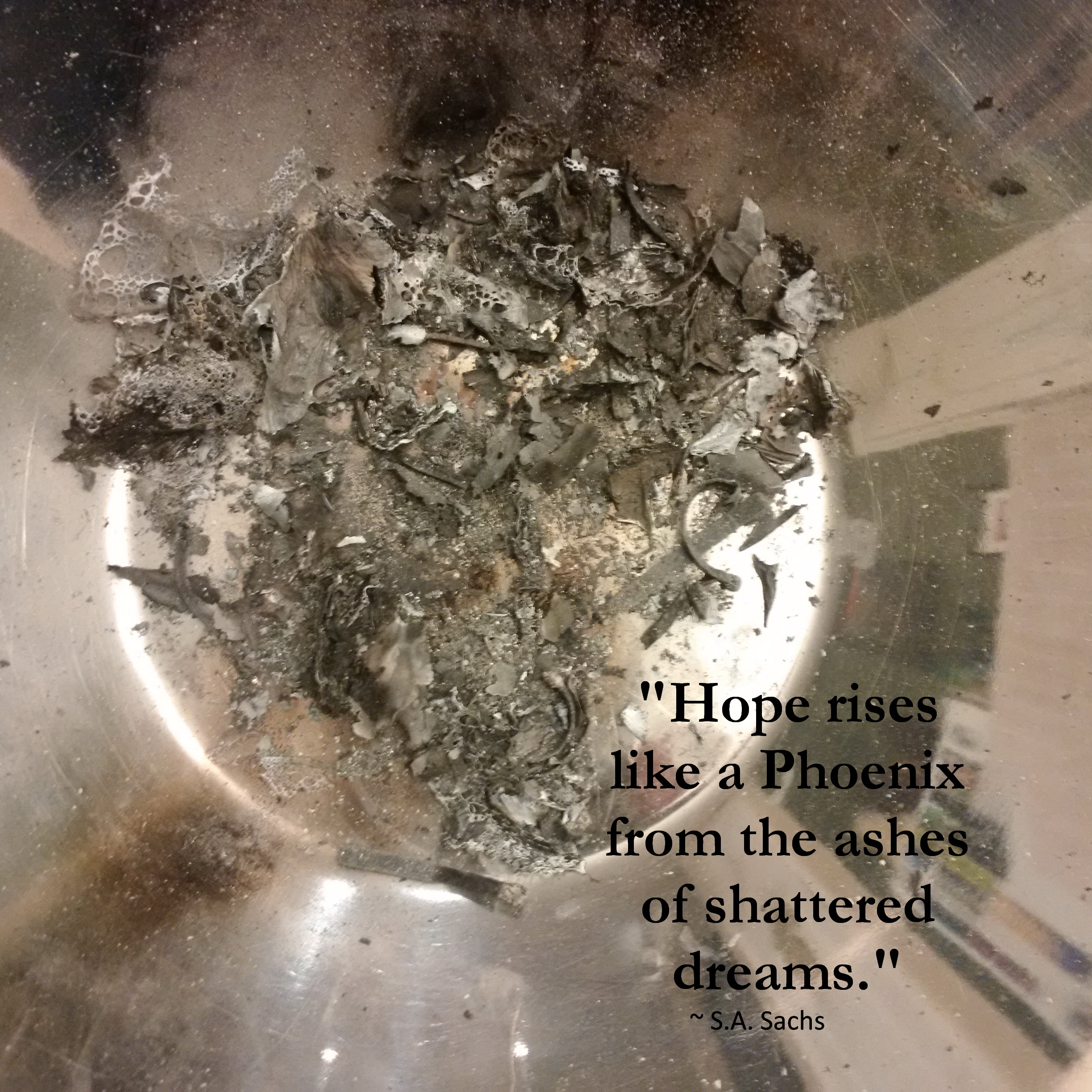
Reflecting on the release of pain, I struggle to find a way to end this blog. It is tempting to return to social commentary. However, that is not the purpose of this confession. The purpose is to step from the shadows—knowing that my story continues as does my healing journey. Chapters close. Characters come and go. The plot constantly changes. I am no longer a victim. I am the protagonist of my story.
Read More