Posted on Nov 16, 2016
“Madame Michel has the elegance of the hedgehog: on the outside she is covered in quills, a real fortress, but my gut feeling is that on the inside, she has the same simple refinement as the hedgehog: a deceptively indolent little creature, fiercely solitary–and terrible elegant. ”
― Muriel Barbery, The Elegance of the Hedgehog
An interesting theme has doggedly pursued me for the past couple weeks. It started with the book club selection, The Elegance of the Hedgehog, by Muriel Barbery (2008). It is not the easiest book to read; but once you get half way through, it becomes very engaging and thought provoking. The theme of the book is being seen and loved/accepted for who we are—yet we go to great lengths to hide our true selves from others—for fear of rejection, judgment, being misunderstood, being unseen, being lost, being wounded.
For me, this theme of being seen by others for who we truly are has also surfaced in sessions, friendships, and social media. The Universe is not letting this one go for me! Evidently I have a significant lesson to learn. I am fascinated that we do not see ourselves as others see us—the good, the bad, the ugly. Yet even our best efforts at hiding cannot dim our light for those who see us sparkle. They can see through the subterfuge—are not put off by it—but simply, gently pursue what they see—maybe even light their own candle by the inner flame of those they encounter.
I have had to squirm my way through this concept of self-acceptance and sense of value these past couple weeks. Not only to be present for my clients also squirming through this one in sessions, but for my personal growth and development: to know that others hold the shiny with dull with complete acceptance and maybe even understanding. I am continuously amazed by the strength and beauty in my clients—a light they cannot always see or are comfortable with. So it is somewhat ironic that others see my inner light even when I don’t. And yes, it makes me uncomfortable to be seen. I am just as afraid as my clients.
There is something about feeling exposed, vulnerable, and unworthy in being seen. We learned at a very early age that love can’t be trusted. That being our true selves leads to pain and suffering. That it is much safer to hide and put on a persona of self-protection. That our dull aspects have no value, are beyond polishing. And yet, there remain those incredibly special souls who see through all of that and wish to draw us out of our protective shells. It is terrifying. Another ironic twist is how I must terrify my clients when I attempt to bring forth their inner light. The word exposure comes to mind as well as safety, trust, and patience.
The absurd conundrum is: we obsess about what “everyone” thinks of us when “everyone” doesn’t even care. And if they do, it is to make judgments; but they are surface judgments without seeing or appreciating our deepest selves. We worry about what impression we are making, when that is not what we are meant to do with our time and energy—or even money. Our true light will shine regardless of what impression or mirage we try to construct. And for those to whom mirages matter—we must ask ourselves, why are we trying to impress them? What benefit is it to us what someone else thinks? How does that help us live more fully?
We get dreadfully distracted from our life purpose when we try to hide behind an impression or mirage. We have no one to impress. We have only to shine. Our true selves will be honoured by those who can see the light. And those who are blinded by smoke and mirrors don’t value what they see anyways.
When we get comfortable in our skin, value our unique contribution to life on this planet, we can confidently go where we’ve never gone before. If others bask in our light, let them. If others prefer to dull our sparkle, get out the chamois to restore the brilliance. Our task is twofold: to continue to shine despite the naysayers—the “everyone” we are trying to impress yet who don’t care; and to soak up the warmth from the flames of fellow, brightly-lit souls. If we add a third task, it would be to contribute to the radiance of others—especially when they don’t see it themselves.
Shine on Beautiful Soul reading this, shine on! Blind others with your brightness.
“It would be so much better if we could share our insecurity, if we could all venture inside ourselves and realize that green beans and vitamin C, however much they nurture us, cannot save lives, or sustain our souls.”
― Muriel Barbery, The Elegance of the Hedgehog
Read More
Posted on Oct 15, 2016
“Love is not the least bit illogical or random, but actually an ordered and wise recipe for survival. The need for connection is our first and most primary instinct.”
~ Dr. Sue Johnson, author of Love Sense (2013) and Hold Me Tight (2008)
While the theory of “survival of the fittest” is lauded in our Western culture and used to promote or justify many terrible behaviours, it is not very accurate and rather misunderstood. Even Darwin himself realized the importance of collaboration and adaptability to change as necessary for survival.
“In the long history of humankind (and animal kind, too) those who learned to collaborate and improvise most effectively have prevailed.”
~ Charles Darwin, English naturalist and geologist, author of Origin of Species (1859)
“It is not the strongest of the species that survive, nor the most intelligent, but the one most responsive to change.”
Working together to adapt to constant change. Not something we excel at as a culture. Yet there is evidence of this all around us in the natural world: species collaborating to survive and even thrive. Paradoxically, the one constant in all the change: relationships and our need for them. So how do we make them work?
“Science says: It is not familiarity or time that kills desire and passion, it is lack of emotional safety and attuned connection.”
~ Dr. Sue Johnson, author of Love Sense (2013) and Hold Me Tight (2008)
Emotional safety and attuned connection. The two aspects needed in order to thrive. Two things we are not taught from infancy—yet which we intuitively know at birth. That’s how we manage those first months of life outside the womb. When emotional safety and attuned connection are compromised, we suffer—as infants, children, adolescents, and adults. We never lose the need for connection and safety.
While developing emotional safety and attuned connection can be a complicated, misunderstood, and unappreciated process, there are two critical avenues we can pursue at any age or stage in life. They are daily affection and check-in conversations.
Daily affection (touch) is a necessity for infants to physically survive. Our lives as adults may no longer be at risk without touch, but life is certainly compromised in all aspects of our health from lowered immune systems to increased risk for depression and anxiety. Touch—especially skin-to-skin contact—produces oxytocin: the bonding hormone. When we touch, we connect and bond on a chemical level. Hence the importance of daily affection such as morning and bedtime hugs and kisses, greetings upon parting and reuniting.
Daily check-in conversations. While it may sound simple, and many people think “we do this already;” it is not a natural way we converse and requires practice as well as patience. When we check in with each other, we are going beyond the banal, perfunctory, and possibly distracted, “How was your day?” to a genuine interest made obvious. It is a structured conversation giving each person time to speak—literally taking turns. Partner 1 has 10-15 minutes (or whatever works for you) to tell about his or her day (what happened, what they did, how they felt about it). Partner 2 repeats back what is said without interpreting, problem solving, or fixing. Just listening and validating. Partner 2 can say something like, “I heard you say….” Followed by “I imagine you feel…” or “I get that would be [name of emotion] for you.” Then Partner 2 has equal time to describe their day and how they feel about it—with Partner 1 repeating back what was said and validating associated emotions. If a partner struggles to identify their emotions, ask questions about what they feel in their body and prompting with “That would make me feel….How about you?” or the “I imagine you feel…” may be enough to prompt emotional reflection.
Generally, when we are ‘listening’ to our conversation partner, we are developing a response in our head long before the partner is finished speaking. We have a rebuttal ready the moment our partner pauses. This contributes to arguments escalating to full-blown fighting that creates distance. We have lost connection and emotional safety—a threat to survival. Reflective Listening (repeating back what is said and validating emotion) is a useful tool for arguments as well as daily check-in conversations. Another communication tool, Expression of Needs (aka Complain without Blame), is also useful to keep in mind if the conversation veers of course (separate handout).
Daily check-in conversations are to be reserved just for that: checking in. They are not the time or place to resolve arguments or problem solve. Those are separate, and equally important, conversations which may go better having an overall understanding of your partner’s interior world/inner life achieved by daily check-in conversations. As well, having established emotional safety and attuned connection, arguments/disagreements will be less threatening knowing each other is secure in the relationship.
These principles can be applied to any relationship and context (with modification for dynamics such as parent-child, friends, school, or workplace). We all need touch and attunement. Armed with this information, we can fulfill our common need for affection and focused attention in respectful ways.
May your day be filled with emotional safety and attuned connection.
Love is a constant process of tuning in, connecting, missing and misreading cues, disconnecting, repairing, and finding deeper connection. It is a dance of meeting and parting and finding each other again. Minute to minute and day to day.
~ Dr. Sue Johnson, author of Love Sense (2013) and Hold Me Tight (2008)
Read More
Posted on Sep 24, 2016
“Those who contemplate the beauty of the earth find reserves of strength that will endure as long as life lasts. There is something infinitely healing in the repeated refrains of nature — the assurance that dawn comes after night, and spring after winter.” – Rachel Carson
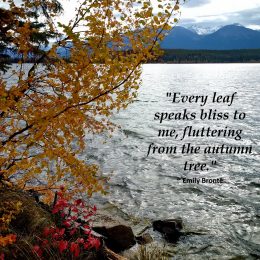
As I write this, I am enjoying a few days away spent in the Rocky Mountains of Jasper National Park. It is absolutely delightful to be among nature, in an unhurried pace. Nothing to accomplish but refreshing the soul. I am also reminded how much I love autumn. At least the first part: once the leaves fall, the trees are bare, and the world is grey until the snow comes to stay, I find the season a bit wearying. On the plus side, it is always rejuvenating being in nature, regardless of its mood—unless there’s a blizzard.
“To be interested in the changing seasons is a happier state of mind than to be hopelessly in love with spring.” – George Santayana
Maybe it’s not so much being in nature as connecting with it. One can more readily connect with a blizzard if one is cozy inside their home or cabin. Even the darker moods of nature have lessons to teach us about our vulnerability and need for each other. We are such finite specks in the grand scheme of things. Sometimes I think technology dulls our senses to our vulnerability and need for connection.
At any rate, I agree with John Burroughs: “I go to nature to be soothed and healed, and to have my senses put in order.” Not only does being in nature regain perspective, it does soothe my soul. It is like there is a reset button that gets pressed when I take a stroll through a forest. Anthony Douglas Williams words it well when he says, “Take a quiet walk with Mother Nature. It will nurture your mind, body, and soul.”
Going for a nature walk gives your mind something else to ponder besides the daily grind. Quiet reflection has a mind-altering ability—no drugs required. Your body moves in unaccustomed ways as it maneuvers the uneven terrain. It may even get your heart pounding and your lungs heaving—life-giving oxygen pulsing to the outermost regions of your body. What the soul experiences is for you to feel as well as contemplate. This is more than a mental or physical exercise—emotion accompanies any outdoor pursuit.
I feel very fortunate that I live in relative close proximity to dramatic vistas and geographic wonders. However, specific surroundings are not required to appreciate nature. Wherever you find yourself, nature is willing to speak to you; or as George Santayana poetically puts it: The earth has music for those who listen.
I realize this blog has borrowed words from several others. Maybe it’s because I find I am at a loss for words to express the eloquence of Mother Nature herself. I do know that my soul is soothed, my mind quieted, by body restored by being where I am.
May you experience the healing power of Nature even if it means stepping out your front door and taking a deep breath of autumn air.
“The muffled syllables that Nature speaks
Fill us with deeper longing for her word;
She hides a meaning that the spirit seeks,
She makes a sweeter music than is heard.”
― George Santayana
Read More