Posted on Feb 15, 2012
This year has begun with challenges from a variety of sources creating an inner (and outer) sense of chaos for me. I’ve recently realized this has been complicated by an interruption in routine for me—those daily events we count on to give a sense of normalcy in our lives.
It is these very routines that can get us through crises of varying intensities—from the death of a loved one to minor irritations at work. When we follow through with what we know, what we can count on, it provides us with a retreat of sorts from those situations that are exhausting our resources at coping. We can be replenished in a way by doing those mundane tasks that have to get done regardless of what else is happening in our lives. We must get up in the morning, brush our teeth, get dressed, walk pets, prepare meals, consume food and beverages, perform required tasks at work or home, commute, chauffeur family members around, and the list goes on.
We get into a daily, weekly, monthly, yearly rhythm that gives shape and meaning to our lives. We know what is expected of us, what must be done at any given moment in the day. When this rhythm is interrupted, it can throw off our sense of equilibrium (that all is right with the world). Toss in an unexpected crisis or two, and the threat to our equilibrium, our sense of balance, is intensified. If the crisis itself affects our routine, the crisis may seem insurmountable. The coping skills we normally rely on may be insufficient to the task. Sleep may elude us. Nourishment depleted due to a diminished appetite. Hobbies and activities may not hold our attention long enough to distract us, even briefly. Our concentration may be broken. Even basic tasks can seem overwhelming. In the midst of this chaos, how do we manage?
The old adage, to keep putting one foot in front of the other, may be of use. Help might be found in tightening our focus to those tasks, those routines that are not interrupted. There are always things that have to be done. Such as getting out of bed, performing morning ablutions, getting dressed, literally putting one foot in front of the other, consuming food and beverages. If an injury has interrupted even these basic tasks, adjustments have to be made to get back into routine—reclaim a sense of normalcy. If the absence of a family member due to death or departure has impacted these routines, refocusing efforts and re-establishing basic routines will help to regain one’s sense of balance—albeit shaky at first.
And it could be worth our while to spend some time considering what all surfaces for us while in that state of chaos—of disequilibrium. Are there internalized messages that need review? Do we need to pay attention to some long submerged emotion or belief? Does our range of coping strategies need a tune up—finding healthier ones to replace harmful ones? Would it be better to engage rather than withdraw? Or spend time alone rather than be distracted by caring for others?
Of course, there are always risks to trying out new thoughts and behaviours. Some of our attempts may be met with disappointment, disapproval, or discomfort. It may take a few tries before we make the adjustment with the most benefits. But isn’t that what life is about? The Chinese symbol for crisis, after all, encompasses both danger and opportunity.
What routines do you rely on to get through tough times? What risks are you willing to take to move forward through chaos? You never know what lies just around the next corner.
Read More
Posted on Dec 15, 2010
Winter dies into the spring, to be born again in the autumn.
~ Marche Blumenberg
Ah, winter. I am one of the few who actually enjoys this time of year—given a period of adjustment, of course. I do not impatiently await the arrival of snow. In fact, I am quite put out if it arrives too early—such as in October.
October is the time of fallen leaves and transition from the vibrancy of autumn colours to the starkness of naked trees. Given this time of nakedness, the snow is a welcome covering for the dreary greyness. The world is once again a beautiful place awash in sparkling white. And when the wind howls and the temperature drops, there is no cozier place than home.
Without the vicissitudes of winter, spring cannot come in all its glory. Nor would there be a season for comfy sweaters, hot chocolate, snowmen, sleigh rides, brilliant starry skies, and all manner of winter fun.
There is a rhythm to the seasons that generates a sense of wonder throughout the year—and conversation topic. I hear in other parts of the world, weather is not a conversation starter as it is here in Canada. And from the weather, there flows a plethora of personal stories—of surviving the elements, adventures, activities, and connections with friends and family.
We grow accustomed to transitioning through the seasons and making the most of each one. Our lives develop a flow and rhythm that corresponds with nature and its seasons. Sometimes we lose touch with this connection to nature. We take things for granted (such as a warm house) or become disenchanted by the inconveniences and interruptions of leaky roofs; snow removal; the unwieldy concoction of snow, sand, and salt; snow storms; icy roads; and all the ways humanity and nature collide.
We dance with nature through the seasons negotiating the steps with smoothness, agility, and appreciation coupled with having our toes stepped on or tripping up when we miss a beat. Nature’s rhythm, after all, doesn’t fit with everyone’s groove.
Much of life itself is negotiating transitions. Job changes. Address changes. Partner changes. Status changes. Family changes. Season changes. Some anticipated; others unexpected. We are constantly maneuvering through these changes and the seasons of life. All in time to a rhythm as natural as our heartbeat.
As we transition into the holiday season in the midst of winter, how will you connect with nature and the rhythms of your life? Pause on an evening walk, bundled against the cold, look up and enjoy the night sky? Join friends on a sleigh ride over sparkling fields of snow? Catch your breath while the wind kisses your tingling face as you ski or toboggan in a winter wonderland? Curl up next to a roaring fire with a cup of hot chocolate in one hand and a good book in the other? Bake up a storm for family and friends to enjoy? Admire the colourful, twinkling lights beaming out into the dark night?
Whatever you do during this month of festivities, may you be surrounded by the warmth of friends and family. Cozy in the knowledge that, wherever you are in the seasons of your life, you are part of the Great Cosmos—a participant in the rhythmic Dance of Life.
Never are voices so beautiful as on a winter’s evening, when dusk almost hides the body, and they seem to issue from nothingness with a note of intimacy seldom heard by day.
~Virginia Woolf
Read More
Posted on Apr 16, 2010
In my readings recently, I have come across a theme that relates to the journey metaphor for life. It is particularly fitting for those moments of “stuckness” when we cannot seem to make any headway—like walking on a treadmill.
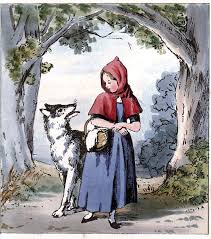
My own treadmill moment intersected with reading about the evolution of a fairy tale: Little Red Riding Hood.1 She is quite the little girl, or young maiden depending on which tale you read. She has travelled across centuries and cultures retaining or shedding some features, adapting others as she has traversed the globe.
Or more fittingly, she has been adapted to suit the cultural morés of the time and place in which she finds herself: an innocent girl to promote obedience and dependency in the Victorian Era; a young maiden to promote chastity (and shape the financial arrangements of marriage negotiations) in the French aristocracy of the 17th century; or a voluptuous stripper redefining courtship in the film genre of the 1930s and 40s.
She continues her metamorphosis as the movie industry requires her services to communicate emerging trends in popular culture and equality of the sexes. A fate shared by her nemesis, the wolf, who has also morphed through the centuries and cultures.
But what of her origins? Turns out, she was quite the resourceful young lady: a female counterpart to the ancient, male-dominated, hero’s quest.
Throughout time, heroic tales follow a consistent plot. The hero is born, full of hidden promise, and must undertake a journey to prove himself. He must face the “dark side” whether that be physical danger and/or one’s inner demons of doubts and weaknesses. He must face his moment of truth, the ultimate test.
In one of the earliest versions of the fairy tale in question, “A Grandmother’s Tale,” a little girl must rise to the occasion and outwit her adversary, the wolf (sometimes an ogress). She must take all that she has absorbed from the wise women who have gone before her and apply it to this dangerous situation: her moment of truth, her ultimate test for survival. She is not admonished to avoid it or wait for rescue but rather faces it and comes away stronger with new found independence.
Moments of truth. Ultimate tests. Can the obstacle be met and overcome? Does the hero have what it takes to rise to the occasion? Generally speaking, in all the hero quests of mythical proportions (either ancient or modern), the hero is victorious. What of the stories of everyday life? What about the hero of your own story? What happens when we fail to rise to the occasion?
Whether we refuse to take the test (fail to try) for whatever reason (fear of failure, fear of change, self-doubt, insufficient moxie) or whether our attempts meet with failure (fail to pass the test) due to unforeseen circumstances, timing, lack of preparation, or other factors the result is the same: We become stuck. Caught on our treadmill.
Are you stuck on your journey? What seemingly insurmountable hurdles are you facing? What’s holding you back? What lessons must yet be learned on your own hero’s quest?
1Catherine Ornstein (2002), Little Red Riding Hood Uncloaked, Basic Books, Perseus Book Group.
Read More