Posted on Apr 15, 2015
With the spring equinox just past, I read a timely article in the Spirituality & Health magazine (March/April 2015 issue) entitled “The Joy of Spring” by Jane Ganahl. So I am going to piggy back on a few of her ideas for this blog.
She opens her article by talking about fertility celebrations and the science behind the equinox. However, she really grabbed my attention by describing the spring equinox as “a powerful time of regrowth and rebirth” (p. 54) with examples of ancient rituals such as Stonehenge. And it is no coincidence that Easter falls within this time frame (first Sunday after the first full moon after the equinox) or that traditions are reinterpreted from pagan rituals like the Easter egg. Originally egg rituals were “ways of inviting fertility and renewal.” (p. 54)
As a therapist, I am always interested in themes of regrowth, rebirth, and renewal—for that is what my job is really all about: change, growth. And when we can combine the natural environment with our inner worlds, the symbolism can enrich our lives. Formerly empty rituals—even religious ones—can be imbued with ‘new’ or fuller meaning.
For me, I try to see these dreary spring days as expectant with regrowth, rebirth, and renewal. The gray trees symbolize hope of green to come. Tight little buds will unfurl to show forth verdant abundance. The brown earth will release new growth that adds colour to life.
The same can be said for human beings. We may feel drab within our brown and gray environments, but hope is stirring deep within all of us. Here are a few suggestions from Jane to “Put Spring in Your Steps.” (p. 55)
1. Visualize yourself in full bloom: Notice what parts of yourself you’d like to see changed or born. Write one list of things to release and another list of things you’d like to have more of in your life.
2. Connect to natural light: In winter we are deprived of the sun’s healing energies and spend more time with bright screens that disrupt our natural rhythms. With the equinox, we turn the tide on the darkness. On at least one day, witness both sunrise and sunset.
3. Reconnect to the earth: Put your bare feet, hands, and even body on the ground. Breathe in the newness in nature. Plant something.
4. Reboot relationships—or let them go: There are always a few of these in our lives. Examine the source of the discord, and open your heart with compassion. Decide whether the relationship can be saved.
5. Create your altar or shrine to spring: Use elements from nature that inspire you, and colours that resonate with you. Use this space to meditate.
6. Arouse your sensual self: Cuddle, learn tantra, slather your lover and/or yourself in oil.
7. Create your own equinox ritual: Whether it’s dancing, painting, hiking—anything that gives you a feeling of connection and rebirth. And get moving. Winter is over, and it’s time to come alive.
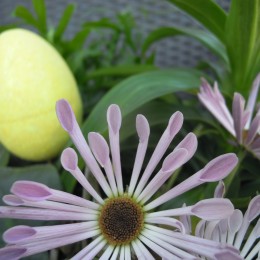
As I type this, I am looking at an indoor plant collection purchased at Costco with symbols such as the Easter Lily and a sparkly, bright yellow (Easter) egg in the centre. A veritable treat for the senses as the lilies exuded a very sensual scent while they were in full bloom, the other flowers are a sight for sore eyes in shades of bright yellow and purple, the dirt feels good to the touch when checking for moistness. Spring flavours were savoured in sweet Easter treats, long since devoured. And I’m listening to a music mix called “In the Summertime” which is sure to pick up my mood on a gray day. Not to mention the cheerful sounds of the birds returning from their time in the south.
May this time of renewal find your verdant Self emerging, ready to show forth the unique beauty and splendour that is you. Release that tight hold on the bud and let your Self unfurl.
Read More
Posted on Mar 15, 2015
Since last month’s blog entry, I have been give opportunities to think about my own positive self-talk—or lack thereof. And specifically what gets in the way. From what I can gather, it all comes down to the concept of shame—which the dictionary defines as “a painful senses of having done something wrong, improper, or immodest.” Synonyms are disgrace and dishonor.
This describes healthy shame when we are actually guilty of wrong doing. But what of the deeper underlying sense of shame-the unhealthy kind—that writes us off as a person? This shame is not limited to a single “bad” or misguided behaviour. This shame is a painful sense of being something wrong, improper, or immodest—of being a disgrace not just behaving dishonourably or disgracefully.
We develop such a sense of shame early on—usually in childhood or adolescence—by the shaming action of another person. The child or youth comes to the conclusion: “There must be something wrong with me; I must be a bad person for this to happen to me.” I had such experiences and conclusions as a child and adolescent—even into young adulthood.
It can carry on indefinitely depending on one’s life circumstances. Shaming is perpetuated by parents toward adult children, spouses, siblings, peers, co-workers, supervisors, managers, teachers, professors, therapists, doctors, church leaders, in fact leaders of any kind. Relationships with a power differential of some sort are especially vulnerable to the practice of shaming.
So early on in my development I internalized that I must be a “bad person”: the only explanation my child-brain could come up with for life’s circumstances. And which was ingrained over the years by shaming messages from a variety of sources. So ingrained that I became expert at shaming myself. No other voice necessary but my own at times.
This healing journey I’ve been on has led me to examine the statement: “I am a good person.” At first, it didn’t fit right at all; but the more I tried it on, the better it felt each time. I was (am) changing the neuronal pathways of my brain. It still needs more wear to become a cozy fit, but I am slowly internalizing that I am good person. And I’m learning the most effective antidote for shaming is a healthy sense of self. Slowly the shaming voices in my head are being silenced.
For I am a good person—even though far from perfect—just like you.
Read More
Posted on Feb 12, 2015
I recently finished reading the book Women Food and God by Geneen Roth (2010). A wonderful book in length and personable writing style. Easy to read and grasp. I like those kinds of books. Books that make me feel welcomed—even when the author is trying to drive home a point that is less than welcome. In this case, points about eating and my struggle with weight.
I’ll admit I have been a comfort eater most of my life. My weight has so frequently gone up and down that my body has the typical marks to show for it. It’s hard not to be judgmental towards oneself—especially with the media messages that women must be a certain size and shape to be attractive and lovable. No woman is immune to that. Even supermodels. Go figure.
And it’s not like I haven’t looked this particular monster in the face before—and won and lost to varying degrees. But Geneen got me thinking. She asked a question that I have switched from the plural ‘they’ to the first person: “If I gained ten pounds, if my arms didn’t look the way I wanted them to look, was I still myself?” (p. 68).
The next page goes on to say: “My body and I are one. There is nothing good about my body and therefore there is nothing good about me.” (p. 69, author’s italics)
These words got me thinking; and I had something of a breakthrough. I have come to realize that I am still me regardless of my size and shape. From my journal entry: “I am still an effective therapist. I am still kind, caring, compassionate, loving, smart, witty, brilliant…with an infectious sense of humour. My core values remain the same regardless of how much extra fat I carry around. And I’ve learned how to dress to hide it—look my best regardless of size.”
Now I don’t normally a) make confessions of this nature in my blog; b) quote myself from my own journal; and c) talk myself up like I did in this journal entry—just in case any of you think I might have a swelled head. 🙂 There, too, shows my disinclination toward positive self-talk. What if I come across as prideful? Or even worse: arrogant!? That just opened a whole other can of worms and content for another blog entry…
But it is challenging to affirm oneself without food if one cannot actually give themselves positive feedback. If I do not know myself for who I truly am, how can I live out loud, so-to-speak? If all I acknowledge are the worst bits about me, the pain, and the suffering, no wonder I am drawn to food to fill the void of where the good bits about me should be and to numb the negative feedback, the pain, and the suffering.
When I am eating, the happy brain chemicals, like dopamine, do their thing; and for that moment, I have a break from the worst bits, the pain, and the suffering. Only to come crashing back to reality. And reinforce the need to eat more to give myself another or a longer break.
Hence the breakthrough. I don’t need food or a better body to live authentically, fully. I can be fully me regardless of cravings, binges, dopamine rushes, and all the rest. I don’t need a different body to be kind and caring—and essentially myself. I do need to start taking care of myself in healthy ways. To be authentic means I must pay attention to the reasons I eat, and give myself the option not to eat, as well as be open to the good bits as well as the less-desirable bits.
All of that to say I am learning to let food be food, weight be weight, and me be me.
Read More
Posted on Mar 15, 2014
May the blessing of the rain be on you—
the soft sweet rain.
May it fall upon your spirit
so that all the little flowers may spring up,
and shed their sweetness on the air.
May the blessing of the great rains be on you,
may they beat upon your spirit
and wash it fair and clean,
and leave there many a shining pool
where the blue of heaven shines,
and sometimes a star.
~Irish Blessing
With St. Patrick’s Day around the corner, the blessings of the Irish come to mind for this month’s blog. While it feels more apt to snow than rain with this fickle weather, the sentiment is fitting for this time of year—for our spirits to be rejuvenated, spreading joy to others. The spring rains will come and with it new growth shedding sweetness on the air, highlighted by blue skies and reflective puddles. All the better in our spirits as well as upon the earth.
Having had surgery earlier this month—after a week of recovery, slowly returning to regular rhythm and routine—it feels like I’ve rounded a corner, turned a page, begun a new chapter. How fitting that it coincides with the turning of the seasons.
With the blank page before me, I wonder what will be written as the chapter moves ahead. It’s off to a good start, at any rate, with physical as well as spiritual healing. This time of rest has prompted rethinking who I am and what I want out of life as well as what I contribute to Life as a whole.
I have affirmed that much of my life will continue to focus on helping women be the best they can be: to overcome internalized messages, limitations of socialization, toxic relationships; to broaden their view of themselves and how they live in the world.
It’s certainly been a life changing, healing journey for me. I’m yearning to peek around the next corner to see what’s ahead; but I haven’t mastered ‘living in the moment’ yet. For now, I will anticipate spring’s gentle rains to enliven my spirit once again, to encourage new growth that sweetens the air—and the people—around me. Maybe those tears of grief I wrote about awhile back truly are enriching the soil of my soul. I look forward to nurturing what sprouts!
May there always be work for your hands to do.
May your purse always hold a coin or two.
May the sun always shine on your windowpane.
May a rainbow be certain to follow each rain.
May the hand of a friend always be near you.
May God fill your heart with gladness to cheer you.
~Irish Blessing
Happy St. Patrick’s Day!
Read More
Posted on Jun 16, 2013
Another Father’s Day has come and gone. Hoping to post something a bit earlier, but it didn’t happen. I was pondering about how special days of the year like Father’s (or Mother’s) Day can be times of true gratitude or significant pain. Maybe even both for some.
These occasions put social pressure upon people to express what they do not feel, trigger grief over lost loved ones, or provide painful reminders of betrayals and difficult childhoods. For those fortunate to have positive childhood memories and healthy relationships with fathers and male mentors, it is a happy time to honour these important people. It can get complicated when there are memories of good times and bad, positive role models and negative ones. Some people we want to forget, others we want to honour and remember.
So how do we get through these days when more is expected of us than we think we can give? Or when what is expected is contrary to what we feel and believe? It is hard to express gratitude to someone who triggers painful memories. Even harder if the relationship continues to be tense or unhealthy. Sometimes we can resolve the baggage. Sometimes that is unthinkable or undesirable. It can seem better to fake it than drudge up past hurts or rock the boat. It is only one day, after all.
Other times it seems impossible if we strive to be people of integrity. How can we sleep at night knowing we gave a false representation of ourselves? Said what we did not mean. Expressed gratitude or honour we did not feel.
Times like these, we need to be honest with ourselves and acknowledge the reasons we choose to ‘make nice.’ We are not doing it because it is genuine—not even due to social pressure or obligation. We do it because it is easier. It is easier to keep the peace than to confront ugly baggage. For at least one day, we can suck it up and pretend everything is okay. We can make the socially acceptable gestures to avoid a fight, retaliation, recrimination, critical comments, emotional blackmail, drama, whining, the list goes on. Or we do it to receive validation and praise. To believe our opinion matters. We do this for ourselves—and maybe the ‘greater good’ of family dynamics—but we do not do it for the ‘person of the day.’
And if you have a guilty conscience, may I be the one to grant you permission to do this—as long as you are aware of what you are doing and why. If you are apart from the significant person (either through death or distance—emotional or geographical), it may be helpful to write a letter saying all the things you cannot in person. This is not a letter the person will receive. It is a letter for you to finally freely express yourself without concern for the fallout. It may also be a letter of good-bye or remembrance if the relationship has been severed by death or distance.
It is also okay to give yourself permission to be “socially acceptable” for yourself—just because it is permissible to do things for ourselves, especially if we have a tendency to give with great personal sacrifice. Consider this a win-win situation. The person of the day receives attention at the same time that you choose the easier route for your own sanity or emotional health. Of course, this comes with a caveat. Do this too frequently, and we live in a constant state of toxic relationship. It requires thoughtful consideration of what we choose to do—and then work with the consequences.
May these special occasions enhance your life, clarify relationships, and assist you to live more fully.
Read More
Posted on Sep 25, 2012
Life is good, but bad things happen. Bad things happen, but life is good. Been turning that phrase around in my head for a few days now.
Usually, I think in terms of ‘Bad things happen, but life goes on.’ Life is hard. Life is painful. A defeatist attitude, really, when I think about it. However, the phrase ‘bad things happen, but life is good’ smells strongly of that oft spoken cliché: Count your blessings. Difficult to do when faced with tough decisions, loss, or any number of life altering scenarios. Counting one’s blessings, while it does have its place in life—namely an attitude of gratitude, can have an invalidating or minimizing effect upon suffering. Life is hard. Life is painful. But life is also good.
However, my thoughts have strayed from the basic ‘count my blessings’ approach albeit that may have been the starting line. By looking at the broader picture, I have come to realize that Life, in itself, is good—regardless of circumstances—or even blessings. Life—the lungs breathing in and out, the heart pumping blood through arteries and veins—is nothing short of miraculous. Without those two actions, there is no Life. Without conception, gestation, and a successful birth, there is no Life. All processes beyond our control—notwithstanding our efforts to influence them.
While some days it may not feel like it, the ability to interact, make decisions, leave our mark on this world, renders life good. It is rather amazing that we get to breathe in and out as well as participate in Life as much as we choose to do so—and how we choose to do so.
Which brings me back to me back to my original statement. Life is good, but bad things happen. Life is hard. Life is painful. But Life, itself, is good.
So how will you celebrate the goodness of Life today, in amongst the pain and sufferings of daily life?
Read More