Posted on Jan 23, 2020
Welcome to a new year and a new decade! As I noted in last month’s blog, this is an ideal time to take stock of one’s patterns and set about changing things up. And in true (ironic) fashion, I was presented with an opportunity to do so for myself.
One of my patterns involves communication hiccups.
Relationships of any kind are tricky. People need varying degrees of space
and/or closeness. Some like frequent contact, others are “lower maintenance”
shall we say. Introverts tend to prefer less direct forms of communication like
texts and emails. Extroverts lean towards in-person and phone/video chats. Add
to that, there is the full spectrum of social media options; providing plenty
of opportunities for connection as well as miscommunication and
misunderstanding.
When I am pushed away (aka given a boundary), my default
processor wonders what I did wrong or what is wrong with me. In a recent
situation, I was able to stop the negative self-examination and instead
consider where the other person might be coming from such as self-preservation.
We tend to push/pull away, or more clearly set boundaries,
as a form of self-protection for both healthy and unhealthy reasons. When I
took a step back, I could differentiate between pulling back and pushing away.
Pulling back might indicate a change in interests whereas pushing someone away
(if not due to a definite dislike) could be rooted in a fear of getting hurt. We
may be scared to invest, be vulnerable, or fully show up because we fear
rejection. In that case, the shift has nothing to do with me and everything to
do with the other person.
Once again, I had to remind myself that how a person acts or
what they say is first and foremost about them—not me. When I shifted my focus
off myself, I could see hurt from the past offering protection from future
pain. I could also zoom out, so-to-speak, and look at the larger context in
which the communication hiccup occurred—personalities, life stressors, personal
histories, and the entire relationship—not just the perceived slight against
me.
This shift in focus completely changed how I understood the situation and hence my reaction. It allowed me to choose to respond seeing their hurt instead of assuming the worst of myself. This also meant I could acknowledge and operate from my strengths. While being pushed away never feels good, I am grateful for the opportunity and ability to appreciate the bigger picture. It allowed me to break the pattern of self-aberration to see the good in both myself and the other person.
Breaking the pattern gave me choices. And I chose to honour
the delicate balance of respecting a boundary without pulling away or striking
back. I did not need to retaliate for my own self-preservation. After all, this
wasn’t about me. Honouring who I am gave me the option to keep showing up as
opportunities (with respect to boundaries) allowed.
Most of all, I continue to be amazed at the rewarding
difference made by simply stopping default behaviours—such as negative
self-examination. That never helps anyone. It is one thing to own our flaws (along
with our strengths) and quite another to assume blame and shame. May you
experience a delightful discovery in your own efforts to break patterns and
give yourself choices.
Read More
Posted on Sep 17, 2019
The recent-past Provincial Election and notification of an upcoming Federal Election has got me thinking about betrayal. In my line of work, betrayal is a common concern—usually in the context of intimate relationships—but sometimes other types of relationships as well. It’s difficult to unpack political betrayal because it is less tangible, less personal. And yet it feels very personal because it relates to our core beliefs and values.
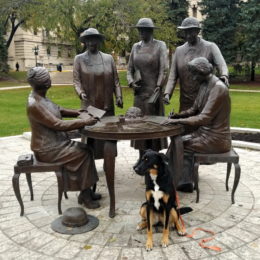
I confess that I am struggling with guilt at not voting in the Provincial Election. It feels like a betrayal of the Famous Five ( Emily Murphy, Henrietta Muir Edwards, Nellie McClung, Louise Crummy McKinney, Irene Parlby) who fought so hard for women to be counted as persons and hence have the right to vote. There is even a striking statue on the grounds of the Provincial Legislative Buildings in Winnipeg.
I also believe that my vote should count and matter—and voting for the sake of voting does not support that belief. There really was not a candidate I wanted to vote for. It wasn’t laziness or apathy. It was a conscious decision NOT to vote for a person or platform that I didn’t trust, or believe in, or perceive he/she represented my vote. I want my vote to count for the things that matter to me. And in the last federal election, my vote for what mattered to me was betrayed. Trust in the fabric of democracy itself was shattered let alone the elected representative who made empty promises.
I will not vote for someone—anyone—just because it is the “right” thing to do, because women’s right to vote is hard won. So is my right to consciously, yet quietly, boycott the political circus. My sense of betrayal is so deep, I have become jaded and cynical about politics, parliament, and our version of “democracy.” Evidently, my values are not in keeping with the majority. And as we all know, majority rules.
Well, sometimes fairness and justice means the underdog should have his or her voice heard too. As I do not trust a political party or politician to adequately represent me, why would I vote for one? Our current political system is archaic and deeply flawed. Parliamentary practices are based upon antiquated tradition (like yelling to drown out the words spoken by the opposition) and not common sense, common courtesy, collaboration, and basic human dignity. It is based upon power plays. How is that democracy?
In a democratic society (and
with the marvels of modern technology), I would like to vote on the individual
issues. I would like my vote to count and my voice to be heard. That’s after
all what the Famous Five fought so hard for—to be heard—and to have the basis
in place to be heard. I don’t feel my voice is being heard with my vote in the current
political climate. In that sense, my individual vote does not count or matter.
It only elects an official.
I am not trying to demand an
audience for extremist views. I simply want human dignity upheld—for everyone—not
the way our power-playing system benefits from it. Common sense says everyone
should have access to drinking water, affordable housing, nutritional food,
education. Not just for the select few who vote “right.”
I don’t want to start a
political rant as I know “no one” is listening and/or cares about what I
passionately believe in—it won’t get votes or win popularity contests. But I
guess I want to express my views on betrayal—which were affirmed in a news clip
just prior to the provincial election. I am not the only woman to feel betrayed
and unrepresented by current options. It was also affirming to hear a clip
about how men and women perceive political issues differently—in essence how we
vote—but for both genders it comes down to trust.
Can I trust this candidate (and/or in the political party platform) to adequately represent me or my concerns? And the answer, for me, is NO. Even if I did hear rhetoric that reflected my concerns, I would be extremely hesitant to vote because of being burned. I trusted someone’s promises to make changes in this country that became hot air. Not only that, but money left the country to educate women in developing countries. I’m all for that—but not at the expense of our own Canadians—male or female!
I will not be taken in like that again. The actions of the candidates must indicate their interests. What does their track record show? What are they already involved in? What change have they supported or created? Most political performers are just that—performers. I have yet to see our political system perform sensibly. If that’s what democracy means—power plays, popularity contests, and performances—then I’m not interested.
My vote means too much to me to
be wasted on a rigged system. Just because the majority rules, doesn’t make it
healthy or even in the best interests “of the people.” There is that charming
saying about followers of the masses: sometimes the ‘m’ is silent.
Read More
Posted on Mar 20, 2018
“And once the storm is over, you won’t remember how you made it through, how you managed to survive. You won’t even be sure, whether the storm is really over. But one thing is certain. When you come out of the storm, you won’t be the same person who walked in. That’s what this storm’s all about.”
~ Haruki Murakami
It’s been a stormy couple of weeks…with a lot to process. The purpose of processing? To learn the lessons presented by the various challenges. I’ve discovered that I function on auto-pilot much of the time; especially when it comes to interacting with people. And then my brain analyzes those interactions on a continual playback loop, like a mental video on repeat. Takes a bit of effort to stop that playbook loop at times. Particularly if it’s a confusing situation or involves a power imbalance. This time I had to slow the loop right down rather than force an abrupt stop.
I don’t respond well when intimidated—even less so when it is intentional intimidation—such as when someone is condescending and supercilious. We all know those scenarios when someone tries to put us in our place or make us feel at a disadvantage. My latest experience with a “power broker” prompted much analysis. No matter what I tried to stop the obsessive thinking, my loop kept playing until I figured out the lesson: I need to honour my gut instinct and intuition. What I “sense” is as important as what I taste, see, smell, touch, and hear. Like most sensitive people and empaths, I grew up with the messages that I was reading into things, being over-sensitive/-reactive, needing to give the benefit of the doubt. In sum, to second guess and not trust mySelf; which leads to putting myself in harm’s way, be taken advantage of, take one on the chin.
I have learned to minimize and doubt what I sense or intuit without even thinking about it. I may get defensive without understanding why; and thus react reflexively because I haven’t process the incoming “sensed” data. Conversations can become confusing and veer off in unexpected directions. Leaving me distressed and uncomfortable. To add to the misery, even that sensation gets minimized automatically. And then the constant playback loop starts because I screwed up somehow and need to figure it out to protect myself from potential future interaction failures.
So. While I am confused and obsessing, I have to defy my auto-pilot—fumbling for the override switch while in crisis mode. It is one thing to be mindful and present when in a calm state (such as part of daily routine), or in slightly elevated states (like waiting in line or for an appointment); but it is quite another thing to be mindful when under duress—as the brain and body has a finely-tuned coping response that is engaged subconsciously. I am still learning how to override the “stress auto-pilot.” Basically, it is a version of “freeze mode”—or playing dead. I don’t tend to fight or flee when stressed. I shut down. I turn inward. I assume I am doing (or being) something wrong.
Hence, I need to keep retraining my brain. Prompting my amygdala to rely on a fourth option instead of fight, flight, or freeze. I have to find that override switch before I encounter perceived threats. So that when my amygdala fires up and engages the engine light of my brain, I am ready to read the incoming data. Data that is nearly imperceptible: the tone of voice, choice of words, eye movement, gestures, energy shifts, a “sense.” If I feel uncomfortable, I need to pay attention. Acknowledge the sensation. Take it seriously, for what it is. If I sense something is off, it is off. Then I can choose what to do next. I don’t have to wait for the conversation to end or attempt to anticipate the next move. I can acknowledge this isn’t working for me and ask myself what to do/say next without being rude, aggressive, or defensive. Sometimes it is as simple as making a mental adjustment without any obvious outward change.
I have such a long way to go in reclaiming my power. I am so conditioned to giving up my power for the greater good, to keep the peace, that I fail to own it before routinely relinquishing it. I need to own who I am and my complete sensory intake. Once I can be mindful of every experience, I can move on to speaking up about what I perceive. Tactfully, of course. That will take much more practice and likely an increase of obsessive playback loops analyzing my every thought and action. But I will get there.
I have many more storms to brave yet. For that’s what life really is all about, isn’t it? Learning how to journey through storms. We certainly can’t avoid them—as much as we waste energy trying to do just that. Life is all about the storms with the odd break in the weather. And my storm detection equipment needs tweaking—not to avoid them, but to prepare more effectively.
I will keep meeting challenges, learning the lessons, and practicing the skills. In the words of Louisa May Alcott,
“I am not afraid of storms for I am learning how to sail my ship.”
Read More
Posted on Nov 15, 2014
I had a most surprising day yesterday—much of which went well. A significant part did not go well. I will share the latter part with you, so you can learn as I go!
It was an object lesson in psychological abuse tactics.
Two weeks ago the local Dodge dealership got into the Halloween spirit by playing a trick on me with my truck repair that didn’t happen; then charging me a crazy amount of money for accomplishing nothing. After reviewing my bill over the weekend—without any clear explanation of what I was charged for—I sent an email to the person I had been dealing with. At the time, I felt he had provided excellent customer care—treating me very well in the shop. A week went by without a response. I forwarded my email to the general manager (their flyer in the mail conveniently provided that information). Yesterday morning I received a phone message that the original person wanted me to call about my email. I left a voice message that I was in town and would stop by before end of business day should time allow it.
When I showed up, said person was out on a test drive of some sort, but that he should be back momentarily. Several minutes later he’s back in his office—and proceeds to ignore me standing at the counter: makes phone calls, walks right by without glancing my way. I call his name. He glances up—and invites me into his office with a jab about not being sure I would show up (I had stated it would be near end of business day, had an hour to spare yet). But his office? Why would I need to go to his office to have my bill explained to me? Warning flags!!!!
Well! What happened next could have been a case study in one of my psychology-related books. I can’t imagine having the conversation I did without the knowledge that I have acquired. By the time I was back in my truck, I was in tears! And so very confused. What had me so very upset?
As I mentally reviewed the conversation, I was able to identify several psychological abusive tactics: contradicting, correcting/chastising, projecting, imposing (telling a person what they should or should not feel or think), ignoring, blaming/not taking responsibility, evading, denying, negating, interrupting, implied insults, power differential/control, finger pointing (intimidating gesture), just to name a few.
When I expressed feeling taken advantage of, he openly denied this. No such thing had happened.
When I challenged the clarity of my bill, he pointed at the ‘answer’ on my bill where two names were printed (not associated with anything else on the page). From that, I was expected to deduce that I had been charged 1 hour of labour for a technician, and one hour of labour for the shop foreman (double the rate of the technician). This had not been cleared with me. No one called to ask if I wanted to pay that much for a repair they couldn’t perform. But I didn’t even get a chance to express all of that. Example of implied insult to my intelligence and negating: what I was saying was inconsequential.
When I asked why the bill wasn’t clearer (with suggestions of how it could be so), he blamed the computer system which “wasn’t theirs.” Wasn’t theirs? What does that mean? He claimed they couldn’t enter the information I required (deflecting). When I expressed seeing the technician type into the system as I pointed at the sheet of paper, he interrupted and tried to deflect/distract by repeating what he had just said about not being able to change things in the computer and pointing elsewhere on the page. And yet, what was on the paper was what I had asked them to check! How would the computer system know that without someone typing it in? But I didn’t get to ask that either. Abuse of interrupting, distracting/deflecting, blaming, repeating instead of answering the next question.
When I expressed frustration that he wasn’t listening to me, he pointed his finger at me as he emphasized that I was the one not hearing him! Projecting the issue back on me with an intimidating gesture.
When I expressed frustration that they couldn’t even fix the problem, he replied he thought it had been fixed (denying, negating) and blamed the used part (couldn’t guarantee the work therefore charged whatever time it took to figure out there might be a glitch with the part or the system). This is inconsistent with the research we did which I attempted to share with him—and he denied of course—and didn’t even allow me to finish (interrupting—this he did whenever I attempted to state my case).
Counter arguing (contradicting) every point I made is another form of abuse—never actually giving me time or space to fully express myself (controlling the conversation). And he was surprised I was angry? I think not.
When I pulled my bill away and got up to leave, he addressed me like I was being unreasonable—he was after all going to refund me the full amount (not just one of the hours of labour as I had requested). He really did not get that it was more than just the dollar amount. I was done with being mistreated.
But when I sat down again, he proceeded with more abuse, not simply the refund—which had to be done in the shop. If he was so prepared to refund my money, why the continued song and dance in his office? Why didn’t he just get up with me and proceed to the shop to refund my money? Evidently he had a point to make which I just wasn’t getting (aka not accepting). He evidently felt it incumbent upon himself to chastise me for choosing a used a part and hence blamed me for the amount of time it took and hence the high fees. No guarantees. It was insinuated that I was being unreasonable by not accepting the bill and for choosing a used part in the first place (implied insult). And here I’m just expecting common decency and respect. I can handle that it couldn’t be fixed. I’m having issues with the way that it was handled and invoiced.
When I asked why he hadn’t just explained the fees in an email, he said that my email had gone to his spam folder; and so he didn’t know about it until the General Manager asked about it that morning—hence my morning phone message. That still doesn’t explain the song and dance. He still could have sent an email with the explanation. Evasion. Another abuse tactic.
This guy was slick, I tell you. When we went to the garage for the refund, he acted like raised voices had not just happened seconds earlier. All sweet as pie. I thanked them for the refund and left. There were witnesses after all.
The part that gets trickier for me was the intense emotional response. I was not in tears simply because someone had been ignorant toward me. I was in tears because this was not my first time. This is what’s called being triggered—a present moment is triggering unresolved issues from the past. I have a long, complicated history of being treated in this way.
It is simply that my strong emotional response was layer upon layer of my personal experience of being treated like I don’t count, that I don’t matter. It became normal for me to be treated thus. So I didn’t even recognize it as necessarily harmful when I began counselling—just par for the course. As I have worked with many women (and men too) in abuse recovery coupled with my own abuse and trauma recovery, I have become very familiar with the insidious and pervasive nature of psychological abuse. I now recognize what even I don’t want to see. Doesn’t make it less painful—to hear about or to experience. But I can recover—each time.
I think I was also shocked to experience psychological abuse in a professional setting like that. Without my past history, it wouldn’t have upset me as deeply—or I wouldn’t even have bothered to address the situation—or I would have quietly gone along with whatever was said to me—or I would have walked out and not gone back for more. Learning experience.
As I type this, I can recognize that I have come a few paces along my healing journey. There was a time when I wouldn’t have addressed the situation for fear of upset; or I would have gone along with it for fear of rocking the boat. I have yet to learn to call a spade a spade and walk out. My personal sense of self is worth far more than any unreasonable bill paid to a dealership.
I do count, I do matter. Regardless if I’m treated that way or not.
May you take to heart that you do count, that you do matter. It will change your world.
Read More
Posted on Jun 16, 2013
Another Father’s Day has come and gone. Hoping to post something a bit earlier, but it didn’t happen. I was pondering about how special days of the year like Father’s (or Mother’s) Day can be times of true gratitude or significant pain. Maybe even both for some.
These occasions put social pressure upon people to express what they do not feel, trigger grief over lost loved ones, or provide painful reminders of betrayals and difficult childhoods. For those fortunate to have positive childhood memories and healthy relationships with fathers and male mentors, it is a happy time to honour these important people. It can get complicated when there are memories of good times and bad, positive role models and negative ones. Some people we want to forget, others we want to honour and remember.
So how do we get through these days when more is expected of us than we think we can give? Or when what is expected is contrary to what we feel and believe? It is hard to express gratitude to someone who triggers painful memories. Even harder if the relationship continues to be tense or unhealthy. Sometimes we can resolve the baggage. Sometimes that is unthinkable or undesirable. It can seem better to fake it than drudge up past hurts or rock the boat. It is only one day, after all.
Other times it seems impossible if we strive to be people of integrity. How can we sleep at night knowing we gave a false representation of ourselves? Said what we did not mean. Expressed gratitude or honour we did not feel.
Times like these, we need to be honest with ourselves and acknowledge the reasons we choose to ‘make nice.’ We are not doing it because it is genuine—not even due to social pressure or obligation. We do it because it is easier. It is easier to keep the peace than to confront ugly baggage. For at least one day, we can suck it up and pretend everything is okay. We can make the socially acceptable gestures to avoid a fight, retaliation, recrimination, critical comments, emotional blackmail, drama, whining, the list goes on. Or we do it to receive validation and praise. To believe our opinion matters. We do this for ourselves—and maybe the ‘greater good’ of family dynamics—but we do not do it for the ‘person of the day.’
And if you have a guilty conscience, may I be the one to grant you permission to do this—as long as you are aware of what you are doing and why. If you are apart from the significant person (either through death or distance—emotional or geographical), it may be helpful to write a letter saying all the things you cannot in person. This is not a letter the person will receive. It is a letter for you to finally freely express yourself without concern for the fallout. It may also be a letter of good-bye or remembrance if the relationship has been severed by death or distance.
It is also okay to give yourself permission to be “socially acceptable” for yourself—just because it is permissible to do things for ourselves, especially if we have a tendency to give with great personal sacrifice. Consider this a win-win situation. The person of the day receives attention at the same time that you choose the easier route for your own sanity or emotional health. Of course, this comes with a caveat. Do this too frequently, and we live in a constant state of toxic relationship. It requires thoughtful consideration of what we choose to do—and then work with the consequences.
May these special occasions enhance your life, clarify relationships, and assist you to live more fully.
Read More
Posted on Mar 20, 2013
We all know where the road leads that’s paved with good intentions. Maybe that’s why, realistically, our intentions are irrelevant most of the time. Somehow many of us have fallen into the trap of justifying our actions with our intentions. However, regardless of what our intentions are or are not, our words and actions can inadvertently hurt others. And whether or not we intended to hurt a fellow human being, if our words or actions caused harm, we need to own up to that and make amends.
How many of us have begun an apology, I never intended to hurt you, but….? By qualifying our apology in that way, we are trying to give ourselves a break/get ourselves ‘off the hook’ somehow. It’s as if our intentions, whatever they may be, hold more value or weight than what we say or do, or what impact our words and actions have on others. In a nutshell, we tend to believe our intentions have more value than whatever hurt feelings someone else may harbour.
Of course, there is always a flip side. We also know many a manipulator who uses our words and actions against us. And we try to defend ourselves with our intentions. How do we handle that situation? How can we own our words and actions without falling prey to being manipulated or taken advantage of?
Again, intentions are irrelevant. When faced with bullying behaviour, we only have control over how we respond—our own counter-behaviour. Often, our own sense of being attacked or put on the defensive is the cue. If we sense our words are being twisted and used against us, there really is no need to engage in a battle of words—or intentions. As difficult as it may seem, there is truth to the statement of choosing our battles. Simply put, we can own our own feelings and respond accordingly—calling someone on their own behaviour and setting a boundary or limit. Books have been written on this subject. Maybe in a future blog post, I will review some of the classic manipulations and appropriate responses.
Another layer to our good intentions running a muck is triggers. What we say and do may trigger another person to have a certain response. That person is fully responsible for their own reaction to that trigger. However, there is a delicate balance of communicating and respecting triggers. If someone tells you a tone of voice is a trigger for them, you can get defensive and pull out your good intentions, or you can honour the courage it took for that person to communicate their trigger and the request for changed behaviour. Which option sounds like a longer-term, healthier solution to interpersonal conflict?
Same goes for the reverse. If we find ourselves triggered by someone’s words or actions, we can use that internal cue to make a request and/or process what the trigger is all about. Of course, there is always the possibility that our request is negated or turned down. It is then up to us to make a counter offer or figure some other way through this interpersonal conflict. That can be tricky.
Our intentions really don’t count for much when it comes to negotiating the turbulent waters of interacting with other human beings. We can set boundaries with good or harmful intentions. We can respond to triggers with good or harmful intentions. We can be railroaded or respected. But do we have a sturdy water-safe vessel, appropriate gear, paddles in good shape, and the skills to navigate the rapids of interpersonal communication?
The starting point is those skills. We can have all the right equipment; but if we don’t know how to use it, we will soon flounder under pressure. One of those skills is having a good sense of self including a good set of boundaries and a good understanding of who we are in relation to others.
Journey mercies to you as you continue to learn about yourself and navigate the rapids of life.
Read More