Posted on Dec 28, 2017
December. Amazing how a month can become such a crazy time of year filled with hustle and bustle as well as intense emotion. We have so many associations with this time of year. Some positive, some negative. And yet it is meant to be a season of quiet reflection and regeneration—to ready us for the next year’s cycle of spring, summer, and fall.
As I reflected upon what to write for this month’s blog, the word that came to mind was Light. This entire holiday season is deeply rooted in the lunar calendar and the revolving rotations of the earth. It is the season of the Winter Solstice marking the shortest day of the year. This is the darkest period if you live in the northern, Northern Hemisphere—a place I am very fortunate to live as it lends itself well to this holiday season of Light. Christmas just isn’t the same if you live nearer to the equator or in the Southern Hemisphere. For me, growing up with Canadian winters, I cannot imagine experiencing Christmas in summer conditions!
This time of year is resplendent with light in various forms with diverse reasons. Christmas lights act like a beacon on the dark nights—guiding our eye to a symbol of warmth. The stars twinkle brighter. Even the sun casts a different glow. And I realize my perspective is a rural one. In urban centres, the decorative lights are a welcome change from the standard street lamps and advertising signs. Again, they serve to point the way to something more significant than “business as usual.”
Religious faith also imparts meaning to the Light of this season: Hanukkah, the Jewish Festival of Lights, celebrates the rededication of the Holy Temple after a time of oppression by the Greeks and the miraculous one-day supply of oil that lasted for eight days; for Christians, Christmas, celebrates the birth of Christ—the Light of the World; Kwanzaa is an African-American celebration that also incorporates candles into their customs representing family, loved ones, and reflection upon principles of importance.
A concept I have been recently introduced to is that of soul-light. I continue to read Anam Cara by John O’Donohue. And he presents a counter-intuitive concept of body and soul—that the body is actually within the soul, not vice versa. When we allow our soul-light to infuse our body, we alter our human experience on this planet as it allows us to honour and live out our True Selves. A meditation/mindfulness practice I have added to my morning routine is one of holding myself tight (wrapping myself in a hug) while inhaling my soul-light and exhaling the dark shadows. And it has definitely positively impacted how I start my day when I take the time for mindfulness meditation in the morning.
This year-end in the midst of winter is a season of Light expressed, symbolized, and manifested in many different ways. The short days of sunlight allow for longer periods of darkness creating a backdrop for lights to shine. Our lives our much the same, only in contrast with the dark shadows do our soul-lights shine the brightest. We appreciate all forms of light much differently this time of year; and we need to make room for quiet times of reflection in order to replenish our soul-light in readiness for a new year.
May you invite your soul-light to infuse your body and shine bright in 2018—regardless of what the year brings, what crawls out from the shadows, or what backdrop your life is set against. Peace, love, and joy in the New Year
Read More
Posted on Nov 11, 2017
I know we are well into November—and the onset of winter—but I will still refer to this as my fall blog. Hopefully next month, I will return to my regular monthly musings. So much has happened in my life since the spring. I have definitely traversed my own Heroine’s Journey—and it’s been quite the wild ride! To (re)discover one’s Self is…well, it’s quite beyond words, really. I do know that I am grateful for the opportunity taken. Intimidating and scary as it was to embark on this Journey, the rewards have been beyond estimation. There is a light at the end of the tunnel. And I’ve no regrets.
I’ve looked back a few times (fortunately, not turning into a pillar of salt—for those familiar with the biblical OT story of Lot’s wife); but all I have seen is how far I’ve come. Obviously I am writing this while in a “good place.” There have definitely been many times of quiet (and not so quiet) despair. Along with the usual suspects of longing, anger, hurt, pain, insecurity, and intense confusion/questioning. I have had to close chapters of my life story and begin new ones.
Recently, my sister lent me a book called Anam Ċara: A Book of Celtic Wisdom by John O’Donohue (1997). Anam Ċara is Gaelic for soul friend. And while most of us look outside ourselves for that soul friend (and I am blessed to have more than one of those), I am learning to look inside myself as well. To befriend that deepest part of myself. Here’s a compilation of quotes that really resonated with me:
“The soul needs love as urgently as the body needs air. In the warmth of love, the soul can be itself. All the possibilities of your human destiny are asleep in your soul. You are here to realize and honour these possibilities. When love comes in to your life, unrecognized dimensions of your destiny awaken and blossom and grow. Possibility is the secret heart of time…Love is the nature of the soul. When we love and allow ourselves to be loved, we begin more and more to inhabit the kingdom of the eternal…We do not need to go out to find love; rather, we need to be still and let love discover us…We cannot fill up our emptiness with objects, possessions, or people. We have to go deeper into that emptiness; then we will find beneath nothingness the flame of love waiting to warm us.” (O’Donohue, pp. 9-12)
How beautiful is that! Which makes me think of the blogs I wrote about The Void (worth a re-read even for me). It’s something we all have to face, or else we get caught up in filling it with objects, possessions, or people—some leading to addictions of every shape, size, and colour. My “drug” of choice is food and sometimes retail therapy in the form of bargain hunting. In those moments, I have to become mindful of what is going on for me and choose a healthier coping strategy or method of self-soothing. Music is a big one for me—with no weight gain or self-loathing or over-spending. Journalling is another, as well as being out in nature.
One of the blessings of being where I am now is that I can look out my front window and observe nature without leaving the comfort of my cabin in cold weather! Yesterday, a wood pecker decided to taste-test the exterior of my humble abode right by the window. Fortunately, it didn’t have the right flavour; so he moved on to something more palatable. I also saw a deer in the distance; but the trees directly in front of my cabin blocked my view. Back to watching the wood pecker and other perching birds. Reminds me, I need to refill the bird feeder.
Pardon the wandering off on a rabbit trail.? Back to possibilities: “All the possibilities of your human destiny are asleep in your soul. You are here to realize and honour these possibilities.”(O’Donohue, p. 9) Within that inner Void lie possibilities. If we drown out the Void, we miss out. Embarking on my Heroine’s Journey of self discovery provided me the opportunity to realize and honour the possibilities deep within—to live out my True Self—to find my purpose. We each have personal purpose lying within the Void of possibilities. Your destiny—should you wish to accept it—is waiting to be awakened.
The word that struck me was “honour.” I cannot honour what lies deep within if I don’t befriend my soul—if I don’t allow myself to love and be loved—if I don’t look beneath the nothingness to find the flame of love waiting to ignite me. I am reminded of another Celtic concept: praying through the elements, particularly breathing in the Fiery Presence to become Fire. I need to let go of self-denial and self-denigration if I am to honour and realize the possibilities within—to be ignited or set on fire, as it were.
This brings to mind a quote by Marianne Williamson that has been used in a couple of “overcoming-the-odds” movies such as Coach Carter (2005) starring Samuel L. Jackson and Akeela and the Bee (2006) with Angela Bassett, Laurence Fishburne, and Keke Palmer. On a side note, these movies follow the Hero’s Quest motif from each gender’s perspective: Coach Carter, the masculine; Akeela and the Bee, the feminine.
“Our deepest fear is not that we are inadequate. Our deepest fear is that we are powerful beyond measure. It is our light, not our darkness, that most frightens us. We ask ourselves, Who am I to be brilliant, gorgeous, talented, fabulous? Actually, who are you not to be? You are a child of God. Your playing small doesn’t serve the world. There’s nothing enlightened about shrinking so that other people won’t feel insecure around you. We are all meant to shine, as children do. We were born to make manifest the glory of God that is within us. It’s not just in some of us; it’s in everyone. And as we let our own light shine, we unconsciously give other people permission to do the same. As we’re liberated from our own fear, our presence automatically liberates others.”
(pp. 190-191 of “A Return to Love: Reflections on the Principles of A Course in Miracles” by Marianne Williamson, 1993)
Embrace your possibilities. Or we risk growing stagnant, even bitter and resentful. Incapable of giving and receiving love.
“Others want to love, to give themselves, but they have no energy. They carry around in their hearts the corpses of past relationships and are addicted to hurt as confirmation of identity.” (O’Donohue, pp. 12-13)
What a profound metaphor for how we self-sabotage. We carry around the corpses of past relationships (the wounding by others). We can’t let go and free ourselves to honour possibilities. We strangely think that if we let go, we lose our sense of self, our identity. Somehow we have become convinced that the hurt is who we are. We become stuck in victim mode. Let go of the past hurts. Release yourself to live anew. To become a world of possibilities…
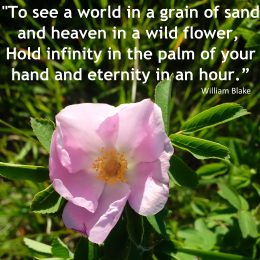
”To see a world in a grain of sand and heaven in a wild flower, Hold infinity in the palm of your hand and eternity in an hour.” poet William Blake (1757-1827)
That pep talk is as much for me as for you dear readers, my friends and fellow life-travellers. I may need to post the phrase, “Embrace your possibility,” somewhere I can see it everyday; along with “Befriend your own soul.” That really could be a killer combination—befriending myself and embracing the possibilities that surface. Who knows what could all come of that! ?
So…Allow the inner Void to exist. Peer over the edge. Let the spaciousness you see speak to you. And then look past, beneath the nothingness, to the flame of love waiting to warm and ignite you. It will illuminate the possibilities just waiting to be honoured and realized.
Read More
Posted on Aug 13, 2017
It is with some amusement that I start this blog inspired by my second viewing of the movie, Rango. Five years ago, it was all about finding community—a sense of belonging. And same as before, the hero’s quest motif was evident to me this time, too. Which got me mulling again about the Heroine’s Journey as well as the depth and subtleties hidden within Rango—the character and the movie. For such “light fare” as animated films generally are meant to be, this one strikes me as quite profound at the same time as amusing and uplifting.
Using Rango as the quintessential hero’s quest (rather than the usual Hercules), it showcases well the contrasts and similarities to the classic Heroine’s Journey. Much of what I’ll be referencing is from the book, Jane Eyre’s Sisters: How Women Live and Write the Heroine’s Story, by Jody Gentian Bower (2015). For starters we’ll look at what the genres have in common.
- In essence, they are stories about emotion and connection.
- Both the Journey and the Quest are about the lead character becoming a whole person, but following different paths to get there.
- Both travel physically as well as within his or her “psyche to a new place of self-understanding.” (p. 134)
The key difference is that the hero must travel away from community in order to rejoin the community with a fuller understanding of himself and what he contributes to society/ how he serves the group or greater good—to find or fulfill his sense of belonging. The heroine or Aletis (Greek for wanderer) must break away from the community she serves to find herself and a truer way of being in community on her own terms—not defined by those around her.
At its core, the hero’s quest is about the male protagonist accomplishing something to prove himself the hero: “the single wondrous thing” that solves all problems for the hero and for his realm. (42) The male hero must leave the comforts of home to prove his masculinity and return to embrace the feminine.
“Men are constantly under tremendous pressure, particularly in Western society, to prove their maleness. Until they can accomplish this feat, they may be denied heartfelt connection to others…Almost any show of emotion, other than anger or pride, is feminine—and therefore threatening to heterosexual maleness. But emotion is how we connect with others…The hero has to learn to trust his maleness, to know that he is truly a man, by doing what only a man can do. Once the hero knows absolutely that he is a real man, he can stop fearing betrayal by the feminine side of his own nature and learn how to connect emotionally…The whole man is at ease with his emotions and can respond to an appeal for connection. The quest usually ends with the hero coming full circle, back to the land of his origin, and getting married. This is symbolic recognition that the feminine is no longer a threat and that the hero’s feminine qualities no longer have to remain in shadow.” (Bower, 45-47)
A female’s femininity is never in question. The female protagonist must wander in search of herself and her true place in the world. She, rather, must travel away from home “to seek not only to know herself but also to reclaim those parts of herself devalued by society.” (135) It is no easy task to break away from the confines of a prescribed role or definition of femininity to discover what it means to be a woman for yourself—to be your own true self regardless of what others tell you it means. “We have to stop looking for a heroine who acts like a hero and look instead for a different kind of bravery.” (Bower, 67)
In the movie, Rango faces challenges to figure out the answer to the question: Who are you? Turns out he is much more than he thinks he is. He looks upon himself as insignificant—not even having a name. Yet he bravely faces his fears, overcomes obstacles, is guided by ancient wisdom in various forms, and ends up saving the day—and himself. He knows who he is now. He is no longer insignificant. He has a place where he belongs. He knows what he brings to the table—what he contributes to society—and he gets the girl.
The Aletis (wanderer) learns who she is when she leaves too. But she doesn’t return from whence she came. She finds a new place of belonging—after she discovers who she is and how she chooses to contribute and connect. She also meets ancient wisdom, but usually as a teacher of some sort—hidden in the woods or a cave—from whom she learns difficult lessons. She proves herself to the “wise woman” in order to face future challenges. As Bower notes, “To embrace femininity entirely means to embrace the dark, wild, and dangerous aspects as well as the queenly, loving, and mother-like aspects.” (60) Too often our prescribed female role in the community focuses on serving and overall goodness which means denying being fully human with a dangerous, dark side as well. This leads to all sorts of un-wellness and dysfunction with which we are all familiar.
There are far too many nuggets in the book by Bower to do it justice in this blog. In a nutshell:
- The Hero’s Quest is about “doing” and the Heroine’s Journey is about “being.”
- The hero’s bravery is in accomplishing the “single wondrous thing,” while the heroine’s is in refusing to do what is expected of her.
- The hero often starts out isolated from community whereas the heroine is immersed in it to the point of being invisible or denied a separate identity.
- The hero does what is expected to complete his quest, the heroine does what is unexpected to begin her journey.
- The hero moves toward, and the heroine away from, something.
- Significantly, “the hero transforms himself and restores or preserves the community…The Aletis transforms the community while preserving herself.” (69) The heroine “embarks on the journey because she knows her soul will die if she stays”…She journeys to discover “and value the uniqueness of her being.”(72)
Bower concludes her chapter highlighting the key differences by saying, “To become balanced and whole, it seems each must learn the opposite shape: the hero must trace a circle while the Aletis must follow the arrow’s flight.” (72)
Understanding these two types of storytelling will change forever how you watch movies or read books. You will see these patterns and motifs over and over again. Hence why plots and characters can become predictable. We know how the story will end because we have been told it so often. It is the storytellers who brave exposing the shadow side that tend to switch things up and pique our interest—and disappointment without the expected happy-ending. Fortunately life stories are made of chapters—each with its own ending—leaving the story open for more possibilities. We never know what lies around the next corner…
Read More