Posted on Aug 19, 2022
Being a person who is considered small in stature (and once upon a time in girth), the first description is quite apt—especially considering the context in which this musing developed. I have been known to be lively given the right circumstances. Determined and courageous definitely fit my personality in general. There is not much I let get me down—at least not for long.
However, having OCD, PTSD, GAD among my alphabet soup of conditions, I am easily triggered at times. The most frequent shame message to surface is that of being in trouble or getting in trouble. And not the mischievous kind. 😉 Most recently, I interacted with a new case manager at an insurance company on behalf of a client. I couldn’t read his response for a few days because of this shame message. It took a bit of time to process. In the end, as per usual, the trigger was all for naught as his response involved a version of backpedalling rather than further provocation or recrimination. Whew.
But I misspoke. The internal struggle was not all for naught as it prompted me to reclaim my feistiness. As said person who is short of stature (and once upon a time of girth), I often heard the infuriating phrase: You’re cute when you’re mad. Talk about not being seeing or heard! But that’s for my memoir. The point is, once upon a time, I was feisty. Full of spunk. Had a strong will and was unafraid of showing it in difficult circumstances or when challenged. I remember that younger version of myself. Even though pathologically shy, I somehow managed to be feisty when circumstances called for it. Due to my shyness, this spunk often took people by surprise.
At the time of writing, I was working through a meditation book on self-compassion, using it more for journalling prompts. Quiet reflection is a form of meditation; I just don’t follow a structured approach. Here are some of those reflections from that time of processing my getting-into-trouble shame message…
“I did well, not poorly, speaking up for my client. His quick reply (which I haven’t read yet) triggered my internal shame message of being in trouble. And what the hell is wrong with being in trouble? It means I stood up for someone or something. I no longer need to fear being in trouble. I need to embrace it. To raise a little hell! My spirited, feisty self has nearly been squelched twice—first in my adolescence and then in my marriage…I need to own /re-embrace being feisty—not disavow it…Well, I gotta say I was NOT expecting that in this journal entry [about being receptive to good things including opportunities]. Self-compassion at its finest. 😊 I do miss that feisty girl. She was (and is) pathologically shy; but she did have spirit and gumption.”
In my youth, my world was a weird mix of “I can do anything” and debilitating insecurities (along with undiagnosed anxiety and depression). I had this sense of untapped potential, if only people gave me a chance/believed in me. Somehow, I was expected to believe in myself when that was never modelled for me. No one showed me how to do that. That actually stayed with me for a very long time. Even when I was studying for my Master’s degree in counselling there was this sense of: “If only I could get my shit together…”
Well, my poop is no longer in a group. I think a better analogy would be that it’s been spread liked fertilizer. My life has expanded and grown. I have evolved from someone who had no idea who she was to someone who is getting the hang of owning her own life—however it looks or whatever it entails. This also involves reclaiming my feistiness and seeing “getting in trouble” through a whole new lens.
What character trait do you struggle owning? What lens may need tweaking to see it in a different light?
Read More
Posted on Jul 26, 2022
So. For those interested in the follow up to my comment on Facebook about a nasty trauma trigger, here goes.
When I handed my business card to a tradesman so he could have my email address to send me an estimate, he commented on my profession of counselling therapist. When explained what I did, he replied that you just have to have faith. I replied something to the effect that it would nice if it worked that way. He then made a comment about believing in science and made a reference to everything being in the good book.
Now I have heard comments like these my entire life. I was raised in the proverbial “Christian” home. I have even been prayed over in my early twenties and sent many desperate pleas heavenward during my teens to relieve me of my constant depression (read: self-hatred and suicidal thoughts).
I did not receive any help managing my depression until my mid-twenties when I finally had a good medical doctor who sent me for a referral to a psychiatrist and a trial group for women with depression. My diagnosis of dysthymia didn’t help much though. Anti-depressants managed the daily “low mood” but not the dips into major depressive episodes; and I didn’t remain on them long. I also didn’t understand my diagnosis until I studied counselling at the Master’s degree level. Then lights came on and reading about bi-polar resonated with me even though I do not have manic episodes.
Dysthymia is on the bi-polar spectrum, but remains on the depression end. I am at risk for developing manic episodes if I am not careful and must be aware of drugs (including cannabis) that can trigger a manic episode. No, thank you. The depression is enough to contend with along with my other diagnoses of General Anxiety Disorder, OCD, and PTSD. I also have social anxiety that hasn’t been officially labelled, but my symptoms fit the criteria. This last one is likely one of my most disabling mental health conditions that I have had since early childhood (aka pathological shyness). Add to all that my Chronic Fatigue Syndrome, and you have quite the alphabet soup that impacts my daily functioning.
Anyways. This tradesman’s comments about having faith and everything being in the good book is what triggered me. I am still fighting the internalized shame messages associated with those words. My mental illnesses of depression and anxiety made my life exceptionally difficult during my teens and early twenties. The inner struggle was real. Growing up in a religious environment with an attitude of “the devil made me do it” and satan being blamed for human wrong doing and/or illness added to the pressure. I was led to believe that I wouldn’t have these terrible thoughts and feelings if I wasn’t oppressed by demons or plagued in some way. I was cursed due to some unconfessed sin or lack of faith. Didn’t matter how hard I prayed or good I tried to be or to “get it right” (still a compulsion of mine), my thoughts and feelings didn’t improve. Worsened in fact.
It took a long time before I finally had the right doctor who recognized symptoms and took action. It also took more trauma. After my dog, Gracie, died, I spiralled downward. Functioning was seriously impaired. I was working as a therapist at this point already. I had seen psychologists as part of my training (plus one in my early twenties and participated in that depression group). I could not get anyone to take me seriously or follow my train of thought. One therapist mistook my anxiety body language for anger and declared I was an angry young woman and beyond help.
Anyways. My point is, science has been my life saver. If psychopharmacology hadn’t developed effective medications to treat depression, anxiety, and OCD, I wouldn’t be here. I’d either be in the loony bin (pardon the expression) or dead. And don’t start me down the path of “if faith could’ve saved my mother…” The science of mental health wasn’t developed enough in the 1970s to help her either. I, thankfully, have been more fortunate.
I must add that I am very much a woman of faith. But does my faith look like that of my childhood? Not in the slightest. I had to open my mind (which I was able to do thanks to meds) and my heart to explore my faith deeper and in different directions. I don’t use the religious language of my childhood and adolescence (it is, in fact, triggering). I have found words that reflect my spiritual existence much more accurately and add to my life rather than detract. I no longer feel like a worthless, hopeless sinner (aka piece of shit). Although yesterday’s encounter certainly brought up all those old thoughts and feelings of not being good enough and never able to get it right. The emotional turmoil is indescribable to someone who hasn’t experienced it. Utter anguish and despair is a start.
But “blessings-and-curses” is an archaic worldview that does not reflect what we know in today’s technological age. And what we believe now will likely have to adapt for future discoveries. Theological arguments during Jesus’ time on earth were already about older versus newer ways of thinking. Open minded people even have to accept that what Darwin believed is outdated and reflective of another day and age. Think the Dark Ages and the Renaissance. Worldviews are in constant flux.
Anyways. How does any of this help you to understand my trauma trigger yesterday? In a nutshell, those closed-minded and judgemental comments triggered a shit storm of dormant messages in my psyche that rose like a many-headed beast. I have to remind myself that I am a whole and complete person, capable of making my own decisions about my life and what I want to do with it. I am not all those things that I was led to believe in my youth. And I have to remind my amygdala that I am not in any danger. That’s a tough one when faced with dangerous, closed-minded thinking. I am still working on helping my amygdala recognize I make my own choices that do not include those old thought patterns.
I have braved the storm of a faith crisis and surfaced with a deeper faith that looks nothing like its origins. It will not be understood by many. Only by those who have braved similar storms and surfaced as well. When what we hold to be true contradicts lived experience, we experience a faith crisis. My world was filled with these paradoxes. It took a long time to let many of them go and embrace the Great Mystery. Then “the world” and the bible and my faith began to make more sense.
Your faith journey will be your own. Kind of like the hero’s quest. By the way, I watched the movie Rango last night. Always a pick me up. And your encounter with the Great Mystery will be unique to you and provide just what you need—if you’re open to it. I also worked out what I could say the next time some man tells me my profession is useless and one just needs faith.
“Before we have a discussion on faith or theology, you might want to know that I have a Bachelor’s degree from a bible college and a Master’s degree from a seminary. I have read the bible in its entirety at least twice, front to back. I might be willing to listen to what your faith means to you, but not to your thoughts on mine or my life’s work.”
Now will I have the courage to actually say it when it happens again? And it will. I have no doubt of that. I do need to own my power, my life experience, and my education. One of my triggering responses to shaming messages is to shut up and back off. So I will have to work on that next time. I had a blog on feistiness ready to go for July. I need to tap into that when it comes to trauma triggers which shut me down. Something to ponder and process. ‘Til next time (and the blog on feistiness)…..Barb
Read More
Posted on Jun 15, 2022
It has certainly been a “long minute” since I wrote a blog. I found that I had to re-examine my motivations and associated rewards for keeping up a regular blog. The year started on a cynical note for me with plenty of ‘why bothers?’ to sort through. While sometimes the question of ‘why bother’ is rather cliché or rhetorical, I had to wrestle with it when it came to writing this blog.
My musings are certainly not going to change the world, or even people’s minds. They are not going to attract new clients or be a way to engage with current ones (although sometimes this does happen). My blog has definitely morphed over the years from principally sharing therapeutic information to a personal reflection of my own healing journey. It will likely remain closer to this reflective end of the spectrum. However, now I will be writing for me rather than having an audience or purpose in mind.
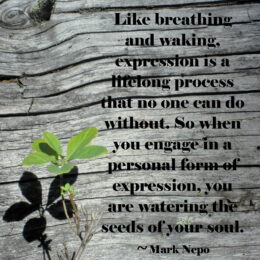
This latest morphosis was prompted by reading Drinking From the River of Light: The Life of Expression by Mark Nepo. I didn’t realize the book was set up as a series of writing prompts; so it hasn’t been a quick read. In fact, I’ve hardly begun. I have to be “in the mood/mindset” to read, reflect, and record said reflections. Maybe it will happen more now with a new season upon us.
Nepo talks about expressing oneself through the art of writing (or any kind of creativity) as akin to breathing. I have to write simply because I am a writer. It surprised me to realize there was some truth to this idea. While I am not a published writer (unless you count the months I worked for my uncle’s small-town newspaper), I do write regularly in a journal.
This journal writing began as a way to get the gunk out. It has evolved, as I have, into a receptacle for my thought process. Similar to getting the mental gunk out, but more refined; or so I’d like to think. But my writing has much deeper roots. The first compliment I received in regards to writing came from my Grade Five teacher, Mr. North. It planted the seed that I might actually be good at something specific.
I also received encouragement from other teachers over the years and wrote short stories and poems. Some of which were entered in contests. No major prizes, but it was nice to place in the top three at times and receive the external validation. In junior high, I wrote for the elementary school paper. Sadly, the positive feedback the resource teacher provided had the opposite effect to what she expected. I quit writing as it became pressure to perform. And I ended up doing what I feared most: disappointing the young students.
Creative writing remained a past-time and coping strategy for me until my college years when essay writing somehow killed the desire and ability to write stories and poems. Writing became about getting a good grade. My only source of self-worth at the time. Since my post secondary education, I have not been able to tap into that imaginative mind I once had easy access to and that provided an escape from daily life.
One of Nepo’s writing prompts encouraged “telling the story of…” and as much as I tried, it became reflective writing more so than creative. I will keep trying; but this lack of imaginative fantasy has also influenced the memoir I wish to write. I cannot write my story as an autobiographical account of my life as I don’t have enough detail stored in my memories; but that doesn’t mean I don’t have a story to tell in my own unique way. I am nearly ready to develop an outline, which is rather exciting in a small way, as I have been thinking about this memoir for many years.
An added inspiration came from Self-Care Cards by life coach Cheryl Richardson. The card I picked on a day not so long ago was that of “Achievement: Chase Your Dreams—You may be surprised by where they lead you.” The day I selected that card, I thought it referred to my dream of one day hosting trauma recovery retreats. However, in the wake of a slow client season and lacking the feasibility of running retreats right now, my thoughts about dreams and writing coalesced. Maybe the achievement I need to chase during this quiet spell is writing my memoir.
So with all that in mind, my blog will hopefully become an expression of my life. There will be no “hidden agenda” or purpose other than to keep me writing, whether creatively or reflectively. It is who I am. While I am also a creative person in other ways, writing is closer to my core than home décor, card making, or baking. Writing serves no other purpose other than a life of expression.
Until next time, feel free to share the ways in which you live a life of expression.
Read More
Posted on Dec 19, 2021
I am going to cheat with this blog entry in that I am going to use someone else’s words—mainly because I can’t say it any better myself. At the very start of this holiday season (which for me is the end of November, typically the first Sunday of Advent—albeit rooted in religion, but I like to make use of its spiritual focus), I read a book entitled Christmas: A Short History From Solstice to Santa by Andy Thomas (2019). A lovely small volume that respectfully explores the journey this holiday has made from ancient roots to religious rituals to commercial excesses. I highly recommend this literary gem if you ever need a bit of perspective this time of year. So here are his concluding words from the section he titled “A Moment of Stillness.”
“Christmas offers a rare liberating breakdown of normality, with its glowing lights and colours, nostalgic aromas, distinctive food, and warming drinks. It also gives the pleasures of opening presents and watching others receive them, seeing the gleeful faces of children as they tear the wrapping off in a whirl, the healthy indulgence of having a little harmless misrule. If the thrill of Christmas has been forgotten, it is worth remembering the magic and joy many of us felt as children and seeing the festival through those eyes again.
If you stop to look beyond the paraphernalia of the modern Christmas and think about how this festival can make you feel, there remains a tangible aura around it that is easy to miss in all the rush. Children experience its purity the most, but without too much effort, the atmosphere of the season can still touch the hearts of adults. There is an undeniably distinctive quality about this annual nexus point. Perhaps something about the solstice itself might one day be identified to explain it. Maybe it is a subtle human response to the qualities of winter light and weather, or even the psychic accumulation of eons of focus on this celebration. The devout see the divine at work. Whatever it may be, there is something unique about the annual cycle we now call Christmas.
If Christmas is, in the end, a feeling above anything else, then it is worth trying to find a moment over the festive period to tune into it. This is not always easy for those who have to juggle entertaining, decorating, wrapping, and cooking; but if you consciously select a time to suspend all of that for just a few minutes, you can create a small eye of calm at the centre. One useful opportunity comes in the early hours of Christmas Day itself (or Christmas Eve, depending on your custom), something churches tap into with midnight services. It is a time when a stillness starts to fall: roads begin to empty, revellers make their way home, and excited children are finally persuaded to sleep. A collective buzz of hushed anticipation, and a tangible quietness unlike any other, combine for a few hours as the Silent Night arrives. How, then, to best use this little window?
To create a valuable moment of stillness, find a snug and tranquil place, perhaps by the tree, fireside, or crib, turn the room lights low, and just be with Christmas. Within a few hours, the delightful madness of the day will begin and another opportunity may not arise.
Your thoughts might drift to all the many different facets this festival has sparkled with over the centuries, from the ancients standing ready to welcome the first discernible signs of the sun’s return, to civilizations marking the births of their messiahs or commemorating wild hunts across the sky, from the taking down of normal boundaries and indulging in unfettered celebration, to considering the needs of others and putting animosity aside. All of it has, in one way or another, been a celebration of light in the darkness. Whether people see that light as the radiant sun, astrological signs in the heavens, the Star of Bethlehem, the divine illumination of a son of God, the grace of Saint Nicholas, or the glow of Santa’s sleigh as he rides through the sky, the message remains the same.
Each tiny glowing light, albeit just wire and plastic or wax and wick, can be a reminder that the smallest glimmer in the shadows can lift spirits and offer new hope for the future. This simple ceremony of rebirth each December, marked with laughter, contemplation, music, generosity of spirit, revelry, and feasting, has been a crucial support to the cultures that celebrate it throughout their many trials and challenges. There is no indication that this expression of determined optimism will be changing anytime soon.
If too many plastic reindeer and all the commercial excesses of Christmas can distract from its wider good, we can always make the choice to turn our gaze inward to its real meaning—a meaning that you can decide on.
People don’t always get to be where they would like to be on Christmas, and sometimes they have others to care for or can’t spend it with those they would like to—or can’t spend it with anyone at all. But you can get the Christmas you deserve in the best sense—in your heart and soul. For in reality, this is the only place where the act of celebration really resides, immune to outside influence. You choose. Christmas can be what you want it to be, wherever you are, and whether your celebration is grand or modest.
[This book has] attempted to trace the origins and evolution of a festival that, for all the many forms it has taken, remains at the centre of the year in many cultures and thus the lives of everyone living within them. Hopefully, in journeying through its development—and sometimes its travails—you will have found renewed worth in this strange and wonderful occasion that we call Christmas.”
Wishing you and yours
A Very Merry Christmas, Joyeux Noël, Wesołych Świąt, Buon Natale,
Καλά Χριστούγεννα, Feliz Natal, Mele Kalikimaka, Frohe Weihnachten,
Glædelig Jul, Nollaig Shona Dhuit, Zalig Kerstfeest, Meri Kurisumasu,
Mutlu Noeller, God Jul, Feliz Navidad!
Christmas: A Short History From Solstice to Santa by Andy Thomas (2019)
Read More
Posted on Nov 28, 2021
I have had plenty on my mind this month, so my procrastination to write this month’s blog is a bit unexpected. Nevertheless, here we are at the end of the month and I am wondering where to start. November is a tricky month for some. Candy hangovers from Halloween, Remembrance Day solemnity, bombardment of Black Friday sales far in advance of the actual day, American Thanksgiving, and the Advent of Christmas (which for some starts earlier in the month than for others). In amidst all of that, I attended an online, indigenous-focused, professional continuing education course. That’s a great deal of adjectives for one simple noun! Somewhat apt as the content was equally weighted.
However, as much as I want to share some of what I learned in that course, I am going back in time to Remembrance Day. A solemn occasion to honour the men and women who have defended this country from megalomaniacs and warmongers on the world’s stage—and a reminder to not take our country’s privileges for granted. While I fully support this country’s efforts to honour veterans, past and present, sometimes Remembrance Day can feel like an empty gesture—especially for those veterans struggling with returning to civilian life—whether it be financially, socially, mentally/emotionally, or physically.
And then I saw the controversial meme posted above with a comment about the original intention of Armistice Day (the forerunner to our Remembrance Day) was to promote peace and prevent more war. When I did an internet search, very little is said about the peace promoting origins; but I did find one comment stating: “…traditional services also witnessed occasional calls to remember the horror of war and to embrace peace.” https://www.warmuseum.ca/firstworldwar/history/after-the-war/remembrance/remembrance-day/
“Teach your children there is no glory or heroes in war. That glory comes from actions that prevent war; and the heroes are the ones who implement those actions.”
It reminds me of the original purpose of Mother’s Day which was not to honour mothers per se, but a plea for husbands and sons to no longer be killed in war, and was called “Mother’s Day for Peace” back in 1907 in the States. Apparently there was an American Mother’s Day Proclamation made in 1870 “which called upon mothers of all nationalities to band together to promote the “amicable settlement of international questions, the great and general interests of peace.” https://en.wikipedia.org/wiki/Mother%27s_Day
In my opinion, it is not a matter of either-or, but both-and. We need to care for and respect those who have served our country (even for questionable causes). But in the memory of the horrors of war, may we be inspired to work towards peace—that amicable settlement of international questions—to prevent further losses—of life, or limb, or sense of life, or sanity. How do we honour the soldier while we protest the war?
There are no easy answers, if any at all. Teaching our children to understand compromise verses sacrifice seems insurmountable. And it grieves me to see the good intentions of strong, courageous women have been thwarted, yet again. This actually ties in to something I learned in that course I mentioned. Indigenous nations were predominantly matriarchal, with a few exceptions, of course. Canadian officials were swift to disarm the women, the leaders, by taking away their rights and freedoms—imposing a culture of dependency. What was hard-won for white women in the first decades of the twentieth century (1916-right to vote in prairie provinces, 1929-status as persons) took several more decades for our indigenous sisters.
“The Indian Act has affected Indigenous cultures, systems of governance, societies and ways of life since its enactment in 1867. Gender discrimination in the Act further disadvantaged First Nations women, in particular. Until 1985, women with Indian status who married someone without status lost their status rights. Men, on the other hand, did not lose Indian status in the same way. Even after Bill C-31 reinstated the status rights of many women in 1985, the Act still discriminated against women by privileging male lines of descent. Amendments in 2011 and 2017 sought to fix these issues. In 2019, the federal government brought into force the remaining part of Bill S-3, which is meant to address lingering sex-based inequities in the Indian Act.”
https://www.thecanadianencyclopedia.ca/en/article/women-and-the-indian-act
Two things have become evident to me in this revealing information. One is that the way of healing for indigenous cultures and nations will be through the women—reinstating their status on the national level as well as within their unique cultures, reversing that imposed culture of dependency. The other is that this won’t be possible without the help from their white sisters. Ultimately, it will take efforts from all genders to make this happen. However, I believe the initial movement will be from women rising up to support each other.
I have no idea how this will happen. I am not a dreamer or a visionary or even a leader. I can only use what little influence I have to, at the very least, get people—women especially—thinking and talking. In an ideal world, the conversations will expand to women of all ethnic backgrounds sharing stories and experiences. Connecting on those very basic matters of being human. Transitioning to collaborative problem solving. Something than women have wanted since time immemorial. We are tired of shouldering the emotional weight of the animosity that leads to violence and the horrors of war. We are also tired of our hands being tied—mostly figuratively, but sometimes literally—to effect change.
So if Remembrance Day and Mother’s Day seem to have little in common, maybe I will have changed your mind by these thoughts I’ve shared. It is my hope that the more we open our minds and our hearts, our commonalities will outweigh our differences. When we can establish common ground, we improve our chances to negotiate and compromise becomes appealing. To compromise does not mean one party wins and one loses. Comprise means each party gives a little to get a little.
And in an awkward tie-in to the first Sunday of Advent represented by Hope, it is my hope that we can we can overcome the shadow side of our human nature (for individual supremacy), so that we can live up to our human potential for collaboration, connection, and community. In this holiday season, may you find opportunities for thought and talk that contributes to peace and hope for all of humanity, not just your own little world.
Read More
Posted on Oct 19, 2021
Today is my 50th birthday. While that is a non-event for some, for me it has significance beyond the culturally conditioned issue with women aging. But let’s start there. In today’s society, there are plenty of mixed messages to choose from regarding women aging. At one end we can embrace it, or, we can purportedly fight it with the proverbial potions and lotions as well as supplements, medications, surgery, and a host of other treatments. It is a billionaire’s dream industry. I find it sad that we, as women, literally buy into this phenomenon, trying to make ourselves into someone that we are not: nubile. Young and sexually desirable.
The first point of contention is objectively undeniable. We are no longer young according to the calendar and passage of time. The second is subjective. Sexual desirability is personal and age exempt. What turns on one person won’t arouse another. There are young people with libido issues as well as aged. Desirability is what you make it –for yourself being desired as well as what you desire. Emotional connection based upon consistent attention and affection is the foundation for a satisfying sex life, which includes knowing what is arousing to you and your partner. Chemistry and desirability between a couple includes appearance (which we know changes over time and circumstances) as much or as little as you choose. Hygiene notwithstanding. 😉 It is not a sole question of finding certain physical traits appealing—again subjective. What is appealing to one person is repelling to another.
My point is that we are buying into a lie when we chase “nubility” as a legitimate course of action to accommodate aging. That would be denial. We are in denial about aging and succumbing to shame messages that we are not valuable unless we are youthful looking and sexually desirable as per an industry or cultural standard. It is a sad state of affairs.
I just finished reading a book entitled On Turning 50: Celebrating Mid-Life Discoveries by Cathleen Rountree that was published in 1993. I found it engaging, inspiring, informative, and in one aspect, disheartening. For the most part, I had to remind myself the book was published 30 years ago given the relevant content. In all likelihood, some of the women who participated in the book are now deceased, or at the very least, octogenarians. What saddened me was how little has changed in 30 years. We, as women, face the same challenges and obstacles today. The only advantage we have is improved access to information about aging and the openness to talk about it. So thank you to all the women who have shared their experiences and paved the path for all who follow.
In mythological terms, women are usually categorized as the maiden, matron, or old crone. Personally I look forward to being an old crone: the wise old woman who lives in the woods. 🙂 Some days, I feel like I embody her already. Other days I feel my mid-life. I think we mistakenly view our 50s as the halfway point of our lives (I certainly do no wish to live to 100!). I have come to perceive our 50s as the midpoint of adulthood given our brains are not fully developed until the age of 24 or so. I can see myself living another 25 years, maybe a bit longer. That in itself is a revealing statement given my struggle with depression and childhood trauma.
There was a time I could not see myself living past my mid-thirties—the age my birth mother died. After reading Motherless Daughters by Hope Edelman, years ago, I was somewhat prepared for this and able to normalize it contextually. Sometimes it still is a surprise to think I have made it all the way to age 50. And there are, admittedly, days when I do not want to live out a full adult life when the depression seeps in and steals my joy. Those days remain very real for me. Thankfully not as frequent as in my youth—a stage of life I would not return to for all the billionaires in the world!
I, personally, have no desire to be nubile. I was going to say ‘once again;’ but at my core, I have never seen myself that way. However as I look at old photos, I can admit that I was young and desirable, in the stage-of-life sense. I have always struggled with fitting in, being appealing to the masses, socially acceptable. However, like many women, I learned early on that “nubility” makes you vulnerable to being taken advantage of and/or traumatized for a lifetime. It is a catch22 to be desired. Our sense-of-self may require it until we learn better; but it also puts us in harm’s way as well as steals our power and authenticity.
I much prefer being 50. I quite enjoyed my 40s. I think the subtitle of the book says it well: celebrating mid-life discoveries. Something I have never done before: look forward to what’s ahead. My struggles with depression included suicidal fixation in my adolescence; which I was fortunately able to downgrade to a tiredness-of-life-in-general: wanting the end to come sooner than later, simply because I tired of the ongoing struggle. But after a near-death experience in my late twenties, I realized that my end would come when it was “time” and not a moment sooner. I was spared for a reason. Even now, on the low days, I ponder about that reason being fulfilled and hence the end can come whenever my allotted time is complete. When all is well with my mental health, I look forward to what is left to discover about myself and the world around me.
If I struggled with believing I am a person of worth and value in the first half of my life, I hope in the second half of my adulthood, I can celebrate more of life’s discoveries. A significant part of embracing aging is being our authentic selves and knowing what we have to offer. Understanding we all have the gift of life, it is up to each one of us how to make the most of that gift both in what we receive in this life and what we give. May your life have purpose and meaning rooted in a strong inner core/sense of self—not defined externally by industries and shame messages.
My birthday wish today is that you all experience a wonder-filled aging process—wherever you might be on that path.
Read More