Posted on May 14, 2010
“Remember that happiness is a way of travel—not a destination.”
~ Roy M. Goodman
In my March entry, I mentioned a practice referred to as mindfulness. In the not-too-distant past that concept resurfaced for me while watching television. There is an element of irony there if TV viewing is perceived as a “mindless occupation” but sometimes TV can surprise us.
The program I was watching focused on happiness. I was somewhat skeptical at first; but the guest therapist had some very good things to say. This month’s entry will be my attempt to regurgitate that program’s1 content with some of my own thoughts.
The starting point for the show’s discussion was defining happiness as a feeling of its own—not restricted to being the opposite of sad. The reasoning goes that just because you are not happy does not mean you are sad—you simply are not experiencing happiness at a given moment. Adjoined with that thought is separating happiness from goal setting, accomplishment, or a point in time. The ‘if onlys…’ or the ‘I’ll be happy when…’ considerations. When I get a new job, new partner, new house, etc., then I will be happy.
This line of thinking draws a target around happiness—something to shoot for—and in aiming for happiness, we are only postponing it. It reminds me of those deferred payment plans for big purchases. You can take it home, but it’s not really yours until the conditions have been met.
This is where happiness as a journey comes in. If we release happiness from the constraints of a moving target or a far-off destination, we free ourselves to experience happiness along the way—regardless of the end result or if all the conditions are met.
This is not to negate the importance of setting and reaching goals or the milestones of life; but these achievements should be valued in and of themselves—not be forced to take on the added weight of influencing happiness, nor be allowed to take over the journey. By focusing on a target or destination, we obstruct our vision—put blinders on ourselves and miss a lot along the way. In fact, passing by a great deal of what makes us happy—unnoticed.
So what does it take to experience happiness in any given moment? For starters, it requires being conscious about being happy. This is where mindfulness (the lost art of thinking) enters the journey. When we start to think about being happy, we will be amazed by all the little things that come to mind. In looking for happiness, what will come into focus?
One happiness-exercise to help bring that elusive emotion into our consciousness is to carry a happy stamp or stickers and card of paper that we can mark whenever we experience a happy moment. What makes us happy will vary from person to person, but some examples include arriving to work on time, reliable transportation, short lines at the grocery store, meetings that go well, a child’s smile, a friendly wave, a hug or a kiss from a family member, a beautiful sunset. The list is endless. So the possibility arises that we are happy—we’re just missing it. Once we get a handle on what makes us happy, we then have an opportunity to make the most of those moments affecting the duration, intensity, and frequency of our happiness. This is not to be confused with filling the void with substances or activities that eventually harm us. To be mindful is not to be careless or excessive but attentive.
Another exercise in happiness-consciousness is to be aware of how our five senses experience being happy. What we see, hear, smell, touch, and taste influences every moment of every day. What sights, sounds, smells, textures, and tastes make you happy? And finally, we cannot ignore the connection between thankfulness and happiness. Marking those moments we are truly grateful for will bring happiness along with it.
1 March 30, 2010, episode of Cityline featuring therapist Joe Rich, stylist Sandra Pittana, and host Tracy Moore.
Read More
Posted on Apr 16, 2010
In my readings recently, I have come across a theme that relates to the journey metaphor for life. It is particularly fitting for those moments of “stuckness” when we cannot seem to make any headway—like walking on a treadmill.
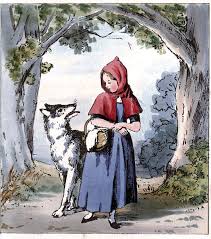
My own treadmill moment intersected with reading about the evolution of a fairy tale: Little Red Riding Hood.1 She is quite the little girl, or young maiden depending on which tale you read. She has travelled across centuries and cultures retaining or shedding some features, adapting others as she has traversed the globe.
Or more fittingly, she has been adapted to suit the cultural morés of the time and place in which she finds herself: an innocent girl to promote obedience and dependency in the Victorian Era; a young maiden to promote chastity (and shape the financial arrangements of marriage negotiations) in the French aristocracy of the 17th century; or a voluptuous stripper redefining courtship in the film genre of the 1930s and 40s.
She continues her metamorphosis as the movie industry requires her services to communicate emerging trends in popular culture and equality of the sexes. A fate shared by her nemesis, the wolf, who has also morphed through the centuries and cultures.
But what of her origins? Turns out, she was quite the resourceful young lady: a female counterpart to the ancient, male-dominated, hero’s quest.
Throughout time, heroic tales follow a consistent plot. The hero is born, full of hidden promise, and must undertake a journey to prove himself. He must face the “dark side” whether that be physical danger and/or one’s inner demons of doubts and weaknesses. He must face his moment of truth, the ultimate test.
In one of the earliest versions of the fairy tale in question, “A Grandmother’s Tale,” a little girl must rise to the occasion and outwit her adversary, the wolf (sometimes an ogress). She must take all that she has absorbed from the wise women who have gone before her and apply it to this dangerous situation: her moment of truth, her ultimate test for survival. She is not admonished to avoid it or wait for rescue but rather faces it and comes away stronger with new found independence.
Moments of truth. Ultimate tests. Can the obstacle be met and overcome? Does the hero have what it takes to rise to the occasion? Generally speaking, in all the hero quests of mythical proportions (either ancient or modern), the hero is victorious. What of the stories of everyday life? What about the hero of your own story? What happens when we fail to rise to the occasion?
Whether we refuse to take the test (fail to try) for whatever reason (fear of failure, fear of change, self-doubt, insufficient moxie) or whether our attempts meet with failure (fail to pass the test) due to unforeseen circumstances, timing, lack of preparation, or other factors the result is the same: We become stuck. Caught on our treadmill.
Are you stuck on your journey? What seemingly insurmountable hurdles are you facing? What’s holding you back? What lessons must yet be learned on your own hero’s quest?
1Catherine Ornstein (2002), Little Red Riding Hood Uncloaked, Basic Books, Perseus Book Group.
Read More
Posted on Mar 15, 2010
If you have read the previous two entries, you will be aware of my musings about life, and counselling, as a journey. In addition, the symbol of the daisy serves well as a visual representation of this journey as we all need a centre point from which to venture forth and to return to.
I also mentioned that at times it can feel like we are traveling up the stem in search of our centre point: being at home with ourselves and in the world. So many factors are at play in our personal formation. We are remarkably complex creatures with an intricate interplay of biological, psychological, social, and spiritual features. Sometimes we focus on one area to the exclusion of the others: often to our detriment. Most would assert that life is not so simple.
To find our centre point is no less complicated. In my recent readings, I have been encountering ways of understanding my place in the world, the universe, the cosmos, the grand scheme of things. Or maybe more accurately—my awareness of my place in the cosmos. My centre point may be as simple as practicing mindfulness: being aware that I am a part of the Bigger Picture. My very existence is a piece that fits into the puzzle.
For me, and my belief system or worldview, that awareness is connected to creation and its Creator. I can be aware of the sun that lights my world, enabling me to observe and wonder at the birds flitting in the evergreen just outside my window. I can be connected to their existence as I tend to my own daily needs. And if I so choose, I can be aware of the presence of the Creator in that moment.
We all have spiritual hang ups. Our perceptions of who we are, who God might be, and our spirituality affect all the other ways we simultaneously exist (socially, biologically, psychologically). How we see ourselves in the Bigger Picture affects our centre point—of being at home with ourselves and in the universe. Am I a piece of the puzzle or floating aimlessly about?
Or perhaps we are a particular note of the song of Creation. According to creation stories of Australian Aboriginals, the created world was sung into existence; and we, as human occupants, participate in this song keeping the earth’s spirit alive.1 What connection do you have with the Creator and all of creation?
Even if a person is uncomfortable with associating the Bigger Picture with anything that vaguely hints of religion, finding one’s place in the grand scheme of things remains possible. In order to do so, using the words of author Gabor Maté, we must “look past ourselves and find some meaningful relationship with the universe outside the confines of our egotistic needs.”2
It appears paradoxical: to become at home with oneself and the world we must include in our view something other than ourselves. From your viewpoint, what makes you feel at home?
1 Colin Ellard (2009), Where am I? Why we can find our way to the moon but get lost in the mall, Harper Collins, p. 51.
2 Gabor Maté (2008), In the Realm of Hungry Ghosts: Close Encounters with Addiction, Vintage Canada, p. 392.
Read More